Tuesday, October 9, 2012

Songs of Logan #2: Tibbie Fowler o' the Glen

Here is a song that, at least by some accounts, was inspired by my Logan ancestors themselves.  It is still about a woman but not about a woman pining.  Tibbie, rather, is a woman beset by suitors, but they--and by extension all the Scottish men of the time--are more interested in her dowry than her.  Here's the full text, courtesy of the BBC; I have again given translations of a few Scots terms with guidance from www.scots-online.org and recmusic.org.
Tibbie Fowler o' the glen,
There's o'er mony [many] wooin' at her,
Tibbie Fowler o' the glen,
There's o'er mony wooin' at her.

(Chorus) Wooin' at her, pu'in [pulling] at her,
Courtin' at her, canna [cannot] get her:
Filthy elf, it's for her pelf [money],
That a' the lads are wooin' at her.

Ten cam east, and ten cam west,
Ten came rowin' o'er the water;
Twa came down the lang [long] dyke side,
There's twa and thirty [32] wooin' at her.

There's seven but, and seven ben [7 outside the house and 7 in the parlour],
Seven in the pantry wi' her;
Twenty head about the door,
There's ane and forty [41] wooin' at her.

She's got pendles in her lugs [jewels in her ears],
Cockle-shells wad set her better;
High-heel'd shoon [shoes] and siller tags [silver straps],
And a' the lads are wooin at her.

Be a lassie e'er sae black [ugly],
An she hae the name o' siller,
Set her upo' Tintock-tap,
The wind will blaw a man till her.

Be a lassie e'er sae fair,
An she want the pennie siller;
A lie may fell her in the air,
Before a man be even till her.

Dimpleknowe Cottage, Scottish Borders

It is very possible that Tibbie was real, but there is more folklore than fact.  An introduction to the story behind the song can be found at mysongbook.de.  There is no agreement on the "glen" and a good deal of question on who finally wooed her.  In Book of Scottish Story, cited at electricscotland.com, John Mackay Wilson spins the most romantic tale, placing the glen near Berwick-upon-Tweed and below Edrington Castle.  Tibby, daughter of old Ned Fowler, was left at the death of her parents with five hundred pounds and thus surrounded by a pack of desperate gold diggers.  Her chosen was none of the formal suitors but one William Gordon, a young seamen she encountered on Leith Links.  When he says he must sail on a year-long voyage, Tibbie revealed her inheritance to keep him home.  So Willie went into the coasting trade and obtained a beautiful brig he named after his beloved.  However, the ship went missing, driving Tibbie and her children into poverty.  They returned eventually to the old family cottage only to find Willie, who had escaped from the enemy after eighteen months and gained riches and honours.  They took up the cottage, and everyone lived happily ever after.
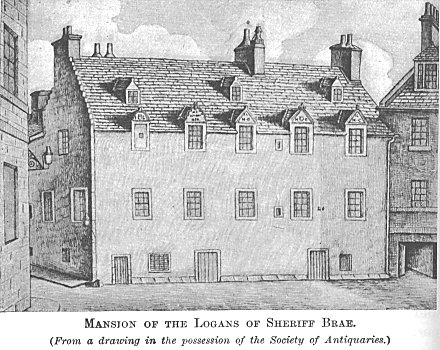

The more common story places Tibbie's story into the long, complex relationship between the Logans and Leith, Scotland.  This is written about at length in History of Leith, online at electricscotland.com.  As I have discussed before, in 1606, the "godless, drunkin, and deboshit" Sir Robert Logan of Restalrig died, but two years later his body was exhumed, put on trial, and convicted for participation in the Gowrie Conspiracy against King James VI and I.  His properties were confiscated, and the Logan name was forever besmirched, even after the sentence against his family was reversed in 1616.  Among those those to suffer was one of Sir Robert's sons, George.  Enter the heiress Isobel Fowler, said to be the inspiration for the fictional Tibbie.  It is established fact that George married Isobel, but the details are left to the interpretation of local legend.  The father from whom Isobel gained her inheritance appears to be Ludovic Fowler, but some say the "glen" where Tibbie was raised was Burncastle, while others point to an old thatched house at Lochend near Restalrig.  In the 1891 Scottish Notes and Queries, George--here a grandson not a son of Sir Robert--sought his fortune in the wars of Europe but was still shamed at home.  He was, in spite of the objections of her father, the successful wooer of the "well tochered" Isobel...or, here, "Isabella."  It is Leith tradition that Isobel's riches allowed the couple to live comfortably in a well-known mansion.  The house in question (pictured above), however, was in another area of Leith, Sheriff Brae, which had long belonged to another line of Logans.  Storytellers even point to initials carved into the building's stones, left even when most of the building was torn down and replaced by St. Thomas' Church and Manse in 1840 (now 9 Mill Lane).  Yet these initials are more likely those of John Logan and Mary Caire, who had rebuilt the mansion back in 1636.

There is even less agreement on who originally wrote the song, tho' today's version is credited to--or was at least collected by--the inevitable Burns.  I, for one, love a song with a deep back story, and this one is positively convoluted, Logan connection or not.  It is also a very, very catchy song.

  • Andy M. Stewart, from Donegal Rain.  Andy M. Stewart was the frontman of Silly Wizard until 1988, after which he has had a successful solo career and penned such classics as "The Queen of Argyl" and "Valley of Srathmore."  Stewart recorded this version of "Tibbie" for his first solo album.  He is playful, almost sly with the lyrics.  Backed by a full band with bass and drums, this is what I like to call concert Celtic, as opposed to pub Celtic.  It is available from  iTunes.
  • Jock Tamson's Bairns, from A' Jock Tamson's Bairns.  "Jock Tamson's Bairns" is a Scottish saying that means, basically, "we are all, deep down, the same."  It is also the name of a Scottish band.  Their "Tibbie" was originally on a 1978 album but can now be found on a band compilation, an import by CD but available on iTunes.  I first found it on YouTube here.  This is pub Celtic--upbeat, strictly acoustic--and their take on the song is positively bouncing and joyful.
  • Old Blind Dogs, from Legacy.  Old Blind Dogs has been around for over twenty years.  Jim Malcolm was with them for quite some time, but their recording of "Tibbie" was from before Jim, in 1995.  Typical of the Dogs, the arrangement is artful, "Tibbie" being interwoven with a dance tune from Breton.  It is available on iTunes.

Coming up next:  Logan's second favorite shanty!

Sunday, October 7, 2012

Songs of Logan #1: Logan Braes

There is a playlist on my iPod called "Imaginary Logan."  It is the soundtrack to the unwritten Logan novel/movie, following him from Leith, Scotland (see old post "Logan, an introduction") and the Jacobite march to Preston (see "Logan, Pt. 2:  The Jacobite Rising of 1715") to his sailing to the Caribbean and pirate adventures.  Over half of the tracks are original compositions; a couple years back I had a flurry of inspiration and wrote half an hour of imaginary score in a few days using GarageBand.  I will likely come back to this in another post if I can figure out how to upload MP3's.  For now I want to focus on the other part of the playlist:  'traditional' Celtic tunes and shanties.  What follows is Logan's Top 5+1, the songs that he would have known, or at least the songs I love that inspire me and my character.  I'm including links to my favorite versions, either for purchase or, when possible, for listening online.  I was going to post all the songs in a single post, but that was turning into a massive blog and was thus taking too long.  So, we'll start with just one.

Logan Water

The first song is about a place called Logan.  Logan Water is a river in southwest Scotland that flows into the Nethan and thence into the Clyde.  The tune is an 'air,' a slow, melodic kind of music that is a common type in the Celtic repertoire but hardly exclusive to it.  According to contemplator.com, a very extensive site that compiles traditional songs from the British Isles and America (and some shanties), the tune "Logan Water" first appeared in print in 1709 but is quite probably much older than that.  Typical of most old tunes, it has been set to different lyrics over time, including, like pretty much every tune in Scotland, by Robert Burns, who, typically, added a political slant to the tale of woe.  His 1793 version has become known as "Logan Braes" ('brae' means hill or hillside in Scots), which is the version most people know, including myself.  Beyond simply having "Logan" in the title, it is the kind of sad, Scottish song that characterizes Logan and contains a theme central to the remainder of this list:  Man is gone--in this case to war--and woman is heartbroken.  My story is more pathos then swashbuckle.  He is "Blue" Lou, after all.  This is the poem, borrowed from Robert Burns Country (robertburns.org); I have added in brackets translations of some of the Scots language:

O Logan, sweetly didst thou glide,
That day I was my Willie's bride,
And years sin syne hae [have long since] o'er us run,
Like Logan to the simmer [summer] sun:
But now thy flowery banks appear
Like drumlie [muddy] Winter, dark and drear,
While my dear lad maun [must] face his faes [foes],
Far, far frae [from] me and Logan braes.

Again the merry month of May
Has made our hills and valleys gay;
The birds rejoice in leafy bowers,
The bees hum round the breathing flowers;
Blythe Morning lifts his rosy eye,
And Evening's tears are tears o' joy:
My soul, delightless a' [all] surveys,
While Willie's far frae Logan braes.

Within yon [yonder] milk-white hawthorn bush,
Amang [among] her nestlings sits the thrush:
Her faithfu' mate will share her toil,
Or wi' his song her cares beguile;
But I wi' my sweet nurslings here,
Nae [no] mate to help, nae mate to cheer,
Pass widow'd nights and joyless days,
While Willie's far frae Logan braes.

O wae [woe] be to you, Men o' State,
That brethren rouse to deadly hate!
As ye make mony a fond heart mourn,
Sae [So] may it on your heads return!
How can your flinty hearts enjoy
The widow's tear, the orphan's cry?
But soon may peace bring happy days,
And Willie hame [home] to Logan braes!

As a standard among Scottish songs, it has been recorded by many artists.  These are my favorites:
  • Jim Malcolm:  "Logan Braes," from Acquaintance.  Jim is a friend of mine (thanks to Zanne) and one of the best folk artists in Scotland today.  In addition to being a fabulous singer-songwriter, he is one of the foremost modern interpreters of Robert Burns.  The album Acquaintance is entirely Jim singing Burns songs and is highly recommended.  This is a gentle version of "Logan Braes" set to Jim's voice and guitar and some light instrumental backing.  I'd buy it directly from Jim, but it is also available on iTunes.
  • John Cunningham:  "Logan Water," from Fair Warning.  The late Johnny Cunningham will be familiar to any fan of Scottish music as one of the founders of Silly Wizard, not only one of the premier groups of the Scottish folk revival but one of the best band names of all time.  He was only thirteen when he joined Silly Wizard!  On one of his few solo albums, Cunningham does the old, instrumental tune, strictly overdubbing himself on fiddle.  It is the melody from this version that I learned for use in composing the Logan score.  The album and the tune are available on iTunes.
  • Jean Redpath:  "Logan Braes," from The Songs of Robert Burns, Volumes 1 & 2.  I first heard Jean Redpath as one of the regular guests on Garrison's Keillor's "A Prairie Home Companion" way back in the 80's.  She was born in Edinburgh and raised in Leven, Fife, Scotland.  Now 75, she was there with Dylan and the rest in the early 60's Greenwich Village folk scene.  In 1976, she set out to record every Robert Burns song--a projected 22 volumes--but stopped after seven albums and 323 songs when her arranger, Serge Hovey, passed away.  Their setting of "Logan Braes" is very, very dark, more classical than folk, with a low, dismal piano leading the accompaniment.  All but the seventh volume of Redpath's Burns project is available on iTunes.
Coming up next:  Logan history in song!

Saturday, September 29, 2012

Ethics and Morality According to Gary Gygax

Mmm, succubi
Many, many lunar cycles ago, back in the days when Cherry Coke was "new," The Police were still together, and video arcades echoed with "Elf is about to die," I was, yes, a Dungeons and Dragons geek.  I had the dice, I had the Manuals, I had the Terry Brooks novels.  It was not at all the only thing I did, nor by any means was it my only kind of geekiness, but it filled a gap.  Star Wars was over (we thought), Star Trek: The Next Generation had not yet aired, and Dr. Jones was stuck in India with the annoying Willie Scott.  OK, people, you've got the years narrowed down, right?  In that time between Wookiees and Klingons, orcs and dragons served nicely for an early teen for whom modern reality just couldn't compare to the wonders of imagined realms.  Times have changed.  I'm still a geek.  Now I carry a "real" cutlass instead of a "pretend" +3 short sword.  What I didn't know until recently is that D&D also contains a philosophical treatise that gives a very interesting map of human behavior and a sort of chart that could be applied, well, to at least fictional piracy.  A few months ago, I found this, which I urge you all to entertain--dare I say enlighten--yourselves with:

The one like Gygax
In the simplest possible terms, alignment is one of the variables in creating and using a roleplaying character.  A character may, for example, have a "race" of dwarf or human and "class" of fighter or cleric.  These variables in turn set parameters for abilities such as strength and constitution whose numeric values (this is where the famous 20-sided die comes in) are used in game play.  This is a very nutshell version of game mechanics that will be intimately familiar to anyone who has actually played.  Yet if strength, for instance, is quantified, alignment introduces something far more qualitative:  perspective and behavior.  In 1974, Gary Gygax, the inventor of D&D, gave only three possibilities: Law, Neutrality, and Chaos.  Law was essentially synonymous with good, and Chaos was the same as evil.  In fantasy, those two poles would be fairly obvious--Sauron bad, Aragorn good.  It got more interesting a few years later when Gygax developed Advanced Dungeons & Dragons (AD&D, which is what I played).  Ethics and morality were separated into two crossing axes.  Good and Evil were now the poles of morality, Law and Chaos were the poles of ethics, and true "Neutral" was where the axes crossed.  Thus, a character could of one of nine alignments (chart and links borrowed from Wikipedia):

Lawful GoodNeutral GoodChaotic Good
Lawful NeutralNeutralChaotic Neutral
Lawful EvilNeutral EvilChaotic Evil

Considering and distinguishing morals and ethics is one of the long-standing debates in philosophy.  I considered much the same in my blog "Ethics of a Sinking Lifeboat," in which I discussed the debate between "natural law," essentially the conflation of ethics and morality by thinkers like Aristotle and Socrates, and "positive law," the laws of man as defined by Thomas Hobbes.  From the perspective of AD&D alignment, morality could be defined as the value an individual places on his fellow beings.  A Good character strives to be constructive and helpful to others, while an Evil character would be destructive and harmful; Good is heroic, Evil is villainous.  Ethics, on the other hand, is the value an individual places on the structure/system created by his fellow beings, i.e. "law."  A Lawful character not only follows the rules but will fight to protect them.  A Chaotic character discards the rulebook and disregards the standards, acting instead on the basis of their own personal code and believing that it is the right of everyone else to do the same.  Neutrality, in the case of either ethics or morality, implies that these judgments don't come as a rule into play (literally or figuratively); he, she, or it will decide simply as specific circumstances require for survival.  Defining ethics and morality in this way is more or less in line with modern understanding.  In a succinct article at DailyWritingTips.com, Mark Nichol writes, "One lives according to one’s morals but adheres to one’s ethics while doing so.  Morals are the tools by which one lives, and ethics constitute the manual that codifies them."  Fact is, for me, the idea that ethics and morality are different, that good and lawful are not to be confused, is axiomatic.  So I was thus pleased with the results of my test.  As far as I can tell, this description comes directly from AD&D canon...
Chaotic Good A chaotic good character acts as his conscience directs him with little regard for what others expect of him. He makes his own way, but he's kind and benevolent. He believes in goodness and right but has little use for laws and regulations. He hates it when people try to intimidate others and tell them what to do. He follows his own moral compass, which, although good, may not agree with that of society. Chaotic good is the best alignment you can be because it combines a good heart with a free spirit. However, chaotic good can be a dangerous alignment when it disrupts the order of society and punishes those who do well for themselves.

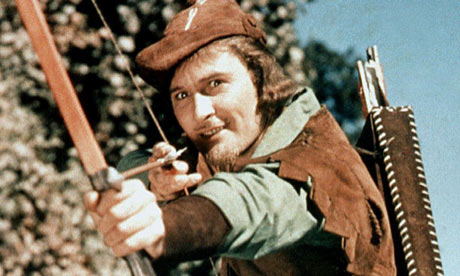
Robin Hood:  not just a hero, a philosophy

Yep, that's me, or at least I like to think so.  Easydamus.com is a thorough, well-made site on AD&D alignments that also contains a long but rewarding What D&D Character Am I? test.  The site quotes Gygax:  "To the chaotic good individual, freedom and independence are as important to life and happiness. The ethos views this freedom as the only means by which each creature can achieve true satisfaction and happiness."  This philosophy was hardly invented by Gygax.  He has credited the inspiration for the alignment system to, among others, fantasy/SF author Michael Moorcock, a self-described anarchist.  I have often said to friends that I live be one rule--Do whatever you want, as long as it doesn't prevent anyone else from doing whatever they want.  This standpoint was codified by a favorite philosopher of mine, John Stuart Mill, one of the original "liberals," or what would more likely now be called libertarianism.  In his 1859 essay "On Liberty," Mill famously wrote:
The object of this Essay is to assert one very simple principle, as entitled to govern absolutely the dealings of society with the individual in the way of compulsion and control, whether the means used be physical force in the form of legal penalties, or the moral coercion of public opinion. That principle is, that the sole end for which mankind are warranted, individually or collectively, in interfering with the liberty of action of any of their number, is self-protection. That the only purpose for which power can be rightfully exercised over any member of a civilized community, against his will, is to prevent harm to others.
The last, italicized bit has come to be known as the Harm Principle.  To those of a certain bent (myself included), it's also the Wiccan Rede:  "An it harm none, do what ye will."

I usually do.

An easy and common means to explain alignment is to exemplify the types with well-known fictional characters.  Indeed, it has become an Internet meme to create alignment charts for popular universes, from Star Wars to The Walking Dead.  Robin Hood, Batman, and Han Solo are often used as examples of Chaotic Good, all of which suit me just fine.  The single character, however, that hits the nail on the head for me is Captain Mal Reynolds on Firefly, truly a man with his own code, a man that fought against the "meddling" Alliance and maintains a very, very strong anti-authoritarian stance, a man that will fight for his crew and his boat, a man that may push a stranger off the Mule but will put a bullet in the man's head before he suffers at the hands of the Reavers.  This brings to mind other captains.  Captain Jack Aubrey is nothing if not Lawful Good, not only upholding Navy and country but also jumping into the sea to rescue officer and deckhand alike.  Captain Jack Sparrow would be Chaotic Neutral:  The Pirate Code itself is, with due irony, an embodiment of lawlessness as law, while wicked Jack's most singular skill is to look after (seemingly) no one but himself.  Captain Barbossa, however, points out the subjective nature of the alignment system and, indeed, of morality and ethics themselves.  As a pirate, Barbossa would be against law or at least a criminal, and thus Chaotic, yet within the pirate community he often cites the Code, which could make him Lawful.  Whether he is Good or Evil is even more vague; he is certainly the destructive villain in Curse of the Black Pearl, but is he a good guy or a bad guy after his resurrection?  Perhaps Barbossa put the whole topic of alignment best:  "The Code is more what you'd call 'guidelines' than actual rules."

All of this is, of course, an exercise in geekiness.  But isn't that the point?  Can't geekiness be not only an identity but also a means to exploring identity and big questions?  Suit yourself, go, be free, it's the Chaotic Good way.  But, in true geeky fashion, do post a comment if you take the test!

click for larger picture, and go visit mohagencomic.com

Tuesday, September 25, 2012

Aubrey-Maturin in Brief 9: Treason's Harbor

The ninth book of Patrick O'Brian's Aubrey-Maturin series takes its title from Shakespeare's Henry VI, Part 2:  "Smooth runnes the Water, where the Brooke is deepe/And in his simple shew he harbours Treason."  This is possibly the origin of the saying 'still waters run deep'--Someone who is calm probably has a lot more going on under the surface.  In the context of the book, this could be either Stephen Maturin or Jack Aubrey, who have intertwining troubles on and off the Mediterranean isle of Malta.  (SPOILER alert.)  The Surprise begins the novel unrepaired and abandoned in the port of Valletta and ends the novel threatened with being sold out of the Navy or even broken up.  In between are not one but two failed missions, the most central of which sees Aubrey, his friend, and his crew marching across parched desert sands in Egypt to the dangerous waters of the Red Sea in pursuit of a treasure-laden galley.  Both missions are diplomatic in origin, which is, of course, Maturin's milieu, but underlying both the diplomacy and the failure of each assignment is the fact that the French have compromised British intelligence in Malta.  Maturin must thus maneuver with his wits and keep his cool, which is not always easy for the pensive doctor.

Before proceeding, I want to take a little time to describe the methodology behind these summaries.  It must seem odd to some to watch me reading a novel but all the while jotting notes in the margins.  These notes try to capture major names, plot points, locations, and flavor.  When I'm done with the book, I use these to summarize one chapter per blog paragraph.  I have found that there are other study guides out there to O'Brian's works, but my goal is not Cliff Notes:  I'm not making a cheat sheet or a quick means to know the book without reading it.  My objective is to give existing readers a hyperlinked review, seeing as his novels are so packed with dialogue and detail that it can be easy to lose the larger plot.  I also hope to tease the uninitiated into the O'Brian universe.

I must also give credit where it is due.  One of the particular joys and challenges of the books is geography.  Not only are there a lot of places, but also it can be very hard to figure out exactly where O'Brian is talking about or even if the locations or real, fictitious, or somewhere in between.  Since I like to get it right and add links to the places in Aubrey and Maturin's travels, I am indebted to Dean King's atlas and guide, Harbors and High Seas, which offers maps and answers to (some) geographical mysteries.  Since illustrations can take the dryness out of any piece of writing, I take time to add pictures representative of the ships, places and events O'Brian and I are writing about.  As this is historical fiction, a modern photograph, in my opinion, just wouldn't fit.  So I try to use nothing but paintings and period paintings when I can, captioning the title and artist.  I must also give thanks to all of the online galleries I have Googled and borrowed from.

Enough shore work.  Let's get sailing.

"Grand Harbour and Fort Sant' Angelo, Valletta, Malta" by Johann Schranz

(1) The city of Valletta on the island of Malta is a pretty sight to all but those unfortunate officers of the Royal Navy who are stranded in port without ships to command.  This melancholy group includes Capt. Jack Aubrey, who has not one but two vessels in dock--the worn-out 74-gun Worcester, nearly sunk in a storm serving with the blockade of Toulon, and Aubrey's dear frigate Surprise, damaged in battle with two Turkish ships.  Yet, on this day, Aubrey is cheerful and boisterous, not only because his longtime shipmate Thomas Pullings has just received his captain's commission, but also because he can show off the chelengk on his hat, a prize from his recent successful mission in the Ionian Islands.  In a far more sanguine mood in Dr. Stephen Maturin, who sees chaotic Malta--which was not long ago under French control--as the perfect place for British information to be leaked to Napoleon's intelligence networks.  Indeed, Maturin's and Aubrey's very moves are being tracked by the French agent Lesueur.  Furthermore, Lesueur has forced a woman into his service named Laura Fielding, a Neopolitan whose husband, a Naval lieutenant, was captured and imprisoned at Bitche.  As an instructor of Italian to the local British officers, she is well-placed to gather intelligence, and Lesueur has planned specifically to have Fielding use Aubrey as a means to approach Maturin.  Further complicating matters are two of Aubrey's old foes:  Rear Admiral Harte, who has just ended a term as temporary Commander in Chief, and Andrew Wray, Second Secretary of the Admiralty, who has recently arrived in Malta to deal with corruption.  That night, Aubrey takes his violin to Fielding's little garden house.  He discovers that her big Illyrian mastiff, Ponto, has fallen in a water cistern.  He tries to rescue the dog but falls into the cistern himself.

Sunday, September 16, 2012

Considering Exquemelin and the Buccaneers

Dear readers!  No, I was not trapped in the Locker.  I, was, however, trapped in something just about as bad, namely Overlake Hospital.  About a month ago, I was at work and started getting progressively worse pain in my abdomen and lower back.  One trip to Urgent Care, and I was diagnosed with diverticulitis--essentially, something got stuck in my colon and decided to go outwards, creating a sort of inflamed, infected internal hernia.  Two days later and several antibiotic pills later, I was worse not better, went back to Urgent Care, and was given a hospital room about midnight.  For the next week, I was in a bed, tethered to an IV, poked and bled and woken at all hours, and somewhere between a Dilaudid-induced haze and extreme discomfort.  At least I had Zanne.  Then I was released and spent a while on the sofa eating bland food and dealing with Short-Term Disability.  I am better, and I have a new understanding (respect, Pauline) of medical incarceration.  This blog was started before all of the calamity.  I am happy to get back to happier topics...and a classic.

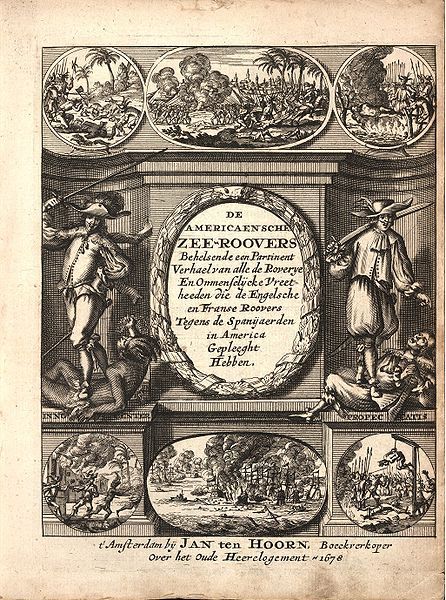
The 1678 original

Most pirate fans know that the go-to book for the buccaneer era is Alexander Exquemelin’s The Buccaneers of America, originally published in Dutch as De Americaensche Zee-Roovers in 1678.  Typical of historical accounts this old, the history of the book and its author are complicated and full of questions.  Is it Exquemelin, Esquemeling, Exquemeling, or Oexmelin?  That Exquemelin was a real person can safely be assumed, and his accounts can be verified by other sources, but who he was is total conjecture.  It seems likely, based on the available evidence, that he was from Harfleur and that he was a Huguenot, his religion driving him from France and to indenture himself to the French West India Company and sail to the Caribbean.  Regardless of holes in his biography, it’s clear that Exquemelin is the real deal:  Exquemelin landed in Tortuga in 1666, and three years later, once free, he joined the buccaneers.   He sailed with, most notably, none other than the most famous buccaneer of all, Henry Morgan, probably as barber surgeon.  Later, in Amsterdam, at about the same time he was writing the book, he qualified professionally as a surgeon; does that make Exquemelin the pirate Maturin?

The modern Dover edition

I have used Exquemelin as a reference book but until recently had never just sat down and read it all the way through.  I thus want to consider The Buccaneers of America as a whole, not as a collection of the tales of Morgan, Rock Brasiliano, etc.  Through a combination of detailed historical account, amateur ethnology, and natural history, Exquemelin portrays a wild place populated by brutal men.  The author's own style is direct, but to me it is unclear whether it is detached or, in fact, unsympathetic.  Exquemelin and his buccaneers are not romantic, tho' they are colorful.  Most importantly, these earliest pirates of the Caribbean are bloody players on a colonial frontier in which men regularly killed each other for religion, country, gold, and simply to survive.