Showing posts with label piracy. Show all posts

Wednesday, December 19, 2012

Booze and Boat Bits #7 (5 Short Items of Interest)

And now it's time to return to Blue Lou's quick entries on happenings in the world of piracy, vessels, and alcohol!  It's been a while for some of these topics, starting with...

washed up?

1.  Somalia update:  There are numerous signs that piracy in Somalia has been, if not eradicated, at least brought under a reasonable amount of control.  Signs of its demise began earlier this year.  A September 25th article for the Huffington Post described how Hobyo, historically one of the key pirate dens, is now back on hard times.  You know the boom is over when "most of the prostitutes are gone and luxury cars (are) repossessed."  At that time, 5 vessels had been seized in 2012, compared to 25 in 2011 and 47 in 2010.  December 17th news was even better:  NO ships have been seized by the Somalis in the last 6 months!  Many factors have been credited for the increased success in averting successful pirate attacks--on-board defenses, better and more constant communication between merchant vessels and naval patrols, and air reconnaissance over the shoreline.  Nevertheless, Somali piracy is far from over.  5 ships and 136 hostages are still being held.  In an article for Reuters, Dutch Commodore Ben Bekkering, now commander of NATO's Operation Ocean Shield, told the press, "I am convinced, if navy ships would disappear, the piracy model would still be intact."  He insisted that a minimum of 16 to 18 ships need to be on patrol at any one time just to cover the broad area of the pirates' hunting ground.  Out-of-work pirates, meanwhile, are not treated warmly in the towns where they live, many citizens blaming piracy for what Hobyo mayor Ali Duale Kahiye calls "inflation, indecency, and insecurity."  Even the investors that used to fund pirate expeditions are backing off, seeing decreasing returns.  It is important to keep in mind that poverty and instability will still make the pirates' life appealing.  Yet it seems that...just maybe...we're winning.

washed up?

2.  Kalakala update:  Our dear old ferry has entered a new phase of limbo.  As reported at the Tacoma News Tribune, in November the Kalakala passed from Steve Rodrigues to Karl Anderson, who owns the moorage where the ferry resides and who invited Rodrigues and his boat back in 2004.  The transfer was a "quietly arranged lien foreclosure sale," as Rodrigues owned $4,000 in past due rent.  Kalakala remains in its conundrum:  The Coast Guard still considers it "a hazard to navigation," but, at the same time the Coast Guard has declared it too fragile to move, environmental regulators have forbidden repairs on the water.  Call me a perpetual optimist, but, honestly, I am hopeful about the new ownership.  Rodrigues' heart was in the right place, but he was a dreamer not a planner, and certainly no businessman.  Anderson has made clear that he'd rather restore than scrap, and, besides, the only graving dock up to the task of dismantling the big ferry--a dock that also happens to be owned by Anderson--is tied up with making pontoons for the 520 floating bridge for two years.  Anderson may not be the one to bring back the Kalakala to its former glory, but, at the very least he seems to care about her.  The waiting game continues, same as it ever was.


washed down!
3.  'Tis the season to give beer.  Last week at work, we had "Secret Santa" exchanges.  My Secret Santa scored perfectly, supplying me with toys, a huge one-pound bag of Pirate's Booty cheese puffs, the book Dead Men Tell No Tales on the 18th century pirate Charles Gibbs (a book I didn't even know existed), and finally a gift box with three pint glasses she hand etched with skull and crossbones and two big bottles of ale!!  The beer was from a brewery I was unfamiliar with, Minhas Craft Brewery of Monroe, Wisconsin.  Minhas traces its origins to the Blumer Brewery, founded way back in 1845 during the Midwest's lager boom, and today makes its way out of Wisconsin via Trader Joe's.  Although it is in a little town in rural cheese country, they style themselves nautical under the brand name "Boatswain."  The two beers I was given were a double IPA called Twin Screw Steamer and a strong ale called Heavy Lift Vessel.  The former was unremarkable, simply because I really could care less about IPA.  The latter, however, I would recommend as a sturdy, hearty brew, one that I would not only drink again but also could see myself trying to adapt into a homebrew recipe.  More importantly, I would like to suggest that my coworker Juanita had the right idea:  Don't waste your Christmas money buying socks or a gift card, show someone you care by giving them good ale!


4. It may be a wee bit wet and cold for sailing, but what does that matter to underwater archaeologists?  Between diverticulitis, work, and the coming of fall weather, I have not been to the Center for Wooden Boats in months, but then the CWB livery does tend to hibernate, too.  Nevertheless, the CWB's blog "Bearings" tells of restoration work, a new exhibit on boathouses and fishing resorts of Puget Sound, and the ongoing survey of shipwrecks on the bottom of Lake Union.  I have embedded a nicely made 9-minute video about the project above, and you can learn more at the Lake Union Virtual Museum.  I have written about this before.  It is not just of local interest:  It is a remarkable work of archaeology because of the extreme conditions it takes place in and the treasure trove of vessels found.

not a wash, a wish

5.  A month ago, I posted on how I was going to 'pretend' to take Mystic Seaport's summer seminar at the Munson Institute.  Well, all of the books have arrived from Amazon as well as two thick readers from Dr. Glenn Gordinier.  Dr. Gordinier told me that the seminar did not have any assignments; this was not a graduate seminar but an educators' seminar, and not only was the reading list too intense for weekly papers, but, really, teachers probably don't need the practice when they're too busy writing articles for actual publication.  So, by comparing the reading list to the draft syllabus posted online, I have created my OWN assignments.  In the upcoming weeks (or, rather, months), I will be posting here what I am already calling, perhaps presumptuously, "The Munson Papers."  Some of these will be topic only until the reading is done.  These subjects include the definition of maritime studies, the relationship between maritime labor and slavery, and the end of the age of sail.  Others, drawing partly from the actual seminar and partly from my own library and interests, already have initial titles:  "Blackbeard in Colonial Context," "Late Piracy and the Early U.S. Navy:  The Case of Charles Gibbs" (thanks again Juanita...you had no idea), and "Scholars and Scavengers:  Archaeology vs. 'Treasure Hunting'."  As you can tell, my brain is all buzzing.  The bad news is that it might be a while 'til you see a post here on the blog, as I lose myself in hundreds of pages of literature; Hell, I might even take a break from O'Brian (*gasp*)!  The good news is that there are over a dozen 'papers' you can look forward to reading...and, for me, perhaps the seeds of a new academic career.  Plus, you know, I'm a pirate, and thus likely to be distracted by something shiny that I think is worth writing about.

Stay roguish, my friends...

Thursday, November 1, 2012

A few words about historical archaeology

Dr. James Deetz, Master of the Parenthetical Comment
One of the chief reasons I am here (and thus you are here) is my academic background.  Way back yonder, I graduated with a Bachelor of Arts in Anthropology, Magna Cum Laude, from the University of California, Berkeley.  I learned about the (pre-)history of California, the great era of the Maya, and even "circumpolar" peoples like the Inuit and the Sami.  But the class that set my course was James Deetz' "Introduction to Historical Archaeology."  This made sense, really, as I grew up on back roads and trails to ghost towns of the American West, from California's 49'er country to the high and lost in the Colorado Rockies.  Being in California, I could have focused on the mission chain, all of which I have visited and which I studied a little while apprenticing at what was then still called the Lowie Museum.  Instead, my major adviser was Kent Lighfoot, who was doing the archaeology of the oft-ignored Russian impact on U.S. history and digging at its southernmost reach, Fort Ross.  He, in turn, had a grad student named Aron Crowell, now director of the Arctic Studies Center's Alaska office in Anchorage (Pauline, if ye ever by some truly odd chance run into Aron, say Lou from Berkeley remembers him fondly).  And so I spent two adventurous, soggy, and life changing summers digging at Three Saints Bay, Kodiak Island, the first Russian American colony in North America.  I then wrote my Honors Thesis, "Elderberry Wine and Other Necessities," which argued, based on a combination of archaeobotanical evidence and local ethnography, that, in the absence of vodka, the Russians were distilling the local plants.  I then endured a year of grad school at the University of Alaska, Fairbanks, before realizing that the discipline was veering down a road I didn't want to be on...more on this in a moment.  All of this has, in a way, circled back with my interest in maritime culture and pirates, whether it be shipwrecks or Port Royal.  So, after all that preamble/CV, I want to take a few minutes to discuss the field I love, which I may have left officially but still have dalliances with.

Fort Ross in 1828.  Outside the wall were the homes of seal hunters brought all the way from the Aleutians, and where the archaeology has been focused.

Naturally, historical archaeology is defined in contrast to prehistoric archaeology.  Unfortunately, this distinction is troublesome.  It might seem simple to say that the former implies the archaeology of historical time, while the latter is the archaeology of people and places before there was a historical record.  The problem is that "history" as it is commonly perceived prioritizes written history, but culture always has memory.  Every culture has at least oral history.  Many cultures will have some representational history--Mayan glyphs, southwestern pictograms, Plains hide paintings--yet these are not, by most classifications, within the purview of historical archaeology.  This also means that creating a numeric break from prehistory to history will vary from society to society and even from site to site.  Thus, another distinction is often made between "pre-contact" and "post-contact"--that is, before and after the coming of European colonizers; the term "Pre-Columbian," referring of course to Columbus, is often used to generalize pre-contact.  "Contact" was in most cases a huge, and often catastrophic event for indigenous cultures.  However, this distinction gives that moment premier priority, a distinction that might not be shared by that culture.  Do Arawaks consider the coming of Columbus the single most important event in their culture, the Hawaiians the arrival of Captain Cook, the Powhatans the coming of John Smith?

Monday, October 22, 2012

Great flavors that taste great together


Just a quick recommendation...

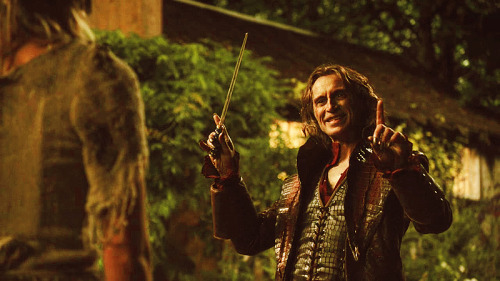
You, dear reader, may already be a fan of the show Once Upon A Time.  If not, you should be, as it is a truly enchanting piece of entertainment.  It is now just into its second season; the first has been out on DVD for a couple of months, if you want to catch up.  I bring this up now as it has now gone piratical.  In the latest episode, they have introduced none other than my original pirate, Captain Hook!  I will give away nothing, just urge you to seek it out via On Demand, online, etc.  If you have already watched it, feel free to leave a note on how you liked the show's spin on Hook.  And, just to make it even cooler, our good Lady Washington appears, under sail and all, as Hook's ship.  Magic, piracy, tall ships, swordplay, taverns...  More, please! 

Sunday, September 16, 2012

Considering Exquemelin and the Buccaneers

Dear readers!  No, I was not trapped in the Locker.  I, was, however, trapped in something just about as bad, namely Overlake Hospital.  About a month ago, I was at work and started getting progressively worse pain in my abdomen and lower back.  One trip to Urgent Care, and I was diagnosed with diverticulitis--essentially, something got stuck in my colon and decided to go outwards, creating a sort of inflamed, infected internal hernia.  Two days later and several antibiotic pills later, I was worse not better, went back to Urgent Care, and was given a hospital room about midnight.  For the next week, I was in a bed, tethered to an IV, poked and bled and woken at all hours, and somewhere between a Dilaudid-induced haze and extreme discomfort.  At least I had Zanne.  Then I was released and spent a while on the sofa eating bland food and dealing with Short-Term Disability.  I am better, and I have a new understanding (respect, Pauline) of medical incarceration.  This blog was started before all of the calamity.  I am happy to get back to happier topics...and a classic.

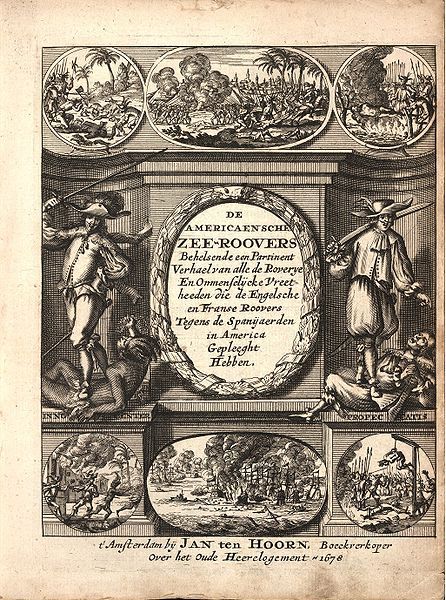
The 1678 original

Most pirate fans know that the go-to book for the buccaneer era is Alexander Exquemelin’s The Buccaneers of America, originally published in Dutch as De Americaensche Zee-Roovers in 1678.  Typical of historical accounts this old, the history of the book and its author are complicated and full of questions.  Is it Exquemelin, Esquemeling, Exquemeling, or Oexmelin?  That Exquemelin was a real person can safely be assumed, and his accounts can be verified by other sources, but who he was is total conjecture.  It seems likely, based on the available evidence, that he was from Harfleur and that he was a Huguenot, his religion driving him from France and to indenture himself to the French West India Company and sail to the Caribbean.  Regardless of holes in his biography, it’s clear that Exquemelin is the real deal:  Exquemelin landed in Tortuga in 1666, and three years later, once free, he joined the buccaneers.   He sailed with, most notably, none other than the most famous buccaneer of all, Henry Morgan, probably as barber surgeon.  Later, in Amsterdam, at about the same time he was writing the book, he qualified professionally as a surgeon; does that make Exquemelin the pirate Maturin?

The modern Dover edition

I have used Exquemelin as a reference book but until recently had never just sat down and read it all the way through.  I thus want to consider The Buccaneers of America as a whole, not as a collection of the tales of Morgan, Rock Brasiliano, etc.  Through a combination of detailed historical account, amateur ethnology, and natural history, Exquemelin portrays a wild place populated by brutal men.  The author's own style is direct, but to me it is unclear whether it is detached or, in fact, unsympathetic.  Exquemelin and his buccaneers are not romantic, tho' they are colorful.  Most importantly, these earliest pirates of the Caribbean are bloody players on a colonial frontier in which men regularly killed each other for religion, country, gold, and simply to survive.

Sunday, July 8, 2012

Portrait of a pirate as a young boy

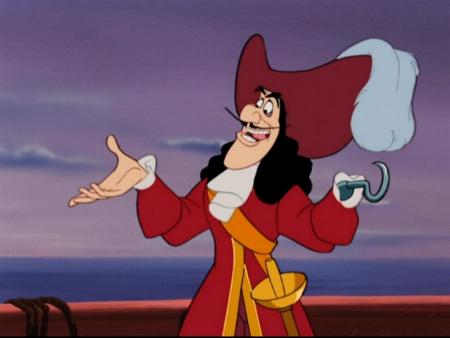
35 years ago.  1977.  Best known to those of my kind as the year of Star Wars.  That momentous day was May 25th, which should have been duly celebrated two months ago with your own personal recreation of the Mos Eisley cantina (just leave the droids outside) or at least a plastic cup of blue milk.  But I want you to go back to earlier in the spring, before the world learned of The Force, before Han Solo became this geek's favorite captain.  Back to when my favorite captain was named...Hook.

Forget about it, Sparrow.  He got there way before you did.

Wednesday, July 4, 2012

Lake Union Wooden Boat Festival 2012: That's A Wrap

Zanne and friend

Wednesday, July 4.  Sun and puffy clouds.  Zanne comes, too.  I introduce her to the usual suspects.  I check in at the Foss, the Betsy D, and the Boat House.  Add Nick Anastasio Gomez, known to most everyone simply by his last name.  He is on roaming duty, which means that as I do my rounds with Zanne he tags along.  Zanne and I are not just the first into the beer garden but are allowed in early by Tom.  Gomez joins us soon after.  And Zanne gains her latest nickname:  "Junior."

Bringing the crew aboard
Storm and train--make the noise, lead 'em on.  It's a more than a decent audience.  Zanne and Gomez go to the top deck of the Foss to watch and take pictures.  Zanne and my camera both, I learn, survive a fall down the ladder into the engine room.  Someone has left a gumby suit in my space...some sort of man overboard demonstration?  The Amie keeps passing, and I keep threatening, but my posturing is no match to the powers of Tinker Bell, who is on the bow, and the simple fact that they're out of pistol shot.

Gomez!


The Amie evades capture


Nearly perfect delivery.  Random kid comments.  A new tool:  When the attention span falls apart, I stop the whole operation and yell, "Are we all crew?"  The kids all shout "Aye!" in unison, and control is reestablished.  History, participation, fear, humor, improv, girls.  All the things that make story time work.

How we do

After a few more pictures with fans we return to the beer garden.  It has become crowded and not with mariners.  We have one pint each and lunch, but we're done.  We know that if we don't escape now, it will be a hard passage home.  As a pirate, I reserve my right to run away.  So I give up our 3:30 spot on the Betsy D and say farewells.  Gomez finds me and accompanies us out.  Zanne is seeking shelter under her little parasol, and I'm starting to pant.  It matters not.  It has been another fun and successful festival.  Thanks...to the kids for pushing their tender boundaries, to the parents for trusting them to my scoundrel ways, to the staff and volunteers who are the best mates a dog like me could ever ask for, and...to Junior!

Logan...until next time.

Monday, July 2, 2012

Lake Union Wooden Boat Festival 2012

The Lavengro says, "Welcome back."

Day One, Saturday, 6/30:  My Happy Place.  It all feels comfortable and familiar.  Eldon walks around and officiates as always, and Aislinn gives me a big hug as I check in.  As Pirate Lou starts making the rounds, it's as much about saying "Good to see you again" with the coffee drinkers aboard the Orion as it is about hooking kids for story time.  I'm convinced by Dan the man that the One Reel relationship may not be so bad.  If it means not only more people knowing about (and donating to) the CWB but also a possible vision for the 4th of July that completely encircles Lake Union, how can one argue?  Even the boats are old friends:  Adventuress is the biggest, Opus is the cutest, and Silva Bans is the one I want to commandeer.  At noon, I maintain my rep for being first patron at the beer garden, the manager from Jillian's grinning and saying, "Back again so soon?"

Thursday, March 22, 2012

Booze and Boat Bits #6 (5 short items of interest)

Hehehehe

I was going to make this the “All Good News” edition, but every single story ended up with a flip side.  In the words of Robert Carlyle’s marvelously creepy Rumpelstiltskin on Once Upon A Time, “All magic comes with a price!”

Judith Tebbutt
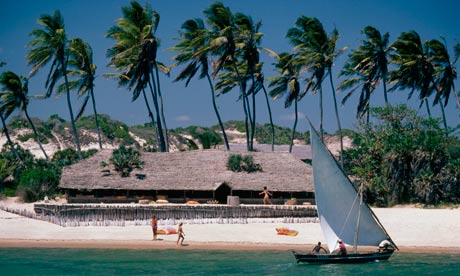
1:  The good news:  On Wednesday, Judith Tebbutt, the British woman who was whisked away from the Kenyan resort of Kiwayu Safari Village by Somali "pirates," was released after six months of captivity.  The bad news…is considerable.  One, the son who secured her release appears to have paid a ransom of over a million dollars.  Two, she had no idea until she was a free woman again that her husband had been killed during the kidnapping.  Three, there are still several civilians being held in Somalia, not to mention the nearly two hundred sailors being held on vessels at sea.

All those dots mean booze.
2:  The good news:  Washington state residents are only a couple months away from Booze Emancipation, June 1.  Recently, a fun and helpful interactive map was published that allows you to zoom in on your neighborhood and see who has applied for a liquor license.  It’s just as you’d expect:  grocery chains like QFC and Safeway, “pharmacies” like Walgreens and Bartell, and big box stores like Target and—of course—Cost Co.  I am all abuzz over the potential for competition and, simply, the new convenience.  I can get me rum at the same time I get my cheese, Bandaids, or toilet paper…all the essentials in one spot.  The question:  specialties.  Are the buyers at Safeway really going to think to stock Rogue Blackbeard Dark Rum, Punt e Mes, or Domaine de Canton, or are they just going to stock Bacardi and Martini & Rossi?  Are there going to be stand-alone liquor stores for bartenders or at-home mixologists?  Liberation:  It's never as simple as how you imagined it.

3:   The good news...is that there's no news about the Kalakala.  No reports of taking on water, no threats of immediate demise.  The bad news:  Steve Rodrigues' trailer next to the ferry was hauled away by the property owners, and, as of last report on March 8th, he is depending on family and friends for a place to live.  I am not here to discuss Steve's personal affairs, but since Steve IS the sole visionary for the Kalakala's future this is yet another bad omen.  The one-cent buyer remains a shadow.  The vast majority of online commentary on the Kalakala is negative, most calling for the boat to be scrapped or sunk.  So no news really means that the fate of the Kalakala is still hanging by that same slender, ragged thread.

And you thought he was ugly alive...

4:  The good news:  Shane is dead.  The bad news:  So is Dale, and we all have to wait til Fall for more The Walking Dead.  But there will be Mad Men, and Christina Hendricks is infinitely more sexy than a walker in a barn.


The Goddess Joan


5:  We got an email from our landlord that we need to move by May 31.  This is a complex mixture of good and bad news.  It was inevitable, and in a way I’m surprised it didn’t happen sooner.  After the initial shock, compounded by the fact that it was morning--I am not a morning person, justsoyaknow-- I have come to realize that this is an opportunity.  Yeah, it's gonna be a gargantuan hassle.  But, in fact, I like moving, and it's something I've done a lot.  Moving is a reset button.  It's a chance to assess your material possessions, sort, and eliminate.  Moving, even just crosstown, means new environs and a chance to learn and explore.  Hell, it's a chance to redecorate, which means maybe I can set up my pirate cave.  For all you readers, I am not going to make this a blog about the move (since this isn't going to mean fulfilling my liveaboard fantasy), and naturally this will temporarily impede my ability to write.  Another day, another horizon.  Watch for my signal flags.

Friday, February 10, 2012

Pirates, archaeologists, and smugglers: a tale of three documentaries

Ile Sainte-Marie:  just another pirate paradise

Last week, "H2," previously known as "History International," aired three shows targeted towards the drunken pirate demographic.  The first I stumbled into (on G'Ma's TV), and when I looked on the Comcast guide and set the DVR for a full showing of that I found two more.  The first, accidental discovery was the best as an actual documentary:  Pirate Island, about investigations of Ile Sainte-Marie off northeast Madagascar.  Ile Sainte-Marie was one of the premier pirate havens of the Golden Age, because it had everything you could ask for--a location close to the rich shipping lanes of the Indian Ocean yet undisclosed to the law, a harbor to keep ships same from both storms and the Navy, and a local supply of fruit and water.  Kidd, Levasseur, Every, and other legendary pirates of the era used the island as a base at one time or another.  It was known for having vestiges of pirate days, but no professional archaeological survey had ever been done.
Bell of the Whydah

The team leader for the investigations documented in Pirate Island is a modern name well known to pirate buffs, Barry Clifford.  Clifford reached fame in 1984 with his discovery of the Whydah (pronounced WID-ah, not WIDE-ah).  The Whydah started as a trading and slave ship in 1715, but two years later it was captured in the Caribbean by the pirate "Black Sam" Bellamy.  Bellamy added cannons, made the 105-foot vessel his flagship, and preyed off the East Coast.  Unfortunately, in April, 1717, the Whydah was caught in a storm near Cape Cod.  Gale-force winds snapped the mainmast, and the ship capsized and broke apart.  Over a hundred pirate corpses washed up on the beach the next day as well as scattered goods that were quickly picked over by wreckers.  Three hundred years later, Clifford found the wreck of the Whydah.  Over 200,000 artifacts have now been recovered, ranging from buttons and buckles to grape shot and grenades...and 10,000 coins and 400 jewelry fragments.  The key find was the ship's bell, clearly inscribed with "The Whyday Gally 1716."  Clifford had found the first positively identified pirate shipwreck.

Sunday, January 15, 2012

Somalia Update: Perspective

Somali pirate dhow captured by the Royal Navy on January 13th

I will be the first to admit that my reporting and analysis of the ongoing saga of piracy in Somalia is based on trolling online articles.  I track Google News, check the Guardian page on piracy, and keep up on Jay Bahadur's blog.  Again I will confess I am no expert.  Yet by watching the news, it is easy to observe that something has changed.  What is unclear is whether the change is actually a shift in events or simply in how the press covers them.  Three themes have taken over lately.  One, the Somalis may have shifted their focus from large commercial vessels to private yachts, and possibly even to tourists ashore.  Two, naval action in the Gulf of Aden appears to be more successful in averting pirate attacks.  Three, the these two factors, among others, may be indeed be indicative of the beginning of the end of Somali piracy.

Kiwayu Safari Village, Kenya

My last post on Somalia, August 22, 2011--nearly five months ago!--was on Bahadur's book.  We have some catching up to do.  Let's start on September 7, 2011, when The Guardian reported on the release of Jan Quist Johansen and family, who had been held hostage since their 47-foot yacht had been taken in February.  It has been suggested that a $1 million ransom was paid for their release.  Only four days later, there was a big news splash when a British couple, The Tebbutts, were attacked at Kiwayu Safari Village, a resort in Lamu, Kenya, not far from the border with Somalia to the north.  The husband was shot protecting his wife, and she was bundled off in a speedboat.  Somali gunmen had attacked across the border before, but the use of the speedboat immediately brought "pirate" to the lips of many.  The suspicion that the Somali pirates had a new modus operandi was strengthened on October 1, 2011, when an elderly woman was kidnapped by speedboat from her beach house near Lamu.

Monday, December 26, 2011

Booze and Boat Bits #5 (5 short items of interest)

Keeps me in rations

1:  I love good rum, but I am not a total snob.  Although I know and value quality, I still want to make sure I have rum even as I wait for the next paycheck.  That's why Cruzan is awfully nice, because it's inexpensive and tasty.  I recently decided to further explore the lower shelves.  But how to decide, other than the orange sale tag?  How about a pretty label?  On the left we have Calypso Spiced Rum.  The name is meaningless:  There isn't even a remote reference to the Goddess of the Sea, whether among the ancient Greeks or the modern Captain Sparrow fans.  What we do have is a bodacious redheaded pirate with a very nice chest...and a very nice chest full of treasure.  Oh ad men, I am weak.  I soaked the label off, pasted it on a card, burnt it around the edges, and had a cool bookmark (now between pages 342 and 343 of The Mauritius Command).  On the right we have Admiral Nelson's Spiced Rum.  The Hero of Trafalgar now sports flaming red hair, an eye patch, a cutlass that appears to be curved backwards, and...both arms!  OK, so the Nelson of the rum world bears about as much relation to his historical namesake as, well, the Morgan of the rum world.  The common denominator here isn't just nautical kitsch but spice, which seems to make cheap rum palatable in much the same way that blending does for cheap whiskey.  The good news is that, with some ginger ale and a good squeeze of fresh lime, it may not be a fancy cocktail, but it keeps the crew happy.

A sad portrait

2:  Meanwhile, the fate of the Kalakala has gone from unknown to downright mysterious.  On December 19th, it was reported that the ferry had a buyer for Rodrigues' token dollar.  The name and location of the buyer is unknown to apparently all but him.  Indeed, all that has been officially posted is:  "After considering offers from two interested parties, the Kalakala has been sold for $1 to an anonymous buyer. The Kalakala will be saved from the scrap yard and restored to her full glory."  Unofficially, Rodrigues has told the Seattle Times that the buyer is not in Washington State; New York is rumored.  Meanwhile, Rodrigues has been under the gun of the Coast Guard to move or at least to offer a plan.  On December 23rd, his appeal for an extension was denied.  The Coast Guard doesn't even believe that this "buyer" exists.  So now there's a distinct possibility that the next actual owner of the Kalakala may be the Corps of Engineers, who may move her, "pin" her in place, or do nothing at all.  As usual, Rodrigues speaks more mythically than realistically.  The ferry needs someone with vision but also with, ideally, some idea of how a boat works, funding, and connections.  What we have instead is a purported fairy godmother, with the authorities on Rodrigues' heels.  Seriously Steve, show us the moneybags.  Even the faithful need to see that miracle, not just promises.

You never know what you'll drink...but it'll be good.

3:  I love random beer!  I discovered  a while ago at Fred Meyer the Dick's Beer Variety Pack, and I got another box of random beer last week.  The case could contain any of fourteen different brews.  I like Dick's generally--this is a brewery in Centralia, WA, that produces about 3,500 barrels per year in about 20 varieties.  Buying random beer does have its risks:  I may be stuck with styles I just generally wouldn't choose, like IPA and hefeweizen.  On the other hand, their trademark dark Dick Danger Ale is very tasty, the Irish Ale is right up my alley, and the Lava Rock Porter I have in my tankard right now is roasty and deep.  Consider the season and opening that gift from the aunt that doesn't know you.  Now consider opening up a box, and even though you don't know the details, you get beer.  A worthy adventure, eh?

4:  I have been completely remiss keeping up on Somalia, what with being absorbed by Naval exploits of 200 years ago.  There have been attacks averted (by Iran!), civilians released, and pirates sentenced.  It is my duty (at least to my own interest) to get caught up.  I will do this in a more thorough post soon.

Cheery, yummy

5:  Lastly, a thank you to my coworker, Joseph, for giving me a truly great beer.  Trader Joe's 2011 Vintage Ale is in fact made by the great Unibroue brewery of Chambly, Quebec, makers of well-known beers such as La Fin du Monde and Maudite.  Trader Joe's scored a marvelous, dark, bubbly, and spicy limited edition ale.  It's good, it's cheap, and it won't be around for long.  Go now!

Thursday, November 17, 2011

Ahoy! Still afloat...

Yes, yes, I haven't posted in a really long time.  I'm planning to get back in it, but I have been busy--I work in Medicare land, and it's that time of year when old folks inundate customer service with questions, plan changes, and the inevitable errors and problems of a major health plan.  So I haven't been on the water much, but...

I have been sailing again the wonderful oceans of O'Brian's Aubrey and Maturin series.  I totally started over, and at this exact moment I'm with the Surprise and crew in Bombay, halfway through H.M.S. Surprise.  There is, as many of my readers probably already know, so much to these novels:  loads of nautical daring-do, amazing amounts of historical detail, characters with depth, Dr. Maturin's old medicine and Darwin-like naturalist exploration, Brontë-esque romance and courtship, and, simply put, atmosphere to spare.  In fact, one of the things I'm doing this time is actually taking notes.  The series is so epic I decided to make sort of a Cliffs Notes version of each book which will allow me to go back and track characters, events, and ships.  I plan to share these summaries...that will likely be the next major post.

Why does my manager keep taking my ale?

Logan, meanwhile, has been living a quiet, off-season existence.  He did go out for Halloween--at work; at the Castaway Lounge of Dan Ross' big, long-standing West Seattle party; and at our front door, threatening youngsters who expected candy but instead got the business end of a flintlock (just kidding).  I love Halloween.  I have recently received orders from the CWB to report to their Christmas party for a sort of impromptu, wandering story time.  Aye!!  More on this later.

Clear the mess and pipe up the grog!

The aforementioned Mr. Ross, also known as Capt. Ross of the Mirus (our host for the Duck Dodge, as mentioned in previous posts), introduced Zanne and me to quite possibly the COOLEST BAR EVER.  It is now called the Benbow Room, essentially the rear of the Heartland Café, but for fifty years before that it was the Admiral Benbow Inn, named for the opening location of Treasure Island.  Dan told us how as a kid he used to look in the window of the place and dream of the day he could go in.  It's awesome.  The place looks like the lower (gun?) deck of a tall ship, with exposed beams, hanging lanterns, and rear gallery windows complete with water effect.  To riff off of one reviewer, this is what adult fans like myself of the original Pirates of the Caribbean at Disneyland WISH was at the end of the ride.  (Vintage Pirates, way before Sparrow, back when the Pooped Pirate was still chasing the "lively lassie.")  Anyways...the Benbow is equal parts kitsch and dive, a cheap bar with nostalgic theme park vibe.  They also serve a completely legit Dark 'n' Stormy:  beautifully dark Gosling's rum, sharp Gosling's ginger beer, and even served in a Gosling's jar!  The nice bartender let me keep the jar--I have a penchant for getting free swag at bars lately--which is now pretty much the only thing I drink out of.  I could keep going, but let's just say that, in the absence of a liveaboard replica 18th Century Bermuda sloop, I'd move in at the Benbow (or at least pass out under a table) if the landlord kicked us out.

Grandpa Charboneau
The worst news of late is the passing of William Charboneau, Zanne's grandpa.  His 86 years were full and amazing.  He was a horn player who worked with the legendary Dorsey and Goodman bands.  He was a proud veteran of World War II, recipient of a Purple Heart and two Bronze Stars nonetheless.  As a member of the 89th "Rolling W" Infantry Division, he was witness to horror and history.  Not only was his division the first United States unit to liberate a Nazi concentration camp, Ohrdruf, part of the infamous Buchenwald camps, but he was at the front of his division and thus one of the first Americans ever to witness the atrocities of the Holocaust.  I only had a chance to meet him once, but even in his evening years he remained a man of wit and warmth.  Sure he kept telling the same jokes, but each time it was just different.  Every single word he spoke was enrapturing--heartfelt, important, even profound.  Neither Zanne nor I could make the funeral in Houston, tho' G'ma and her brother Bill did.  In addition to a few choice guayaberas, I inherited his immaculate gold Gruen pocket watch, an honor I keep with me now everywhere I go.  He was a very, very remarkable and loving man.  Salute to you, sir.  I only wish I could have known you better.

Goodbye, State Liquor Store

On a more upbeat note, the best news of late has been the liberation of liquor in Washington State.  Ever since Prohibition, Washington has been a "control state," and the Liquor Control Board has maintained a pious monopoly on hard alcohol. For those of you in more freethinking places, this means that when I want me rum, I have to go to my local Washington State Liquor Store; I can't simply get it from the local grocery store, much less some wonderland like Spec's.  With Initiative 1183, the voters of this often bass ackwards state have finally moved booze into the actual modern era of the free market.  Sure, Costco dumped millions into the campaign; why wouldn't they want to profit from us lushes?  Will this mean drunken kids?  Not if the Control Board actually does their job and focuses on enforcing the law rather than trying to make a buck off of it.  And what of the employees losing their jobs in this tough economy?  Well, Costco is apparently beneficent enough to offer them all interviews; c'mon, who better to run the liquor section then someone who already has?  But the real point is this:  The government should not be in the business of alcohol.  Separation of church and state?  How about separation of hooch and state?!  I look forward to the actual transition next June, when I can--imagine that!--get what booze I want, when I want it, and where I want it.  Victory at last!

Lastly but not leastly, when Zanne and I are not trying to just keep our ship afloat, help family, or drown our sorrows while watching Bitchin' Kitchen, we are embarking on a major project.  We call it Roadside Distractions.  Remember road trips as a kid, and all the weird things you saw from the backseat?  Motel signs portraying tropical oases in neon?  Concrete dinosaurs?  Likenesses of Bigfoot carved with a chainsaw?  We do, and we have the faded, fuzzy snapshots all digitized to prove it.  Yet these symbols of American wanderlust--and plain oddness--keep getting destroyed, disappearing into disposable memory.  So our cameras are ready again, now on a rescue mission.  Our goal is a sort of generation-wide family album of the highway bizarre.  We're even going to recycle trashed books to do it.  As soon as we can, we are going to launch a funding site on Kickstarter.  Lots more to come.

So I have hardly been idle.  OK, there's a lot of flopping and drinking, but you expect that from me, right?  But there is stuff to report.  Close to 3,000 people have now dropped in since the beginning of the Journal of Blue Lou Logan, even though I haven't written in over two months.  Apparently I may actually have an audience, and I would hate to disappoint!

Monday, August 22, 2011

Jay Bahadur's The Pirates of Somalia: Time for a Reality Check


That a non-fiction book can be a page turner might be weird to some, but Jay Bahadur's The Pirates of Somalia was completely riveting.  Bahadur is a journalist, but he's also in a way an anthropologist:  He clearly knows that facts gathered from real fieldwork and with real cultural sensitivity are far better than second-hand information and armchair analysis.  Rather than extol his writing, however, I'm going to put here some of the facts about Somali pirates that not only struck me but also would be well to remember in any future discussion.

The pirate Boyah
1.  Somali pirates are not all the same.  The historical timeline of piracy in Somalia shows that pirates have different origins, motivations, and methods.  Bahadur describes three "waves" of piracy.  The first wave, beginning roughly with the collapse of the central Somali government in 1991, consisted largely of "marine muggings."  This was the mythical era of the fisherman-pirate, struggling against outsiders first by taking on foreign trawlers and then by attacking any passing, worthwhile target.  Eyl was the pirate haven of the day, and one of the chief operators was Abdullahi Abshir, better known as "Boyah," one of Bahadur's main subjects.  The second wave began in 2003 with the rise of Mohamed Abdi Hassan, alias "Afewyne" ("Big Mouth").  Afweyne was--and is--a businessman, and his "Somali Marines" out of the ports of Harardheere and Hobyo are organized in a military fashion.  The targets got larger:  A joint operation between Eyl and Harardheere, crossing not only geographical lines but also clan lines, captured the now-famous MV Faina with its load of tanks.  Yet, in spite of bigger targets and bigger ransoms, these pirates called themselves "Coast Guards" to at least look they were protecting Somalia from evil foreigners.  As recently as February 2011, Afweyne has been described online as a "Robin Hood" for Somalia.  The third wave began, perhaps, in 2008, when the security sector in Puntland collapsed, leaving trained men unemployed and available to go on the account.  Bahadur calls these most recent pirates "opportunists" on the coattails of men like Boyah, Afewyne, and a third kingpin, Garaad Mohammed, who has taken credit for the Maersk Alabama.  Garaad has recently gained attention when the ransom intended for the MV Yuan Xiang, captured by men under his command, was seized in Mogadishu, resulting in the arrest of three Britons.  The lesson here is simply that the Somali pirates should not be viewed as a unified force:  Time, place, and culture make each group unique.  The one constant is the "fisherman" story, which now must be seen as a public relations strategy not a universal fact.

Thursday, August 4, 2011

Booze and Boat Bits #3 (5 short items of interest)


1:  Move over Somalia, there's a new pirate hot spot:  Nigeria.  An article for the AFP indicates that there is a surge in maritime attacks in West Africa, and specifically in the Gulf of Guinea.  Fact is, this is neither surprising nor new...just new to me.  After only a quick search, I found online articles about Nigerian pirates going back to at least 2008.  There's even a short Wikipedia entry.  Nigeria is well known for its organized crime, from drug trafficking to international fraud.  This is one of the things that makes piracy here very different from piracy off the Horn of Africa.  I'm learning (see my comments about Jay Bahadur's book below) that the Somali pirates are opportunistic and do not have what could be called long-term structure.  The Nigerians, in contrast, are all but militaristic.  They have to be:  Their prime targets are oil tankers, and they're not after ransom but the cargo itself.  The Nigerians, heavily armed and working in organized groups of high-speed boats, seize ships which they divert to waiting facilities so that the oil can be sold on the very busy, lucrative black market.  Although the pirates are Nigerian, their safe harbor appears to be Benin.  The navies of both countries seem to be unable--or unwilling--to handle the problem.  I'm curious to see what the international reaction is going to be.  Nigeria, Africa's biggest oil-producing nation, supplies a full fifth of the United States' imported oil.  Guess what, we've got more modern pirate news to watch for.

Wednesday, June 29, 2011

Somalia update: Yemen, the next pirate coast?

In my discussions of Somali piracy, I have not infrequently mentioned that the problem is not a Somali problem alone.  My very first post on modern piracy noted that both Somalis and Yemenis were taken from the now-famous M/V Quest, and in my post on the "Jeffersonian past" I proposed that Yemen may become a new center of pirate activity.  The map of pirate attacks up to 2010 clearly shows a high concentration of reported incidents immediately off of Yemen.  The cultures and governments of Yemen and Somalia have had a long, close relationship; Yemen has unconditionally accepted Somali refugees.  But does this really mean that Yemen plays or could play the same role as Somalia as a pirate haven?  I decided to look closer at history and recent events.

Wednesday, June 15, 2011

Booze and Boat Bits #2 (5 short items of interest)

1:  Yesterday was one of my worst sailing experiences ever.  It wasn't the boat, and it wasn't the wind.  It was the dynamic of the people aboard the vessel.  I think it was also something dark welling up from the murk and ruins under Lake Union, because there seemed to be a general sense of grumpiness and lack of good cheer among all the Duck Dodge participants.  Why else would we see no one raft up at the end of the race, especially on Pirate Night???  All dressed up and in no mood to party.  What made yesterday even more disappointing was that this was the night we chose to introduce Bev to the Dodge.  This was not a total failure, but it was a lesson and a letdown.  The event is well-described by Zanne over at Zzyzx Kitchen.

2:  You must join the Revolution.


Tuesday, May 31, 2011

Blackbeard's anchor?!

Look at the size of that thing!

The Queen Anne's Revenge Project, which has been been doing ongoing archaeological investigations of what very well may be Blackbeard's famous ship, has just pulled up a massive anchor.  Pauline's blog informed me of the news, and the news is all over the Net.  I still had to share.  There is a nice article from the local StarNews detailing the recovery.  Like all archaeology, this identification is to a certain degree hypothetical, but, nevertheless, the evidence that this is in fact the ship of the notorious Teach is accumulating.  And, by any measure, this is one Hell of an artifact.

Tuesday, May 24, 2011

Somalia update: Jay Bahadur, journalist

He wrote this book, which will be on my shelf when it comes out.

He wrote this article for the Guardian, which is absolutely fascinating.

He writes this blog, which appears to be THE blog on Somali pirates.

And he's Canadian, which always gains someone extra points.

Do not ignore this guy.

Monday, May 23, 2011

"Wicked Pirate City"--or, what's wrong with the National Geographic Channel

Fictionalized Cap'n Morgan and his fictionalized buccaneers

I was pretty jazzed when I found out that the National Geographic Channel had a new documentary coming on about the underwater ruins of Port Royal.  For those unfamiliar with this major piece of Caribbean and pirate history, here are the basics.  Port Royal was England's toehold in the Caribbean during the era of the "Spanish Main."  The English captured the town from the Spanish in 1655, and for the next few decades Port Royal was the center of both (illicit) English commerce and English-led buccaneering.  Legends like Henry Morgan not only sailed from Port Royal to attack Spanish ships and towns but also brought the booty back to spend on rum and women.  At its height, over 6,000 people called Port Royal "home."  The problem with pirate (or privateer?) paradise was that it was built on little more than a sand spit on the outside of Montego Bay.  In 1692, when a major earthquake struck Jamaica, the ground under Port Royal essentially liquefied, and within minutes two thirds of the town had slid into the ocean and most of the remainder was flooded by the ensuing tsunami.  Many of those that were not killed immediately were soon dead from injury or disease.  The English shifted their city to Kingston on the other side of the bay.  The buccaneer era passed as Royal support waned, and piracy shifted to the Bahamas.  The famous Cap'n Morgan had died four years before the earthquake, killed by edema, tuberculosis, and/or the rum.  His grave sank into the sea along with the town he had helped make famous.

Wednesday, May 4, 2011

Pirate Droid!


Don't get carried away imagining C-3PO wearing a tricorne.  The company ReconRobotics is now developing a little mechanical bilge monkey to fight--or at least spy on--them Somali pirates.  The technology's pretty cool.  For one, Pirate Droid (its real, current name is "Throwbot") weighs only about a pound and is about the size of a beer can.  It can survive being thrown 120 feet.  The wheels are magnetic and strong enough to go up the hull of a captured vessel and over the side.  Pirate Droid can then recon the vessel for pirates and hostages, equipped with an infrared camera for seeing in the dark.  Existing Throwbots are usually simply thrown by human power, but the company is talking about a "marsupial robot deployment system" (pirate koalas?!?) that would allow them to be launched from a cannon mounted on a larger robotic vehicle such as a "droid chopper" or unmanned boat.