Showing posts with label Aubrey Maturin. Show all posts

Monday, December 17, 2012

Aubrey-Maturin in Brief...A Review & 10: The Far Side of the World

Ladies, gentlemen, and those below and between, we have reached the half way point of Patrick O'Brian's Aubrey-Maturin series.  We have also reached the book that most directly inspired and gave the title to the film that made Stephen and Jack visible to far more than a broad but nevertheless niche audience.  Before we get to the book itself, let's review where the winds and currents have taken us so far.  SPOILERS beware...

 1.  Master & Commander:  The Introduction.  In the year 1800, Lt. Jack Aubrey and Dr. Stephen Maturin meet in Port Mahon, Minorca.  Aubrey is given his first command, HMS Sophie, and with his friend Maturin cruises the Mediterranean, taking many prizes and gaining his reputation as "Lucky Jack."  The action climaxes with a dramatic battle with the xebec-frigate Cacafuego and ends with the witnessing of the Battle of Algeciras.

2.  Post Captain:  In Love and War.  Aubrey and Maturin, during a brief peace, discover that life ashore can be at least as complicated as life at sea as they become entangled in romance, social politics, and, in Aubrey's case, debt.  The situation is not much better when the war resumes, as Aubrey suffers the command of the dubious HMS Polychrest and nearly comes to a duel with Maturin over their mutual interest in the same woman.  In the end, Aubrey is made Post Captain and professes his love for Sophie Williams, and he and Maturin are as close as friends as ever.  Maturin, meanwhile, reveals his dangerous role in British intelligence and pines for the tempestuous and unattainable Diana Villiers.

3. HMS Surprise:  Romance in the Broad Empire.  After Aubrey is pulled from the tedium of the Toulon blockade aboard the Lively, and in turn after Aubrey rescues Maturin from torture in now-Spanish-controlled Port Mahon, our duo sets sail on Lucky Jack's favorite ship on a mission for Indonesia.  Surviving near disaster in the far south seas, they reach Bombay, where Maturin continues to pursue Villiers while she is under the keeping of the rich merchant Canning. The diplomatic mission fails, but Aubrey succeeds in defending the China Fleet from the squadron of French Admiral Linois.  In Calcutta, Aubrey is celebrated and gains enough freight money to be out of debt and marry Sophie.  Maturin is forced to duel Canning; he kills him but still loses Villiers.

4.  The Mauritius Command:  The Burden of a Grand Campaign.  With the secret help of Maturin, Aubrey is saved from domestic life and given command not only of the ship Boadicea but also of a whole squadron to take Mauritius and the surrounding islands from the French.  Aubrey finds it just as difficult to keep his captains in check and bear the mantle of Admiral as it is to outmaneuver the French Admiral Hamelin.  With the help of Maturin's negotiations and propaganda, bad odds are slowly improved.  The enterprise is nearly ruined with the horrible defeat at Grand Port.  Yet Aubrey defeats Hamelin, and tho' he does not gain all the credit Mauritius is taken.

5.  Desolation Island:  A Harrowing Adventure.  Aubrey and Maturin again escape domestic entanglements with a new mission:  Aubrey is to take the Leopard to Australia with a load of convicts, while Maturin is to coerce information from one of the prisoners, a beautiful American spy named Louisa Wogan.  It is a difficult voyage.  They barely survive a gale in the Bay of Biscay.  Wogan is in love with a stowaway named Herapath.  Much of the crew is killed by gaol-fever.  They play cat and mouse with the Dutch 74 Waakzaamheid until the Dutchman is suddenly swamped in the cruel Roaring Forties.  Then the Leopard runs into an iceberg and limps to the Kerguelen Islands.  In this cold, unforgiving place, the arrival of a Nantucket whaler allows Aubrey to save his ship at the same time that Maturin succeeds in planting poisoned intelligence.

6.  The Fortune of War:  Aubrey and Maturin in America.  The doomed Leopard barely makes Malaysia, and, as Aubrey and Maturin sail back towards England, the War of 1812 against the United States breaks out.  After their ship explodes, they find HMS Java, which is soon defeated by USS Constitution.  Aubrey and Maturin are taken as prisoners to Boston.  As Aubrey recovers from dire wounds at a mad house, Maturin falls into a dangerous spy game that involves the French, Wogan, Herapath and his father, and Harry Johnson, the American "protector" of none other than Diana Villiers.  After several scrapes, Maturin gets himself, Aubrey, and Villiers to HMS Shannon, which gives the British a much-needed victory when she successfully duels USS Chesapeake.

7.  The Surgeon's Mate:  Which Maturin Finally Wins Diana Villiers.  Maturin tries unsuccessfully to convince Villiers into marriage during the celebration of the Shannon in Halifax.  Aubrey, Maturin, and Villiers head home and narrowly escape a pair of American privateers.  Skirting the perpetual personal problems of their own country, Villiers goes to France, and Aubrey and Maturin sail to the Baltic for a delicate diplomatic mission aboard HMS Ariel.  They succeed but afterwards are wrecked on the rocks near Ushant and are imprisoned in France.  Weeks later, after Maturin makes a dangerous deal with a French agent, Aubrey and Maturin escape and are reunited with Villiers.  As they sail from Calais, Maturin and Villers are finally married.

8.  The Ionian Mission:  Back at the War.  Aubrey takes command of HMS Worcester and falls into the perpetual repetition of the blockade of Toulon.  A short, unsuccessful mission to Barka fails to improve the mood.  Maturin fares not much better:  A clandestine rendezvous at the mouth of the Aigouille River ends in chaos.  The Worcester breaks during an inconclusive chase with the French fleet.  Yet this allows Aubrey to regain his dear Surprise, and he and Maturin set off to the Ionian Islands to negotiate among the Turkish Beys to take the strategically important town of Marga.  Between Maturin's mechinations and Aubrey's fierce battle with two Turkish ships, success is at last achieved.

 9.  Treason's Harbor:  Trust No One.  In Valletta on the island of Malta, Aubrey and Maturin suffer interweaving woes:  Aubrey sees Surprise sit unrepaired, Maturin sees intelligence chaos in the city, and both of their lives are complicated by Laura Fielding, the wife of a captured British officer who has been coerced into spying for the French.  The new Commander in Chief gives the two a secret mission to Mubara, but, after braving the hot sands of Sinai and a treacherous voyage down the Red Sea, Aubrey and Maturin find that they have been betrayed, and both a diplomatic coup and a chest of treasure are denied.  Back in Valletta, Maturin uses Fielding as a means to counterintelligence just before joining Aubrey, with a now able Surprise, to escort the Adriatic convoy, during which they find that Fielding's husband is alive...and jealous.  Aubrey and Maturin receive another mission, this time to Zambra, but it's failure again as the French are once more alerted and destroy the British 64-gun Pollux, and the Surprise runs for Gibraltar.

In pseudo-chronological time, perhaps fifteen years have gone by.  Aubrey has obtained his captaincy; married; realized he's better off at sea, tho' better on a single warship than commanding a fleet of squabbling commanders; gained, lost, and regained his favorite ship; and ventured to locales from the Mediterranean to India to nearly Antarctica.  Maturin, in addition to following his friend everywhere, has seen (and been denied) many natural wonders, battled his own inner demons, won the difficult heart of his soul mate, saved many a wounded seaman, spied and been spied upon, and survived innumerable scrapes with death.

The Far Side of the World is, perhaps, Aubrey and Maturin's most far-flung adventure.  Some of the things you know from the movie are here:  Hollom the "Jonah," the rounding of Cape Horn, the Galapagos.  Yet I must hasten to remind you that the movie picked and chose from the whole O'Brian series, and even the plot lines that came directly from the book bear in many cases only scant resemblance to their literary source.  Trust me, the film is great, on its own or as a 'Best of O'Brian.'  But put away the IMDB, clear your mind, and let this fabulous voyage unfold without expectation...

"Nelson at Gibraltar" by Gordon Frickers

(1) In Gibraltar, Capt. Jack Aubrey nervously waits to report the failed mission to Zambra to the Commander-in-Chief, Admiral Sir Francis Ives.  The Surprise is doomed to be condemned, and the once cheerful ship has become a dismal place, her crew to be scattered and her captain with no clear certainty of a command.  On the streets, Aubrey encounters Mr. Hollom, an unlucky perpetual midshipman who had served under him aboard the Lively, and against his better judgment Aubrey takes pity on Hollom and orders him aboard the Surprise.  Aubrey dines with the Fieldings; having been rumored to have had an affair with Mrs. Fielding, Aubrey fears the evening, but he finds that the air has already been cleared.  Dr. Stephen Maturin, meanwhile, receives a letter from the head of British naval intelligence, Sir Joseph Blaine, congratulating him on his coup against French spies in Valletta and hinting at American operations in the Pacific.  Aubrey finally reports to Ives and is pleasantly surprised when he is congratulated for the destruction of the French two-decker Mars.  Even more happily, Aubrey and the Surprise are saved from doom and ordered to intercept the American frigate Norfolk, which is on its way to the Pacific to harass British whalers.  As usual, there is not a moment to be lost.

Monday, November 19, 2012

A better present, a bolder future

Three GDMF'in' months later, the diverticulitis is getting it's a** kicked via at-home IV.   I have a "Midline" running 16 cm into my left arm, and at roughly 6:00PM every day I have a routine of sterilization, saline push, and Ertapenem.  I am no longer dependent on Oxycodone and chewable Pepto Bismol to make it through my day.  I go back to work tomorrow!  And I can tolerate rum and lime juice without feeling hungover within minutes.

wicked

My illness has allowed me the luxury of time and thus a flurry of blog posts, from Logan songs to Logan story bits.  Now I'm back in the woodshed.  I'm two chapters away from completing The Far Side of the World, and I got The Reverse of the Medal from Half Price Books yesterday, as well as the 'last zombie pirate action figure' for $2.  But that's not the coolest thing.

How is this not Heaven?

All ye brethren know that the creme of maritime museums is Mystic Seaport.  Over the summer I noticed that they had a one-month institute for teachers called "The American Maritime People" under the auspices of the Frank C. Munson Institute of American Studies.  This made me drool:  stay in an old building at the seaport, take a series of seminars from the top names in American maritime history, gain access to the Seaport's archives, tour local sites and ships.  Being a Left Coast dude with no money, there was no way I could go.  But I've done the next best thing:  I'm going to reproduce it right here.  The syllabus was put online, and "Santa" (my parents) are gifting all the books.  Better yet, I have established direct communication with Dr. Glenn S. Gordinier, co-director of the Institute, who has given me direct encouragement and promised a copy of the course reader.  I have also added a few extras, namely Konstam's bio of Blackbeard and Clifford's account of the Whydah.

The point is this.  Over the next several months I will be homeschooling myself in American maritime history.  There will be a lot of reading.  I am academic enough to know that reading is not sufficient, and so with a little guidance from Dr. Gordinier I will also be writing "papers" on the course material, with no fear at all of scholarly debate.  And who gets to read these first:  YOU!

The Munson Room

My Christmas present is the open door I've been looking for, the way to get back into the scholarly sports, if you will, but with a new game.  To quote Dr. Gordinier:  "I can relate to your interest in the maritime past.  After ten years of teaching public school, I changed my career because, having taken the Munson courses, determined that I wanted to work at Mystic Seaport.  I've been here now 33 years making the salary of a staffer at a not-for-profit, but never regretting the move."

I hope you will join me in this new phase of Lou's adventures, one that damned well might be life-changing...

Friday, October 12, 2012

Songs of Logan #4: Women of Ireland (Mná na H-Eireann)

"The Beautiful Irish Woman" by Gustave Courbet

Logan's #4 is neither a Scottish tune nor a sea shanty.  Hell, it isn't even "traditional."  It has to be included, however, as it is one of the most haunting songs I know and as a piece of music suits the fictional mood of Logan to a tee.  "Mná na H-Eireann," translated from Gaelic as "Women of Ireland," started life as a poem by Peadar Ó Doirnín, one of a group of eighteenth century poets from Ulster in what would now be Northern Ireland.  The song is a paean to the titular women but, according to Wikipedia (although with uncited sources), took on a "rebel" context in the early years of Irish nationalism.  This would have included the United Irishmen of which one fictional member was O'Brian's Dr. Stephen Maturin.  Someone at the lyrics site lyricsg.com has posted both the original Gaelic and an English translation here; as I will guess you can't read Gaelic, here is only the latter:

There's a woman in Ireland who'd give me a gem and my fill to drink
There's a woman in Ireland to whom my singing is sweeter than the music of strings
There's a woman in Ireland who would much prefer me leaping
Than laid in the clay and my belly under the sod

There's a woman in Ireland who'd envy me if I got naught but a kiss
From a woman at a fair, isn't it strange, and the love I have for them
There's a woman I'd prefer to a battalion, and a hundred of them whom I will never get
And an ugly, swarthy man with no English has a beautiful girl

There's a woman who would say that if I walked with her I'd get the gold
And there's the woman of the shirt whose mien is better than herds of cows
With a woman who would deafen Baile an Mhaoir and the plain of Tyrone
And I see no cure for my disease but to give up the drink

Séan Ó Riada
The poem would have been lost to obscurity had it not been set to music as a slow air by the legendary Séan Ó Riada and then recorded in 1969.  That recording was by the group Ceoltóirí Chualann, a key group in the revival and popularization of Irish traditional music.  One of the members of Ceoltóirí Chualann, Paddy Moloney, went on to gather his own band, which (ahem) you might have heard of--The Chieftains.  As an instrumental, "Women of Ireland" has been recorded by everyone from Mike "Tubular Bells" Oldfield to hard rock guitarist Ronnie Montrose.  The instrumental form is the one I adore, but luckily in recent years singers in both the traditional and popular realms have revived the words.  It is a song that I put on regularly just to sink into emotionally.  Music makes make me weepy like that; gimme a break.  Of the many recordings, here are my top three:

  • The Chieftains, from The Chieftains 4.  I have been a big fan of the Chieftains since I was in college.  I have seen them a number of times--even in Fairbanks, Alaska--and have, at least electronically, their complete, 50-year discography.  Their arrangement of "Women of Ireland" is the standard and still the best.  It was originally included on their 1973 'fourth' album.  Two years later, director Stanley Kubrick placed it prominently in the gorgeous film Barry Lyndon, which starts in rural Ireland in the 1750's.  The soundtrack to Barry Lyndon can be recommended not only because it also includes a solo harp version of "Women of Ireland" by the late, great Derek Bell but also for its fabulous selection of period orchestral music.  Chieftains 4 is available on iTunes, and "Women of Ireland" can be found here on YouTube.  The film Barry Lyndon is also available from iTunes but not its music, while the soundtrack CD has, unfortunately, become a collector's item; keep your eyes (real or virtual) open, it's worth it.
  • Kate Bush from Common Ground:  The Voices of Modern Irish Music.  Anyone with any taste in the 1980's will remember The Dreaming ("Sat In Your Lap") and Hounds of Love ("Running Up That Hill").  Anyone who was paying attention will recall the Irish touches to Kate Bush's music.  This was partly the result of Bush's friendship with Bill Whelan, later of Riverdance fame, who brought men like Irish bouzouki player Dónal Lunny and Uillean pipes player Liam O'Flynn, veterans of such critical Irish traditional bands as Planxty and The Bothy Band, to record on Bush's albums.  More importantly, it's in Bush's blood.  Although Bush herself was raised in South East London, her mother was Irish, while her dad's mom was a former Irish folk dancer.  In 1996, Bush contributed to the compilation Common Ground:  The Voices of Modern Irish Music a version of "Women of Ireland" sung in the original Gaelic, which she had to learn phonetically.  Authenticity aside, Kate's version carries her usual emotional weight over a sweeping orchestral backing, a cinematic piece in under three minutes.  It is available on iTunes as part of a different compilation, Éist, on which well-known Irish artists sing in Gaelic.  It can be found on YouTube here.
  • Sinéad O'Connor, from Ain't Nuthin' But A She Thing.  My introduction to Sinéad O'Connor is a unique memory.  In 1991, I was part of the second, smaller field crew excavating at the Three Saints Bay site on Kodiak Island, Alaska.  Phil McCormick--Kodiak Native from Karluk, trained chef, and archaeologist--had brought ONE cassette tape, I Do Not Want What I Haven't Got.  Picture it:  a half a dozen men wearing Helly Hansen overalls, digging in the wet dirt for Russian artifacts, the ocean behind us and towering mountains before, 10 miles from the nearest village of Old Harbor, listening to Sinéad O'Connor over and over and over.  Perhaps surprisingly, Sinéad's remains one of my favorite voices, able to glide along at a whisper and then explode into a rant.  Her Irish rebel identity is certainly no secret, and she made her love of traditional Irish music known on her 2002 album Sean-Nós Nua.  A hidden gem is her recording in Gaelic of "Mná na H-Eireann," contributed to the 1995 MTV project Ain't Nuthin' But A She Thing.  This is a spacious arrangement that begins with little more than a drone and slowly introduces fiddle, harp, and whistle, with plenty of room for Sinéad's subtle, emotive singing.  The CD is long out of print, but used copies are common and cheap.  It is not available on iTunes but can be found here on YouTube.

Coming up next:  Hands down, my favorite shanty.

Saturday, September 29, 2012

Ethics and Morality According to Gary Gygax

Mmm, succubi
Many, many lunar cycles ago, back in the days when Cherry Coke was "new," The Police were still together, and video arcades echoed with "Elf is about to die," I was, yes, a Dungeons and Dragons geek.  I had the dice, I had the Manuals, I had the Terry Brooks novels.  It was not at all the only thing I did, nor by any means was it my only kind of geekiness, but it filled a gap.  Star Wars was over (we thought), Star Trek: The Next Generation had not yet aired, and Dr. Jones was stuck in India with the annoying Willie Scott.  OK, people, you've got the years narrowed down, right?  In that time between Wookiees and Klingons, orcs and dragons served nicely for an early teen for whom modern reality just couldn't compare to the wonders of imagined realms.  Times have changed.  I'm still a geek.  Now I carry a "real" cutlass instead of a "pretend" +3 short sword.  What I didn't know until recently is that D&D also contains a philosophical treatise that gives a very interesting map of human behavior and a sort of chart that could be applied, well, to at least fictional piracy.  A few months ago, I found this, which I urge you all to entertain--dare I say enlighten--yourselves with:

The one like Gygax
In the simplest possible terms, alignment is one of the variables in creating and using a roleplaying character.  A character may, for example, have a "race" of dwarf or human and "class" of fighter or cleric.  These variables in turn set parameters for abilities such as strength and constitution whose numeric values (this is where the famous 20-sided die comes in) are used in game play.  This is a very nutshell version of game mechanics that will be intimately familiar to anyone who has actually played.  Yet if strength, for instance, is quantified, alignment introduces something far more qualitative:  perspective and behavior.  In 1974, Gary Gygax, the inventor of D&D, gave only three possibilities: Law, Neutrality, and Chaos.  Law was essentially synonymous with good, and Chaos was the same as evil.  In fantasy, those two poles would be fairly obvious--Sauron bad, Aragorn good.  It got more interesting a few years later when Gygax developed Advanced Dungeons & Dragons (AD&D, which is what I played).  Ethics and morality were separated into two crossing axes.  Good and Evil were now the poles of morality, Law and Chaos were the poles of ethics, and true "Neutral" was where the axes crossed.  Thus, a character could of one of nine alignments (chart and links borrowed from Wikipedia):

Lawful GoodNeutral GoodChaotic Good
Lawful NeutralNeutralChaotic Neutral
Lawful EvilNeutral EvilChaotic Evil

Considering and distinguishing morals and ethics is one of the long-standing debates in philosophy.  I considered much the same in my blog "Ethics of a Sinking Lifeboat," in which I discussed the debate between "natural law," essentially the conflation of ethics and morality by thinkers like Aristotle and Socrates, and "positive law," the laws of man as defined by Thomas Hobbes.  From the perspective of AD&D alignment, morality could be defined as the value an individual places on his fellow beings.  A Good character strives to be constructive and helpful to others, while an Evil character would be destructive and harmful; Good is heroic, Evil is villainous.  Ethics, on the other hand, is the value an individual places on the structure/system created by his fellow beings, i.e. "law."  A Lawful character not only follows the rules but will fight to protect them.  A Chaotic character discards the rulebook and disregards the standards, acting instead on the basis of their own personal code and believing that it is the right of everyone else to do the same.  Neutrality, in the case of either ethics or morality, implies that these judgments don't come as a rule into play (literally or figuratively); he, she, or it will decide simply as specific circumstances require for survival.  Defining ethics and morality in this way is more or less in line with modern understanding.  In a succinct article at DailyWritingTips.com, Mark Nichol writes, "One lives according to one’s morals but adheres to one’s ethics while doing so.  Morals are the tools by which one lives, and ethics constitute the manual that codifies them."  Fact is, for me, the idea that ethics and morality are different, that good and lawful are not to be confused, is axiomatic.  So I was thus pleased with the results of my test.  As far as I can tell, this description comes directly from AD&D canon...
Chaotic Good A chaotic good character acts as his conscience directs him with little regard for what others expect of him. He makes his own way, but he's kind and benevolent. He believes in goodness and right but has little use for laws and regulations. He hates it when people try to intimidate others and tell them what to do. He follows his own moral compass, which, although good, may not agree with that of society. Chaotic good is the best alignment you can be because it combines a good heart with a free spirit. However, chaotic good can be a dangerous alignment when it disrupts the order of society and punishes those who do well for themselves.

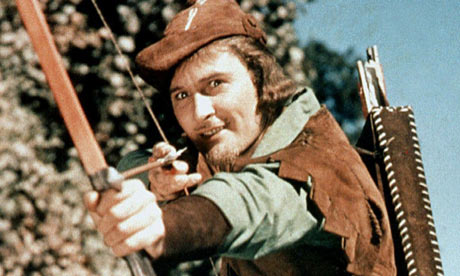
Robin Hood:  not just a hero, a philosophy

Yep, that's me, or at least I like to think so.  Easydamus.com is a thorough, well-made site on AD&D alignments that also contains a long but rewarding What D&D Character Am I? test.  The site quotes Gygax:  "To the chaotic good individual, freedom and independence are as important to life and happiness. The ethos views this freedom as the only means by which each creature can achieve true satisfaction and happiness."  This philosophy was hardly invented by Gygax.  He has credited the inspiration for the alignment system to, among others, fantasy/SF author Michael Moorcock, a self-described anarchist.  I have often said to friends that I live be one rule--Do whatever you want, as long as it doesn't prevent anyone else from doing whatever they want.  This standpoint was codified by a favorite philosopher of mine, John Stuart Mill, one of the original "liberals," or what would more likely now be called libertarianism.  In his 1859 essay "On Liberty," Mill famously wrote:
The object of this Essay is to assert one very simple principle, as entitled to govern absolutely the dealings of society with the individual in the way of compulsion and control, whether the means used be physical force in the form of legal penalties, or the moral coercion of public opinion. That principle is, that the sole end for which mankind are warranted, individually or collectively, in interfering with the liberty of action of any of their number, is self-protection. That the only purpose for which power can be rightfully exercised over any member of a civilized community, against his will, is to prevent harm to others.
The last, italicized bit has come to be known as the Harm Principle.  To those of a certain bent (myself included), it's also the Wiccan Rede:  "An it harm none, do what ye will."

I usually do.

An easy and common means to explain alignment is to exemplify the types with well-known fictional characters.  Indeed, it has become an Internet meme to create alignment charts for popular universes, from Star Wars to The Walking DeadRobin Hood, Batman, and Han Solo are often used as examples of Chaotic Good, all of which suit me just fine.  The single character, however, that hits the nail on the head for me is Captain Mal Reynolds on Firefly, truly a man with his own code, a man that fought against the "meddling" Alliance and maintains a very, very strong anti-authoritarian stance, a man that will fight for his crew and his boat, a man that may push a stranger off the Mule but will put a bullet in the man's head before he suffers at the hands of the Reavers.  This brings to mind other captains.  Captain Jack Aubrey is nothing if not Lawful Good, not only upholding Navy and country but also jumping into the sea to rescue officer and deckhand alike.  Captain Jack Sparrow would be Chaotic Neutral:  The Pirate Code itself is, with due irony, an embodiment of lawlessness as law, while wicked Jack's most singular skill is to look after (seemingly) no one but himself.  Captain Barbossa, however, points out the subjective nature of the alignment system and, indeed, of morality and ethics themselves.  As a pirate, Barbossa would be against law or at least a criminal, and thus Chaotic, yet within the pirate community he often cites the Code, which could make him Lawful.  Whether he is Good or Evil is even more vague; he is certainly the destructive villain in Curse of the Black Pearl, but is he a good guy or a bad guy after his resurrection?  Perhaps Barbossa put the whole topic of alignment best:  "The Code is more what you'd call 'guidelines' than actual rules."

All of this is, of course, an exercise in geekiness.  But isn't that the point?  Can't geekiness be not only an identity but also a means to exploring identity and big questions?  Suit yourself, go, be free, it's the Chaotic Good way.  But, in true geeky fashion, do post a comment if you take the test!

click for larger picture, and go visit mohagencomic.com

Tuesday, September 25, 2012

Aubrey-Maturin in Brief 9: Treason's Harbor

The ninth book of Patrick O'Brian's Aubrey-Maturin series takes its title from Shakespeare's Henry VI, Part 2:  "Smooth runnes the Water, where the Brooke is deepe/And in his simple shew he harbours Treason."  This is possibly the origin of the saying 'still waters run deep'--Someone who is calm probably has a lot more going on under the surface.  In the context of the book, this could be either Stephen Maturin or Jack Aubrey, who have intertwining troubles on and off the Mediterranean isle of Malta.  (SPOILER alert.)  The Surprise begins the novel unrepaired and abandoned in the port of Valletta and ends the novel threatened with being sold out of the Navy or even broken up.  In between are not one but two failed missions, the most central of which sees Aubrey, his friend, and his crew marching across parched desert sands in Egypt to the dangerous waters of the Red Sea in pursuit of a treasure-laden galley.  Both missions are diplomatic in origin, which is, of course, Maturin's milieu, but underlying both the diplomacy and the failure of each assignment is the fact that the French have compromised British intelligence in Malta.  Maturin must thus maneuver with his wits and keep his cool, which is not always easy for the pensive doctor.

Before proceeding, I want to take a little time to describe the methodology behind these summaries.  It must seem odd to some to watch me reading a novel but all the while jotting notes in the margins.  These notes try to capture major names, plot points, locations, and flavor.  When I'm done with the book, I use these to summarize one chapter per blog paragraph.  I have found that there are other study guides out there to O'Brian's works, but my goal is not Cliff Notes:  I'm not making a cheat sheet or a quick means to know the book without reading it.  My objective is to give existing readers a hyperlinked review, seeing as his novels are so packed with dialogue and detail that it can be easy to lose the larger plot.  I also hope to tease the uninitiated into the O'Brian universe.

I must also give credit where it is due.  One of the particular joys and challenges of the books is geography.  Not only are there a lot of places, but also it can be very hard to figure out exactly where O'Brian is talking about or even if the locations or real, fictitious, or somewhere in between.  Since I like to get it right and add links to the places in Aubrey and Maturin's travels, I am indebted to Dean King's atlas and guide, Harbors and High Seas, which offers maps and answers to (some) geographical mysteries.  Since illustrations can take the dryness out of any piece of writing, I take time to add pictures representative of the ships, places and events O'Brian and I are writing about.  As this is historical fiction, a modern photograph, in my opinion, just wouldn't fit.  So I try to use nothing but paintings and period paintings when I can, captioning the title and artist.  I must also give thanks to all of the online galleries I have Googled and borrowed from.

Enough shore work.  Let's get sailing.

"Grand Harbour and Fort Sant' Angelo, Valletta, Malta" by Johann Schranz

(1) The city of Valletta on the island of Malta is a pretty sight to all but those unfortunate officers of the Royal Navy who are stranded in port without ships to command.  This melancholy group includes Capt. Jack Aubrey, who has not one but two vessels in dock--the worn-out 74-gun Worcester, nearly sunk in a storm serving with the blockade of Toulon, and Aubrey's dear frigate Surprise, damaged in battle with two Turkish ships.  Yet, on this day, Aubrey is cheerful and boisterous, not only because his longtime shipmate Thomas Pullings has just received his captain's commission, but also because he can show off the chelengk on his hat, a prize from his recent successful mission in the Ionian Islands.  In a far more sanguine mood in Dr. Stephen Maturin, who sees chaotic Malta--which was not long ago under French control--as the perfect place for British information to be leaked to Napoleon's intelligence networks.  Indeed, Maturin's and Aubrey's very moves are being tracked by the French agent Lesueur.  Furthermore, Lesueur has forced a woman into his service named Laura Fielding, a Neopolitan whose husband, a Naval lieutenant, was captured and imprisoned at Bitche.  As an instructor of Italian to the local British officers, she is well-placed to gather intelligence, and Lesueur has planned specifically to have Fielding use Aubrey as a means to approach Maturin.  Further complicating matters are two of Aubrey's old foes:  Rear Admiral Harte, who has just ended a term as temporary Commander in Chief, and Andrew Wray, Second Secretary of the Admiralty, who has recently arrived in Malta to deal with corruption.  That night, Aubrey takes his violin to Fielding's little garden house.  He discovers that her big Illyrian mastiff, Ponto, has fallen in a water cistern.  He tries to rescue the dog but falls into the cistern himself.

Sunday, July 22, 2012

Aubrey-Maturin in Brief 8: The Ionian Mission


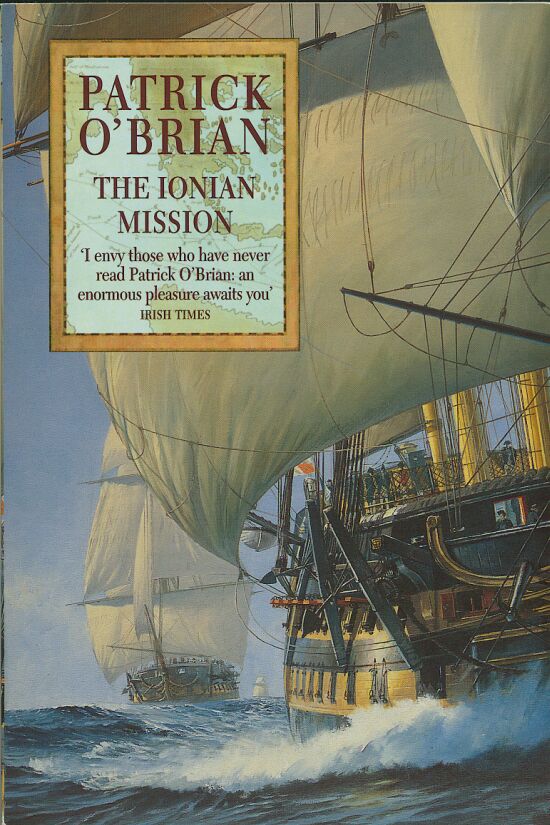
Meanwhile, back at the war.  Also, back to my summaries...four months it has been since my last Aubrey/Maturin post (usual SPOILER alert).  After the far-flung adventures of Desolation Island and The Fortune of War, and the espionage/love story of The Surgeon's Mate, with The Ionian Mission we are reminded that Boney has not yet been defeated.  We are also reminded that war is not all chases, plots, and heroism:  There is drudgery, there is the boredom that is often part of duty.  Maturin and Aubrey have to get back to work.

Fortunately, not only does O'Brian make the repetitiveness of life in an ongoing blockade entertaining, he also breaks the repetition.  Our last book took us north to the Baltic.  This time the Mediterranean that started the show is explored in the Ionian Islands of Greece, where Turkish beys--politicians and pirates--squabble amongst themselves and attempt win the favor, or at least the play the allegiance, of Britain.  Once again the sly methods of the Doctor and the martial skills of Lucky Jack must come together for the mission to succeed.

I am not even half way through O'Brian's series.  At some point we know Boney must lose.  Yet O'Brian's naval universe stands both interesting in its own right and always expanding into new territories.  With Lesbians and red-bearded corsairs now in the mix, who am I to complain?

"Everard Barge Passing HMS Worcester at Greenhithe" by Anthony Blackman

(1) Dr. Stephen Maturin and his new wife, Diana, live in an odd but effective marriage arrangement.  Maturin, ever surrounded by the trappings of medicine and the secrecy demanded by his role as spy, lives at the inn The Grapes.  Diana, with her intense social life, lives in a modern house in Half Moon Street.  Yet they are perpetually visiting each other and are happier than ever.  Maturin is preparing to join his particular friend, Capt. Jack Aubrey, who has taken an unenviable command, the 74-gun Worcester, which will take part in the never-ending blockade of Toulon.  In fact, Maturin is also preparing for a another assignment.  Diana and Maturin have a farewell dinner party, joined by the charming Jagiello, who then takes Maturin south to Portsmouth in his coach.  After an accident, Maturin barely makes the departure in time; Aubrey has to ignore the signal to get underway and almost misses the tide.  The frowns that greet Maturin’s arrival are turned that evening at dinner, but the officers are far from happy.  They have been assigned to an infamously poorly made vessel—a “coffin ship”—and to the monotony of the blockade.

Sunday, March 18, 2012

Aubrey-Maturin in Brief 7: The Surgeon's Mate

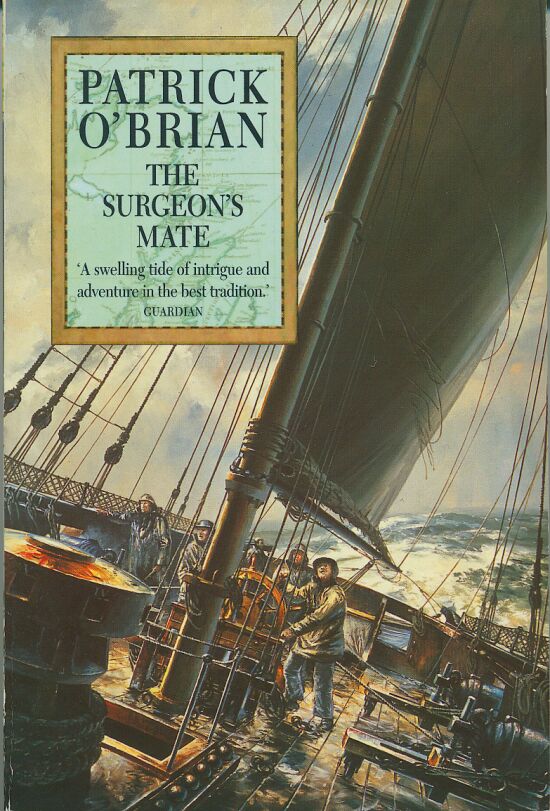
Which it describes what Diana Villiers must tolerate to be with Dr. Stephen Maturin (SPOILERS):
  • Put up with unmitigated, educated obstinacy.
  • Accept that you will not always know everything about him.
  • Balance his awkwardness with your poise and radiance at academic events.
  • Be prepared that he will disappear on dangerous, secret missions with no real expectation of return.
  • Understand that as long as he is on assignment with Capt. Jack Aubrey, there is always the possibility that he may wreck on a lee shore.
  • Expect that you may lose things very valuable to yourself to help him.
  • Know that he may end up imprisoned, even tortured, and that his only possibility of escape may be by making a deal with a dangerous agent.
  • Love him, in spite of it all.
Not that Maturin has it easy dealing with his equally stubborn mate.  Not that Maturin is alone having woman troubles.  Yet The Surgeon's Mate is, even through sea battles, tense diplomatic negotiations, and close calls with French interrogation, above all a love tale, if only as it could be written by Patrick O'Brian.  We pick up where we left off at the end of The Fortune of War...

"H.M.S. Shannon Leading Her Prize the American Frigate Chesapeake into Halifax Harbour" by John Christian Schetky

(1) The battered Shannon brings the battered Chesapeake into Halifax, Nova Scotia.  Grave feelings among the crew quickly give way to cheer as they are given a heroes' welcome.  The curious trio of Capt. Jack Aubrey, Dr. Stephen Maturin, and Diana Villiers goes ashore.  Aubrey longs for news of home but instead finds that two of his foes, Harte and Wray, have achieved further power in the Admiralty.  Maturin delivers the coup of Johnson's papers to Major Beck, the Marine in charge of intelligence.  He acquires a certificate of local liberty for Villiers, who is otherwise viewed as a renegade British citizen.  Although they are barely able to find a bed in the crowded town, Maturin finally gets sleep.  Villiers is happy as she prepares for a celebratory ball, but she once more rebuffs Maturin's insistence on getting married.

"HMS Asia docked in Halifax Harbour, 1797" by George Gustavus Lennock


Saturday, February 18, 2012

Aubrey-Maturin in Brief 6: The Fortune of War

The Fortune of War:  Aubrey and Maturin in America.  We are NOT the good guys.  (SPOILER ALERT now.)  Back in Desolation Island, the Cheseapake-Leopard Affair of 1807 had already created tension between the U.S. and Britain and created trouble for Aubrey and crew even as far away as the southern oceans.  Not long into The Fortune of War, the War of 1812 begins.  As usual, O'Brian puts our fictional heroes into real historical situations, starting with the defeat of the Java by the United States' most famous tall ship, USS Constitution.  For most the book, Aubrey and Maturin are prisoners of war in Boston.  At the same time, the U.S. Navy is shaming the supposedly invincible British with a string of victories at sea.  It is not just the poor "fortune" of the protagonists, however, that puts the U.S. in a bad light.  O'Brian creates an unflattering portrait of our early national character.  Americans are slavers.  There is a fabulous moment when a Huron tells the Irish Maturin, "We are, after all, both defeated."  Northerners are money grubbers, Southerners are crude, and everyone is spitting tobacco.  Most importantly, Americans are power-hungry, ready to stab you in the back...most ungentlemanly.

There is, in fact, a lot of sneaking and stabbing.  The sixth book is more of a spy novel than a military novel.  Although it begins and ends with grand ship battles, most of the plot unfolds in the streets and halls of Boston.  Both Aubrey and Maturin are cornered, the former trapped in, all of all places, an asylum, and the later on the run from French agents and a villainous American who is also the man who stole way Maturin's beloved Diana Villiers.  O'Brian does a pretty respectable job walking the path of Fleming and Ludlum.  If this was a Bond, it would be On Her Majesty's Secret Service, in which the spy does not have the upper hand, and the love is potentially fatal.  Which also happens to be my favorite Bond.

After half a a dozen Aubrey-Maturin books, I am really impressed on how O'Brian can stay true to genre but create whole new settings for each book.  The Fortune of War is a direct continuation of the story arc started in Desolation Island.  It is also follows the unfolding of history.  Best of all, it deepens the characters of the Captain and the Doctor.  Bravo...again.

17th century map of the Spice Islands

(1) HMS Leopard, after its near destruction in the south Indian Ocean, limps into Pulo Batang in the Malay Archipelago.   Capt. Jack Aubrey recounts the adventure to Drury, the Port Admiral.  Horrible old Leopard is doomed to transport duty.  Aubrey and his friend Dr. Stephen Maturin are given orders to sail home aboard the La Fléche, due from Bombay.  Aubrey stands up for his officers and midshipmen, insisting they be sent back to Britain as well.  Maturin meets with Wallis, the Admiral's political advisor, and learns that his friend Sir Joseph is, thankfully, back in charge of British intelligence.  Furthermore, the poisoned dispatches Maturin had planted with the American spy, Louisa Wogan, have in fact reached their destinations and made tremendous confusion in the French services.  Maturin must make haste back to Catalonia and renew his activities.  Meanwhile, the English disruption of American trade and their abduction of American seamen have driven the two countries to almost inevitable war.  Aubrey learns that once home he is to be given command of the heavy, 40-gun Acasta.  As the Leopards wait for La Fléche, they engage in a game of cricket with the local men.  Maturin's experience in Irish hurling makes for an interesting contest.

Friday, February 17, 2012

Antipode: the real (or relative) far side of the world

An antipode is the place on the globe exactly opposite where you are.  In other words, if you ran a line directly from Point A through the center of the Earth and out the other side to Pt B, A and B are antipodes of each other.

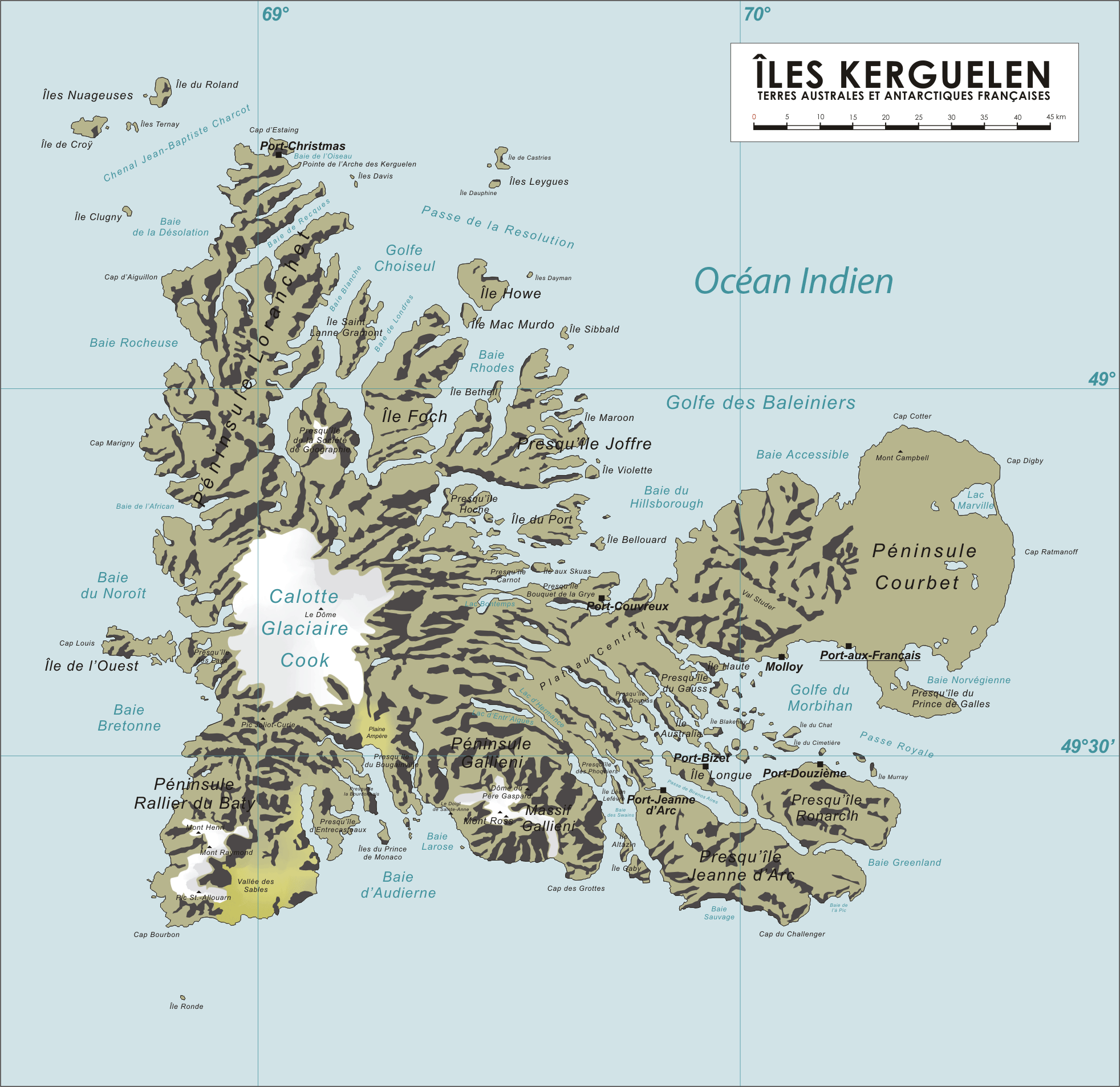
I got curious the other day and wondered, what is the opposite side of the world from Seattle?  I discovered a cool if simple Web site that does just that for you:  antipodemap.com.  By cool coincidence, the major landmass closest to Seattle's antipode is Grande Terre, the main island of the Kerguelens.  For you O'Brian nerds, this is otherwise known as Desolation Island!

I thought it was cool...

Friday, January 20, 2012

Aubrey-Maturin in Brief 5: Desolation Island

Maybe it was the snow and ice that have still not completely loosened their grip on Seattle which made a voyage to an icy rock in the far southern ocean resonate.  Maybe it was the fact that this weather has kept me indoors since Wednesday, which gave me lots of time to read.  Or maybe it was the fact that Desolation Island was just that good.  SPOILERS, beware.

I devoured this one.  Two things made the fifth book especially good for me, which conveniently fall, again, between the sea of Aubrey and the intelligence of Maturin.  Like I said before, the problem with The Mauritius Command was that its was sort of a game of Naval chess:  Néréide moves to intercept Bellone, Boadecia moves to intercept Astreé, and so on.  That's enjoyable...for a while.  Desolation Island, however, is more strictly a sailing adventure, Aubrey and his crew alone on the ocean overcoming perpetual challenges.  And there are lots of problems to be overcome:  storms, disease, a Dutch ship-of-the-line, and finally a collision with Antarctic ice that nearly sinks Aubrey's ship.  It was very refreshing to me for O'Brian to have the action based on the toils of the trip rather than the moves of opposing fleets.  But then, I'm in it for the sailing more than for the war.

Maturin meanwhile, is busy with his own mental games.  He competes with a new character, a beautiful American spy named Wogan.  He competes with numerous medical challenges, not the least of which is an epidemic that nearly wipes out the crew.  And he competes with himself:  his pining for the impossible Villiers, his laudanum addiction.  Since the voyage takes Maturin from the warm Cape Verdes to the freezing Kerguelens--originally called "Desolation Islands" by no less than Captain James Cook--there is plenty to keep the naturalist Maturin, and us, occupied.

It is too broad to say that Aubrey is the brawn and Maturin is the brains.  Yet there is something to be said of the balance that O'Brian obtains in Desolation Island between the life-and-death events of HMS Leopard and the cunning espionage (and self-flagellation) of its physician.  Between the two, Book Five is simply a rollicking good yarn.

"Thatched Cottage, Ringwood, Hampshire" by T. Noelsmith

(1) Captain Aubrey and his family are living in fair comfort at Ashgrove Cottage, the wealth of his success from the Mauritius campaign allowing them to improve their home.  Stephen Maturin comes to observe the physicians attending to the elder Mrs. Williams.  Aubrey excitedly tells his friend about his next command, the two-deck, fourth-rate Leopard, recently rebuilt and not the horrible boat of old reputation.  His task is to sail to New South Wales and look into the situation of Governor Bligh, once Captain of the famously mutinous Bounty.  Aubrey then reveals to Maturin the scheme he has entered into with a man named Kimber, who has promised to turn the dross of an old Roman mine on Aubrey’s property into profitable silver.  In spite of his compatriot’s spirits, Maturin is low:  He has lost a patient, he has lost a folder of confidential papers, and he is pining for Diana Villiers.  The two ride to Portsmouth, and Maturin watches as Aubrey gambles at cards.  Returning to Ashgrove by starlight, Aubrey tells Maturin that the Leopard will be crewed by old friends, including Pullings and Babbington.  Later in the week, they meet with Pullings and Captain Heywood, who was a Midshipman on the Bounty during the mutiny, but his reminiscences offer little information about Bligh.  Although he is drawn to join Aubrey on his voyage, Maturin’s duty to British intelligence forces him to decline.

Friday, January 13, 2012

Aubrey-Maturin in Brief 4: The Mauritius Command

Part four of my summaries.  The Mauritius Command brings O'Brian's series to a grander naval scale and our co-protagonist Aubrey to new levels of rank and responsibility.  In the three preceding books, Aubrey took his first command, fought hard to gain the status of post captain, and gained his most famous ship and sailed it to India.  Now he is saved from his disappointing domestic life by his friend Maturin and given not just a ship but a squadron.  The large action--whole fleets in motion, islands invaded--is matched by large characters.  Aubrey's chief nemesis is, in fact, not the French Admiral he has been sent to defeat but a captain under his own command:  Lord Clonfert strives for, above all else, status and recognition, and he is driven to beat his old shipmate Aubrey.  Clonfert is also at odds with Captain Corbett, who has a reputation for disciplinary cruelty and is not exactly well loved by his crew.  In short, while Aubrey must manage a campaign to control the south Indian Ocean he must also manage the officers who make up that campaign.  He finds this to be much more of a burden than he expected.

The heart of the series remains Dr. Maturin.  His observations, especially of Aubrey and Clonfert, give emotional depth to a book that might otherwise be little more than Navy reports.  He does not, unfortunately, have much time for natural history, because the mission to control Mauritius and its neighboring islands requires as much political maneuvering as military maneuvering.  Maturin's abilities as spy and, now, of negotiator and propagandist, make him critical to the campaign.  As a character, Maturin brings to the novel both humanity and complexity.  It kinda needs it; without Maturin, the book would be all militial tension.

O'Brian brings this all together with a huge amount of historical accuracy, or at least historical inspiration.  Aubrey's earlier exploits were based on the real Thomas Cochrane.  In The Mauritius Command, Aubrey is taking the role of the real of Josias Rowley.  Names of officers, names of ships, and the unfolding of events are all drawn directly from records, climaxing with a telling of the disastrous Battle of Grand Port.  This level of detail also made this book the hardest to summarize so far.  In other words, SPOILER ALERT of the strongest order.

"Portsmouth" by Joseph Mallord William Turner

(1) Captain Jack Aubrey is living with no assignment and on half pay in a small, drafty home called Ashgrove Cottage with his wife Sophie, his daughter Cecilia, twin baby girls, and the always aggressively dominant—and now bereft—Mrs. Williams, his mother-in-law.  It is not the domestic bliss he had always hoped for.  Even as he tries to learn of gardens, livestock, and servants, he spends his time looking out to the fleet of Portsmouth through a telescope in a small observatory, both made by his own hand.  He is ecstatic to be visited by his old friend, Dr. Stephen Maturin.  Over dinner at the nearby Crown, Aubrey admits to Maturin that, however much he may love Sophie, he had the wrong idea of marriage.  The next day, Sophie begs Maturin to get her husband a command.  Maturin secretly reveals to Aubrey that four French ships under Admiral Hamelin, the new heavy frigates Vénus, Manche, Bellone, and Caroline, are making mischief around Mauritius.  Aubrey’s friend has also pulled strings for Aubrey to replace the ailing Captain Loveless aboard the frigate Boadicea, lead a squadron against the French, and install a British governor.  Aubrey can barely contain his excitement at having not only a command but also a Commodore’s broad pennant.  He listens to Maturin’s initial briefing until a Marine arrives with official orders.  Lady Clonfert, the wife of Lord Clonfert—soon to be one of Aubrey’s captains—arrives, having already heard of the mission by rumor, and asks to be transported to the Cape of Good Hope and her husband.  Aubrey, however, is in a happy rush to get to his ship.

Sunday, December 18, 2011

Aubrey-Maturin in Brief 3: H.M.S. Surprise

Welcome back to another SPOILER-laced installment of Aubrey-Maturin In Brief.  Pauline has already taken the pennant, having given her interpretation of Book 3 in celebration of O'Brian's birthday.  OK:  game on.  I am with Pauline in considering H.M.S. Surprise my favorite, thus far, of the series.  Why?  This novel takes our heroes on an excursion way, way beyond the Mediterranean and the English Channel, from the "vampires" of South America to the tigers of India and the breadth of the British Empire, with all its faults.  The first book introduced the world, the second put it in social context, but this one is adventure...and romanticism. 

Romanticism was an ideal, a reaction to the industrial rationality that threatened to conquer the early nineteenth century that Aubrey and Maturin lived in.  (An aside:  Remember how pale ale and then Bavarian lager pushed aside all competition and whitewashed beer?  That's the aggressive rationality I'm talking about.)   It was an ideal not without its ironic complexities, and these are personified in our complementary yet opposing duo and the women they pursue.  Both Aubrey and Maturin are romantic loners but in different ways and for different reasons.  Jack is a loner against his will, defined by a nationalistic (or at least professional) sense of duty, a piratical flair, and the love of the freedom of the sea that always sets the sailor apart.  He has grown to command a fleet, if by accident; his defense of the China fleet is based on the real Battle of Pulo Aura and Admiral Linois and is also a buildup to Book 4, The Mauritius Command.  His desire, however, is to settle down to what he sees as the traditional bliss of marriage and the very English domestic image of Sophie.  Maturin, somehow surviving every scrape, from torture to white squall to bullet wound, loves the largeness the world--natural wonders from South America to the Subcontinent and the cultural complexity of Bombay.  Yet he is a loner by nature, torn between the rationality of his beloved science and his deep pathos and longing.  His female ideal is the fiery and perhaps fallen Diana.  His fate in love is not, shall way say, fortunate.

The tone of H.M.S. Surprise is so very romantic.  Every instance of action and heroism is colored with melancholy.  We have seen the world and returned home with feelings of hope but also anxiety, innocence gone but dreams maintained.  It is a novel of grand geographical and emotional sweep.  Another aside:  Romanticism defined, and defines still, an approach to music, and, given the importance of music to our protagonists, the imaginary score to the hypothetical movie starts to take shape in my brain.  Maybe this is The Empire Strikes Back; damn, that was a bad pun.  Let's just set set sail for the long journey, the exotic shores, and the convolutions of the heart...

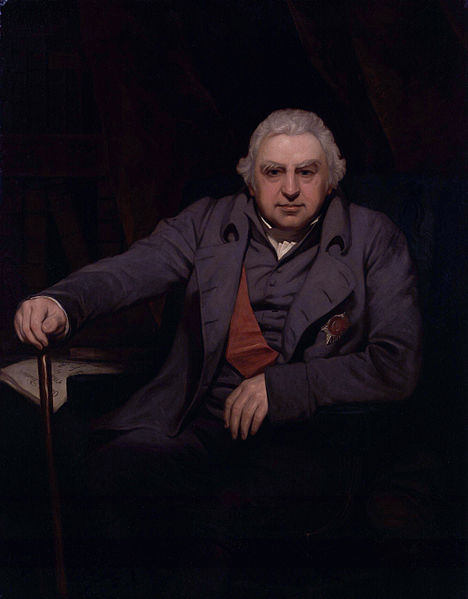
Sir Joseph Banks, historical inspiration to Sir Joseph Blaine
(1) The Admiralty debates the prize money that may be rewarded to the captains of the recent engagement of the Spanish treasure fleet.  Sir Joseph Blaine, ally to Stephen Maturin, argues in favor of a full reward, but between the inexperienced new First Lord and the ever vengeful Harte, Sir Joseph’s entreaties fall on deaf ears.  While the gold is granted to the Crown, a slip reveals Maturin’s role as an intelligence officer.  Maturin, meanwhile, is at Mapes with Sophie; she is considering Jack Aubrey, and Maturin is considering—and tracking—Diana, who is now in India with Canning of the East India Company.  Inevitably, Mrs. Williams interrupts, holding Aubrey’s debt against her daughter’s marriage to the Captain.  Maturin goes to a meeting of the Entomological Society, but his appearance distracts the guilty Sir Joseph. They meet at a secret location, and Sir Joseph reveals to Maturin not only that the captains’ prize money has been withheld but also that Maturin is the victim of an indiscretion.  Nevertheless, Maturin goes ahead with a planned mission and a rendezvous with Aubrey at Minorca, which is now in Spanish hands.

Tuesday, November 29, 2011

Aubrey-Maturin in Brief 2: Post Captain

Second installment:  Post Captain.  This is often considered O'Brian's tribute to Jane Austen.  It is there:  the romance, the class politics.  The lusty Aubrey combats his own swashbuckling ways for the utterly dedicated Sophie, while the mother disapproves on socioeconomic bases.  Maturin falls for Diana, someone as intellectual, tempestuous, and essentially unattainable as himself.  This is played against a backdrop of fox hunts, balls, and (yes) Naval action.

SPOILER ALERT again.

For Aubrey, this is a tale in which for the most part everything goes wrong. His career is thrown into jeopardy by peace. He and Maturin are in France when Napoleon declares war again; he barely escapes with his life. He finds his prize money has been bamboozled, and he is on the run from the law. He is given command of ship with a deservedly bad reputation and has to endure further abuse from Harte, his jealous oppressor from the first book. He even finds himself at almost deadly odds with Maturin.


For me, the most interesting aspect is that this is really Maturin's story.  Although the book is still largely in the third person, there are several insertions of Maturin's own diary, showing his philosophy and doubt.  His laudanum-fueled contemplation of love and life--via Aubrey, via Diana, via Sophie, and via himself--form the mood and the core of the book.  As his role as an intelligence officer of the Crown also is revealed, Maturin emerges as a dark and complicated character, a loner at war with himself for whom science--and his friendship with Aubrey--are an escape from his personal demons.  

I always read books as potential movies (yes, I'm weird).  The first book, Master and Commander, is Star Wars:  a self-contained plot that is also the introduction to a grand universe.   Post Captain would be an interesting novel to adapt into a film, something perhaps with the foreboding mood of Barry Lyndon, picturesque and less concerned with action than the struggle with one's own feelings.  This is not, however, The Empire Strikes Back.  It does not end as a cliffhanger.  It is also still an O'Brian novel.  There's plenty nautical, and it ends with a big battle.  Yet the adventure here, whether love's labors or the consequences of war, is internal...
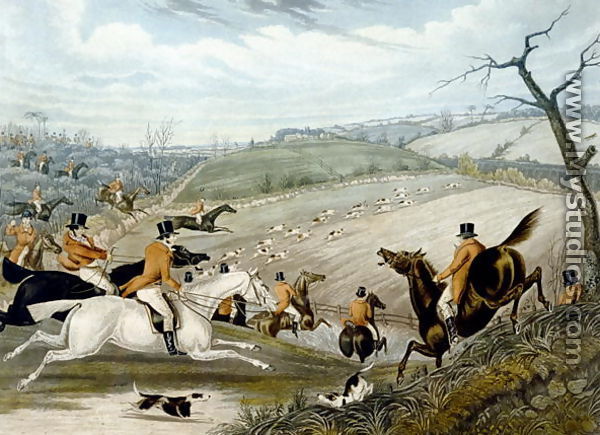
"The Start of the Hunt" by Heywood Hardy

(1) 1802.  Aubrey and Maturin are passengers aboard the frigate Charwell.  They are overtaken by a French ship, but as they are about to engage them in battle they learn that peace has been declared.  This is not good news for a naval man.  Aubrey and Maturin agree to rent a country residence together, Melbury Lodge.  In the Downs, they take up their new lifestyle and join a fox hunt.  Maturin meets a woman, Diana Villiers…and Aubrey falls off his horse.  At nearby Mapes Court, a Mrs. Williams lives with her two daughters, Sophia and Cecilia, and Diana.  The women learn about Maturin and Aubrey when Admiral Haddock visits.


Monday, November 28, 2011

Aubrey-Maturin in Brief 1: Master and Commander

Here, my friends, is the first installment of "Aubrey-Maturin in Brief."  This is yet another in Lou's series of "I Write About It So I Can Think About It, Then I'll Share It" posts.  In short, as I started rereading O'Brian's books from the beginning, I kept notes as I went.  These notes, by no original design, led to a chapter-by-chapter condensation of the plot.  For those of you who have not read O'Brian, these may serve to get you interested, although out of completeness I will warn that there ARE SPOILERS.  For those of who who have read O'Brian, I hope you may find these either a nice trip through pleasant memories or a tool for keeping track of the Captain and the Doctor.

The first book, like in any first in a series, originally stood alone but can now be seen as an introduction.  First and foremost, we are introduced to the protagonists, who I will brazenly describe as the Kirk and Spock of the British Navy.  Maturin himself describes Jack Aubrey as a "pirate:"  lusty, impetuous, driven.  Dr. Stephen Maturin is both passionate and scientific, a man of knowledge and of mystery.  These two are both complementary and polar.  Aubrey represents war and discipline, while Maturin represents both humanitarianism and naturalismism.  The relationship is that of two sparring compatriots that always end up back on good terms.  In essence, they personify Britain itself at the time:  Politics and combat, the tension between progress and tradition, will still be ironed out by gentlemanly code.

We are also introduced, very carefully and methodically, to the British Navy and life at sea.  This is done in four ways.  The first is via Aubrey, with whom we are thrown straight into Naval life as he assumes his first (titular) command.  The second is via Maturin, whose ignorance of the ways of the sailor and of nautical terminology serves as both a means for the author to educate the reader and an ongoing source of humor.  This relates to the third means, as Maturin is as frequently taught by Aubrey as he is by a recurring set of characters such as Pullings and Mowett, both of whom among others are introduced in this book.  The fourth and most dramatic means is by O'Brian's detailed descriptions of Naval tactics and combat.  There are many actions in this first book, leading to the climactic battle with the Cacafuego.  O'Brian ends the book very wisely by putting it all into larger context with the Battle of Algeciras Bay, a battle involving some 18 ships near Gibraltar.

Master and Commander, however, can stand on its own and is more than just a first chapter in the Aubrey-Maturin epic.  There are two marvelous subplots that both serve both an introductory function and make this a distinct book in the series.  The first is Aubrey's increasingly public affair with the wife of the Commandant of Port Mahon.  The second is the tense relationship between Maturin and Lieutenant Dillon, who knew each other as part of the Irish Rebellion  of 1798 but now both serve the Empire.  But enough premable.  This is the book that will hook you on O'Brian (or not).  It happened like this...

"Third-Rate Entering Port Mahon," from the National Maritime Museum in Greenwich

(1) 1800, The Napoleonic Wars, the British port of Mahon on Minorca.  Jack Aubrey, a Lieutenant in the Navy, attends a concert at the Governor’s House.  There he encounters Stephen Maturin, who nudges him for keeping time to the music, a gesture Aubrey considers an offense.  When the music is over, they issue a full challenge to each other.  Fortunately, Aubrey, who has been without an assignment for some time, receives orders to become master and commander of the brig HMS Sophie.  His spirits raised by receiving his epaulette, he meets Maturin under more peaceful terms, and their love of music forms the beginning of a strong bond.  Aubrey then meets with Captain Harte, commandant of Mahon, with whom he has a bitter relationship, especially since Aubrey is having an affair with Harte’s wife, Molly.  Unable to get any assistance for his new ship directly from Capt. Harte, Aubrey turns to Mrs. Harte, who uses her influence to Aubrey’s benefit.  Aubrey begins to gather his officers and assumes command of the Sophie.