Showing posts with label Port Royal. Show all posts

Sunday, September 16, 2012

Considering Exquemelin and the Buccaneers

Dear readers!  No, I was not trapped in the Locker.  I, was, however, trapped in something just about as bad, namely Overlake Hospital.  About a month ago, I was at work and started getting progressively worse pain in my abdomen and lower back.  One trip to Urgent Care, and I was diagnosed with diverticulitis--essentially, something got stuck in my colon and decided to go outwards, creating a sort of inflamed, infected internal hernia.  Two days later and several antibiotic pills later, I was worse not better, went back to Urgent Care, and was given a hospital room about midnight.  For the next week, I was in a bed, tethered to an IV, poked and bled and woken at all hours, and somewhere between a Dilaudid-induced haze and extreme discomfort.  At least I had Zanne.  Then I was released and spent a while on the sofa eating bland food and dealing with Short-Term Disability.  I am better, and I have a new understanding (respect, Pauline) of medical incarceration.  This blog was started before all of the calamity.  I am happy to get back to happier topics...and a classic.

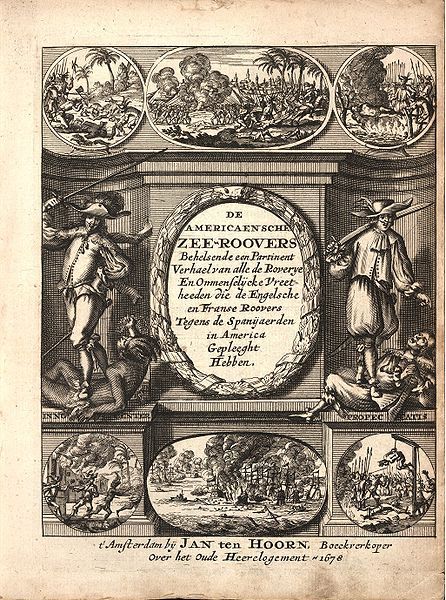
The 1678 original

Most pirate fans know that the go-to book for the buccaneer era is Alexander Exquemelin’s The Buccaneers of America, originally published in Dutch as De Americaensche Zee-Roovers in 1678.  Typical of historical accounts this old, the history of the book and its author are complicated and full of questions.  Is it Exquemelin, Esquemeling, Exquemeling, or Oexmelin?  That Exquemelin was a real person can safely be assumed, and his accounts can be verified by other sources, but who he was is total conjecture.  It seems likely, based on the available evidence, that he was from Harfleur and that he was a Huguenot, his religion driving him from France and to indenture himself to the French West India Company and sail to the Caribbean.  Regardless of holes in his biography, it’s clear that Exquemelin is the real deal:  Exquemelin landed in Tortuga in 1666, and three years later, once free, he joined the buccaneers.   He sailed with, most notably, none other than the most famous buccaneer of all, Henry Morgan, probably as barber surgeon.  Later, in Amsterdam, at about the same time he was writing the book, he qualified professionally as a surgeon; does that make Exquemelin the pirate Maturin?

The modern Dover edition

I have used Exquemelin as a reference book but until recently had never just sat down and read it all the way through.  I thus want to consider The Buccaneers of America as a whole, not as a collection of the tales of Morgan, Rock Brasiliano, etc.  Through a combination of detailed historical account, amateur ethnology, and natural history, Exquemelin portrays a wild place populated by brutal men.  The author's own style is direct, but to me it is unclear whether it is detached or, in fact, unsympathetic.  Exquemelin and his buccaneers are not romantic, tho' they are colorful.  Most importantly, these earliest pirates of the Caribbean are bloody players on a colonial frontier in which men regularly killed each other for religion, country, gold, and simply to survive.

Monday, May 23, 2011

"Wicked Pirate City"--or, what's wrong with the National Geographic Channel

Fictionalized Cap'n Morgan and his fictionalized buccaneers

I was pretty jazzed when I found out that the National Geographic Channel had a new documentary coming on about the underwater ruins of Port Royal.  For those unfamiliar with this major piece of Caribbean and pirate history, here are the basics.  Port Royal was England's toehold in the Caribbean during the era of the "Spanish Main."  The English captured the town from the Spanish in 1655, and for the next few decades Port Royal was the center of both (illicit) English commerce and English-led buccaneering.  Legends like Henry Morgan not only sailed from Port Royal to attack Spanish ships and towns but also brought the booty back to spend on rum and women.  At its height, over 6,000 people called Port Royal "home."  The problem with pirate (or privateer?) paradise was that it was built on little more than a sand spit on the outside of Montego Bay.  In 1692, when a major earthquake struck Jamaica, the ground under Port Royal essentially liquefied, and within minutes two thirds of the town had slid into the ocean and most of the remainder was flooded by the ensuing tsunami.  Many of those that were not killed immediately were soon dead from injury or disease.  The English shifted their city to Kingston on the other side of the bay.  The buccaneer era passed as Royal support waned, and piracy shifted to the Bahamas.  The famous Cap'n Morgan had died four years before the earthquake, killed by edema, tuberculosis, and/or the rum.  His grave sank into the sea along with the town he had helped make famous.