Yesterday, as I was at work, I was keeping an hour-by-hour log of the weather here in Seattle and waiting for the year's big snowstorm. The situation was especially critical as I needed the storm to wait until I picked up my mother in law ("G'Ma") and my daughter from the airport. That worked out fine. As I finally went to bed at midnight, there really seemed to be no visual signs of the forecasted 8 to 14 inches. Lo and behold, only about five hours later, there it was: white landscape, big flakes falling, and a phenomenal silence. Our little car was buried, and the roads had not been cleared at all. My employer's emergency line said all locations were open, but I stood no chance of getting out of the neighborhood. I called my manager and went back to bed. So here I am on a snow day in my
Star Wars pajama bottoms, Admiral Benbow shirt, and Huskies hoodie, listening to Spanish guitar, drinking a Black Butte Porter from the 'deck cooler,' and writing about an unexpected pleasure, a book G'Ma had given me over the holidays.
Captain Alatriste is the first of what is currently half a dozen books about the eponymous protagonist by Arturo Pérez-Reverte. The time is the seventeenth century. The place is Madrid. Our antihero is a veteran soldier of the Catholic-Protestant conflicts who is reduced to hiring out his blade to anyone not willing enough to fight his own battles. In this book, the "Captain" (he is, in fact, only a sergeant) finds himself in over his head with a job that entangles him in intrigue involving the Court, the Inquisition, and the fate of Spain itself.
It's all in a sort of
Three Musketeers mode, and the author evens allows some of his plot to dovetail with the later events described by Dumas. There is more to
Captain Alatriste, however, than swords, pistols, and clandestine rendezvouses. The main character is Spain. Pérez-Reverte spends a lot of time on the arts of old Madrid: poetry, painting, drama. It is a paean (I love that word) but also a lament. The author describes a world of rich culture and creativity but also of rampant corruption, abysmal poverty, and tacitly accepted violence. This is where I, the pirate historian, gets especially tickled. This is the Spain in which the Hapsburg monarchy and its perpetual religious wars are barely propped up by the gold of the distant New World, when the Sea Dogs have recently defeated the Armada and are pecking at the Treasure Fleets. It is the Spain of a grandeur that is in fact rotting both at the royal core and at the peasant surface. This is personified in the titular protagonist, a fatalist who at once fights for Spain, has been discarded by Spain, and bemoans what Spain has become. The book is thus a sort of baroque
noir. The fate of the powerful yet powerless Captain is always hanging; there is no question that he will meet his downfall, it is only a question of when.
Captain Alatriste thus captures--and puts into historical context--the pathos that is the soul of Spain.
It begged for cinematic interpretation...and, by George, it was done in 2006.
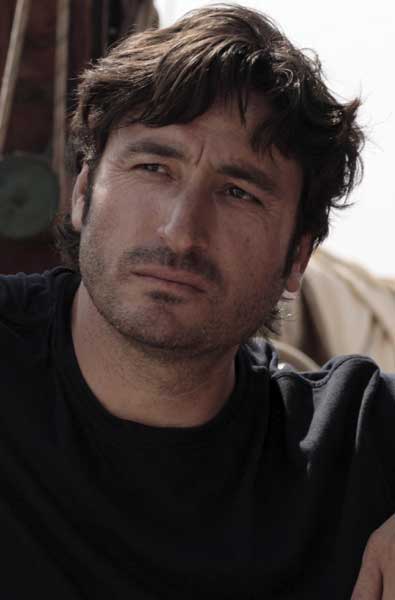
Alatriste is one of the largest, most expensive movies ever made in Spain. The Captain is portrayed by the only non-Spaniard in the main cast, Viggo Mortensen, who by Aragorn alone has proven he's very good at acting and swinging a sword at the same time. The trouble is that the film still doesn't have a U.S. distributor. Yet--ha ha!--by, means only known to the Brethren of the Code (I made that up...you get it, right?), I currently have a PAL copy, in Spanish with English subtitles (which is as it should be), on my hard drive that the Apple DVD Player has no trouble showing. So over this past weekend, after first finishing the book, I settled in with my rum, my new flintlock replica, and my laptop. It is a beautiful movie, and it definitely keeps the tone I have just described. Mortensen plays the antihero well. The fight scenes are on par with the Musketeers but with the tired, practical viciousness that makes the Alatriste universe unique. My only problem with the movie is that it basically takes
all of the Alatriste books in existence when it was made and smashes them into a single storyline. The first book is out of the way within maybe half an hour. It is thus crowded and rushed, which works against the languid feel of the novel and, for that matter, the Spain it portrays. Did they think they couldn't make sequels? Or perhaps it's just the rule of thumb that a movie can never hold up against the book that inspired it?
I will, nevertheless, heartily recommend both Captain Alatriste and its adaptation. I'm ready for more, and especially since the latest in Pérez-Reverte's series is
Pirates of the Levant, which finds Alatriste a mercenary aboard a galleon in the Mediterranean. That will have to wait, but in the mean time G'Ma has today handed me Pérez-Reverte's
The Nautical Chart, which is neither an Alatriste novel nor a purely period piece but instead combines
three of my favorite flavors: history, pirates, and underwater archaeology. This, too, will wait, as I'm half way through O'Brian's
Desolation Island. What can I say? It's a very wintry winter here in Washington State right now, and, unless I want to imagine myself as Shackleton, it is not time for sailing. If you're looking for another good book while its time to snuggle up indoors, try
Alatriste.
Please note that this blog post has no links, in deference to Wikipedia, Google, and others that are protesting SOPA and PIPA and the risks they pose to the Internet and freedom of speech. Consider this my little pistol shot: Imagine
not being able to find the information on the WWW we have come to assume and rely upon. In the words of Captain Jack Sparrow, "We must fight...to run away!" Click
HERE to learn more, and to join in.