 |
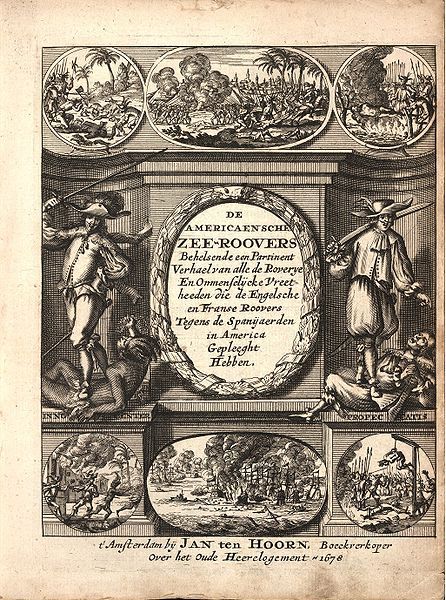
| The 1678 original |
Most pirate fans know that the go-to book for the buccaneer era is Alexander Exquemelin’s The Buccaneers of America, originally published in Dutch as De Americaensche Zee-Roovers in 1678. Typical of historical accounts this old, the history of the book and its author are complicated and full of questions. Is it Exquemelin, Esquemeling, Exquemeling, or Oexmelin? That Exquemelin was a real person can safely be assumed, and his accounts can be verified by other sources, but who he was is total conjecture. It seems likely, based on the available evidence, that he was from Harfleur and that he was a Huguenot, his religion driving him from France and to indenture himself to the French West India Company and sail to the Caribbean. Regardless of holes in his biography, it’s clear that Exquemelin is the real deal: Exquemelin landed in Tortuga in 1666, and three years later, once free, he joined the buccaneers. He sailed with, most notably, none other than the most famous buccaneer of all, Henry Morgan, probably as barber surgeon. Later, in Amsterdam, at about the same time he was writing the book, he qualified professionally as a surgeon; does that make Exquemelin the pirate Maturin?
 |
| The modern Dover edition |
I have used Exquemelin as a reference book but until recently had never just sat down and read it all the way through. I thus want to consider The Buccaneers of America as a whole, not as a collection of the tales of Morgan, Rock Brasiliano, etc. Through a combination of detailed historical account, amateur ethnology, and natural history, Exquemelin portrays a wild place populated by brutal men. The author's own style is direct, but to me it is unclear whether it is detached or, in fact, unsympathetic. Exquemelin and his buccaneers are not romantic, tho' they are colorful. Most importantly, these earliest pirates of the Caribbean are bloody players on a colonial frontier in which men regularly killed each other for religion, country, gold, and simply to survive.

