Showing posts with label HMS Surprise. Show all posts

Saturday, December 8, 2012

The Tenuous Lives of Tall Ships: A Reminder

heartbreaking

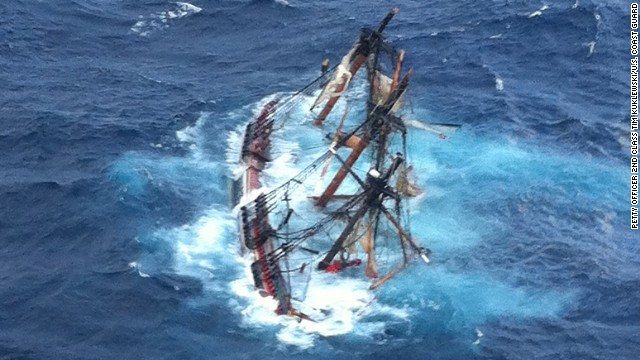
In the recent Weather Channel special on the rescue of fourteen of the sixteen crew of the HMS Bounty by the United States Coast Guard, survivor Douglas Faunt said it well:  "A wooden boat is always sinking."

The mariners all know, to borrow a turn from Gordon Lightfoot, that there is no permanency to a ship.  This was simply a given in the age of sail:  The lee shore would come, or simply the timber would give out.  The bottom of of any body of water will bear testament to that water's power over the vessels that pass through it.  Yet today's tall ships--museums, classrooms, and symbols of the bygone--can achieve such a status that their fragility can be overlooked.

Wasn't she lovely:  HMS Bounty and a nice bow wave

The 1960 replica of the legendary HMS Bounty has, outside of the family of sailors and fans, perhaps achieved that unfortunate status of becoming more famous in death than in life, like the Edmund Fitzgerald that Gord immortalized in song.  The aforementioned TV special places equal emphasis on the tragedy of the ship's loss and the heroism of the Coast Guard.  It seemed wise enough for Captain Walbridge, who had commanded the Bounty for seventeen years and through plenty of rough weather, to see riding out Hurricane Sandy at sea as a better alternative to being battered ashore.  Whether it was the 80 knot winds and the 30 foot seas, some special circumstance, or some fateful decision that brought the ship and its commander down may never be known.  What is clear is that the personnel of an HC-130 and two helicopters braved incredible conditions to rescue the equally courageous souls, in gumby suits and fragile rafts, that made it off the Bounty as she took on water, listed, and sank.  USCG rescue swimmers have the most insane job ever, and, really, Daniel Todd deserved a shout out from President Obama.  Yet I cannot help but think that for millennia there were no such saviors.  Is it possible that sailors take for granted that a Jayhawk will swoop out of the sky, drop a swimmer and a basket, and put the sea at bay?

Almost beautiful:  The La Grace aground

And is it also possible that we take today's tall ships for granted, as if their curatorial position makes them more invincible than the thousands of real, working vessels that they strive to maintain the memory of?  Over at the Fo'c'sle, the fate of the the Czech brig La Grace has been followed after she ran aground at Marbella, Spain, in October.  There was no hurricane taking over the national media here, no dramatic rescue.  It took weeks for the La Grace to be pulled free, and it is still unclear whether the damage sustained is too severe for the ship to be restored to her previous splendor.  Only slightly less alarming was the Fo'c'sle's reporting that schooner W.N. Ragland, built in 1913, the private boat of Neil Young for 35 years, and a regular at the CWB's annual festival (and thus I boat I have been aboard) was dismasted during transit from Seattle to San Francisco.

La Grace:  It could happen to anyone

You have to be getting the picture by now.  All beings are mortal.  Boats are mortal.  Wooden boats are even more mortal.  I shudder at the idea that, some day, dear vessels to me, from the little sharpies Betsy D and Colleen Wagner to the grand ships Lady Washington and Surprise, may not exist.  You are the choir being preached to, of course, but recent events MUST REMIND US that we cannot assume that boats we know and love can live and thrive without human care and effort.  Let not the deaths of Robin Walbridge, Claudene Christian, and the ship they adored be not without a lesson worth repeating, a purpose worth giving and even sacrificing for.  Do everything that you can.

Now.

Monday, October 15, 2012

When boats are movie stars

The postmodern tall ship:  The Earl of Pembroke in a poster for the upcoming Cloud Atlas

Outside of genre films, it's not very often that a boat gets to be a movie star.  The Lady Washington, thanks to her role as the Interceptor in the original Pirates of the Caribbean, is now recognizable to fans worldwide and is essentially the modern image of the pirate ship, even tho' not only as brig would she have not been common in the Golden Age Caribbean but also the ship was built as a replica of a late 18th century vessel of the U.S. Navy.  The HMS Rose, after her moment in the spotlight as Lucky Jack's dear ship in Master and Commander:  The Far Side of the World, was even renamed the Surprise and is now educating thousands at the San Diego Maritime Museum on the ways of the old Royal Navy.  Now the barque Earl of Pembroke of Bristol, already a veteran of the Hornblower series among other roles, is hitting the big screen in the new Cloud Atlas.  All of these are, at least in part, historical dramas, and readers of this blog should know these ships well.  But, the other night, the DVR captured a modern film that was all about the boats.  This is especially worth pausing for as one of the vessels is no longer with us.

At sea, no one can hear you scream

Dead Calm came out back in 1989, based on the novel from 1963 and directed by Australia's Philip Noyce.  There are only three human cast members:  the always intense Sam Neill, a young Nicole Kidman (only 22 at the time), and, the sole Yank, Billy Zane (with hair!).  Without giving too much away, as this is a film I would recommend, the premise is that Neill and Kidman are cruising the South Pacific when they are overtaken by the psychopathic Zane.  Other than some set up at the beginning, the film takes place entirely at sea.  It is a psychological thriller, but the tension would be nothing without some realistic nautical elements.  Thus one must give equal billing to the film's two boats.  The identity of these vessels are revealed in Dead Calm's production notes here.

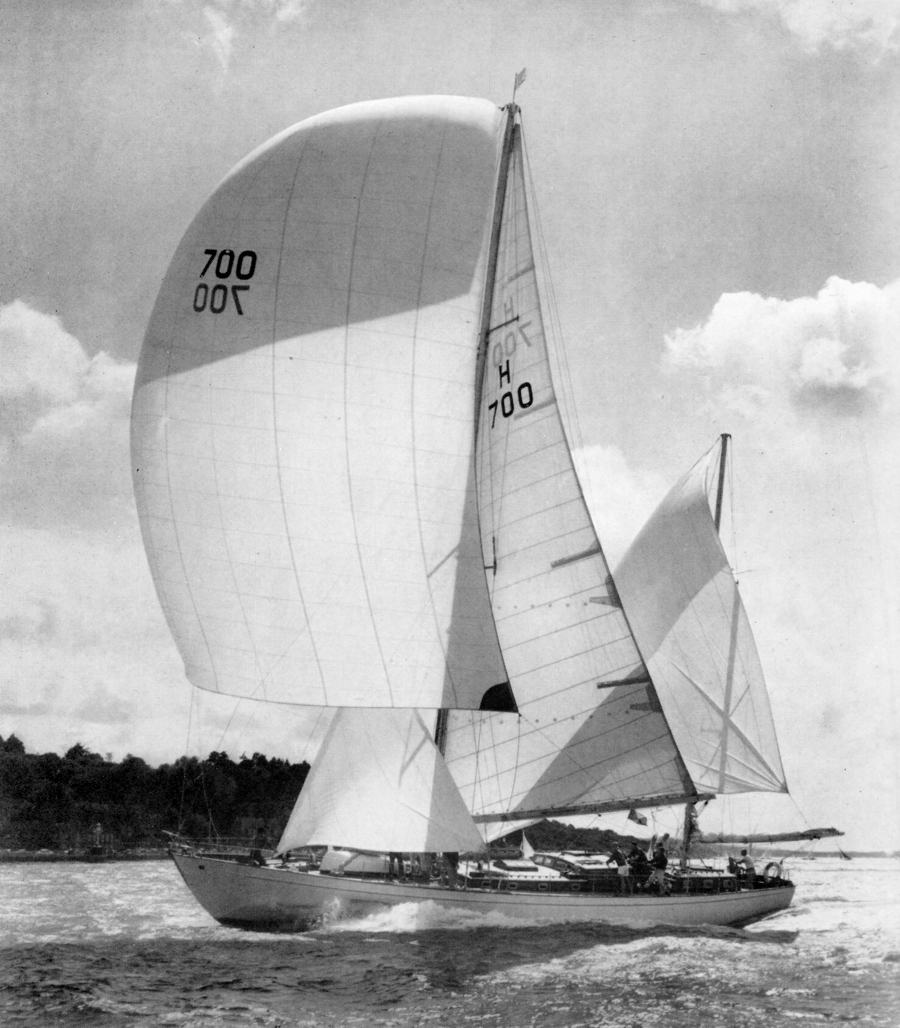
Stormvogel with sails set for running downwind, from blog.tadroberts.ca

The protagonists are sailing aboard a ketch named the Saracen.  In reality, this was a rather famous yacht named the Stormvogel.  Details of her design can be found here at boat designer Tad Roberts' blog, while a discussion of her history is here at the Wooden Boat Forum.  She was built in in 1961, commissioned by one C. Bruynzeel.  Not surprisingly, as Bruynzeel was at the time the head of a long-standing and still extant producer of plywood, he had the boat made of marine plywood.  Stormvogel was built in South Africa, purportedly the "first truly light displacement maxi ocean racer."  She has won numerous blue-water race trophies.  She is also a big boat, 74' LOA, with three double-bed cabins and a fourth twin-bed cabin.  Bruynzeel died on Stormvogel while racing her in Greece.  The producers of Dead Calm found her in Sydney, doing their filming in the Whitsunday Passage between Queensland and the Great Barrier Reef.  The latest I can find on the Stormvogel is that she is on the charter list at yachtcharter.jp.

The Golden Plover in all her finery

The Stormvogel appears to be alive and well, but her costar in Dead Calm did not fare well.  In the movie, the villainous Zane has just abandoned the "schooner" Orpheus.  The ship was in fact a 30-meter (ca. 98') brigantine, the Golden Plover, and had been around since 1910.  A well-written narrative on the ship can be found here at wordpress.com blog The Fo'c'sle.  She began life as a steam-powered tug in Melbourne and worked various jobs for decades until she caught fire.  She lay sunken in the Maribyrnong River until she was resurrected by the brothers Helmut, Gunther and Gerhardt Jacoby.  In 1974 she lived again, and by the 1980's was not only the oldest working boat in Australia but regularly used in film, including 14-year-old Brooke Shields' notorious softcore disguised as cinema, The Blue Lagoon.  In the 1990's, the Golden Plover was based in Cairns and spent time doing "Great Barrier Reef boat partying tours."  Whether as a result of this lifestyle or not, at the turn of the century she was in horrible disrepair.  In 2011, at the age of 101, she was broken up.

Golden Plover in 2009, looking weary

I don't mean to be a downer, but fame does not equal preservation when it comes to boats.  The Surprise was deemed unseaworthy by the Coast Guard for quite some time after filming Master and Commander, tho' she is now fully operational and was back in form in On Stranger Tides.  Lady Washington underwent major hull restoration over the summer that required nearly $200,000 dollars in state and private funding.  There is even a web site, still to be seen, that tried to save the Golden Plover.  The point is simple:  If we are to continue to enjoy our tall ships, on the water or on the screen, then we must contribute how we can.  That message must and will be repeated.  You can help the San Diego Maritime Museum here, and the Historical Seaport, home of the Lady Washington and the Hawaiian Chieftain, can be supported here.  If there is a boat dear or close to you, and you can't give money, give time.  Every effort counts.

Sunday, December 18, 2011

Aubrey-Maturin in Brief 3: H.M.S. Surprise

Welcome back to another SPOILER-laced installment of Aubrey-Maturin In Brief.  Pauline has already taken the pennant, having given her interpretation of Book 3 in celebration of O'Brian's birthday.  OK:  game on.  I am with Pauline in considering H.M.S. Surprise my favorite, thus far, of the series.  Why?  This novel takes our heroes on an excursion way, way beyond the Mediterranean and the English Channel, from the "vampires" of South America to the tigers of India and the breadth of the British Empire, with all its faults.  The first book introduced the world, the second put it in social context, but this one is adventure...and romanticism. 

Romanticism was an ideal, a reaction to the industrial rationality that threatened to conquer the early nineteenth century that Aubrey and Maturin lived in.  (An aside:  Remember how pale ale and then Bavarian lager pushed aside all competition and whitewashed beer?  That's the aggressive rationality I'm talking about.)   It was an ideal not without its ironic complexities, and these are personified in our complementary yet opposing duo and the women they pursue.  Both Aubrey and Maturin are romantic loners but in different ways and for different reasons.  Jack is a loner against his will, defined by a nationalistic (or at least professional) sense of duty, a piratical flair, and the love of the freedom of the sea that always sets the sailor apart.  He has grown to command a fleet, if by accident; his defense of the China fleet is based on the real Battle of Pulo Aura and Admiral Linois and is also a buildup to Book 4, The Mauritius Command.  His desire, however, is to settle down to what he sees as the traditional bliss of marriage and the very English domestic image of Sophie.  Maturin, somehow surviving every scrape, from torture to white squall to bullet wound, loves the largeness the world--natural wonders from South America to the Subcontinent and the cultural complexity of Bombay.  Yet he is a loner by nature, torn between the rationality of his beloved science and his deep pathos and longing.  His female ideal is the fiery and perhaps fallen Diana.  His fate in love is not, shall way say, fortunate.

The tone of H.M.S. Surprise is so very romantic.  Every instance of action and heroism is colored with melancholy.  We have seen the world and returned home with feelings of hope but also anxiety, innocence gone but dreams maintained.  It is a novel of grand geographical and emotional sweep.  Another aside:  Romanticism defined, and defines still, an approach to music, and, given the importance of music to our protagonists, the imaginary score to the hypothetical movie starts to take shape in my brain.  Maybe this is The Empire Strikes Back; damn, that was a bad pun.  Let's just set set sail for the long journey, the exotic shores, and the convolutions of the heart...

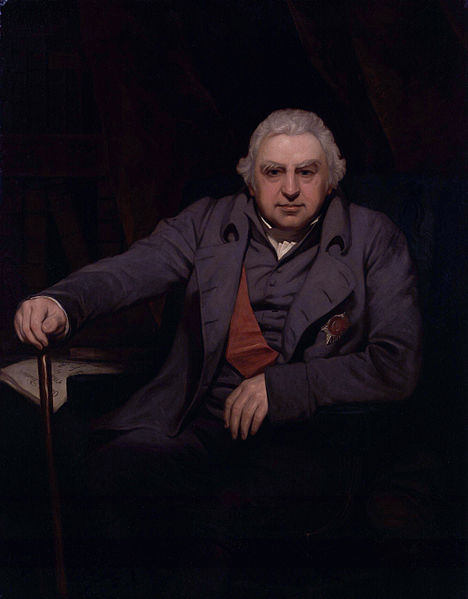
Sir Joseph Banks, historical inspiration to Sir Joseph Blaine
(1) The Admiralty debates the prize money that may be rewarded to the captains of the recent engagement of the Spanish treasure fleet.  Sir Joseph Blaine, ally to Stephen Maturin, argues in favor of a full reward, but between the inexperienced new First Lord and the ever vengeful Harte, Sir Joseph’s entreaties fall on deaf ears.  While the gold is granted to the Crown, a slip reveals Maturin’s role as an intelligence officer.  Maturin, meanwhile, is at Mapes with Sophie; she is considering Jack Aubrey, and Maturin is considering—and tracking—Diana, who is now in India with Canning of the East India Company.  Inevitably, Mrs. Williams interrupts, holding Aubrey’s debt against her daughter’s marriage to the Captain.  Maturin goes to a meeting of the Entomological Society, but his appearance distracts the guilty Sir Joseph. They meet at a secret location, and Sir Joseph reveals to Maturin not only that the captains’ prize money has been withheld but also that Maturin is the victim of an indiscretion.  Nevertheless, Maturin goes ahead with a planned mission and a rendezvous with Aubrey at Minorca, which is now in Spanish hands.