Showing posts with label Scotland. Show all posts

Sunday, October 14, 2012

Songs of Logan #6: Fear a' Bhàta (The Boatman)

Achiltibuie Boatman's Bothy

Last, but not least...

The essence of the fictitious Logan is that, had not so many events transpired that made his dream impossible, he'd still just be a fisherman back on the Firth of Forth, living simply, settled down with his sweetheart.  Perhaps it started with the conviction of the Logan name.  Perhaps it was Mar's calling Scotland to rise up in '15, but then maybe it was that beautiful, untouchable woman I danced with and that made me itch to prove myself.  How did I expect to woo her, anyways?  Perhaps it was Borlum and his damned fool march into England, or that coward Forster who doomed us all at Preston.  After that it was all luck, good and bad--getting to Liverpool, managing to get on a ship bound for America, tho' a hungry bitch of a freighter with an afterdeck working her crew 'til the sheets were smeared with blood.  And then it was that fateful day when Hornigold and his brigands fell on us just as we were almost to the Colonies, and we, doomed anywhere but at sea, fought with the pirate and signed his articles...

That's pretty much the first half of the unwritten Blue Lou Logan, The Pirate Far From Home.  All of this was in my head in some form when, a few years back, I was listening to my iPod and rediscovered the song "Fear a' Bháta."  It was an AHA! experience, and from it tumbled the "Imaginary Logan" score and, eventually, this blog thread.  The perspective, like "Logan Braes," is that of the woman left behind.  The song was originally written in Scots Gaelic and has gone through several variations and translations.  Here are the lyrics as I first heard them in, in English, transcribed directly by me from the recording...

Fhear a' bhàta na hóro eil'e
Mo shoraidh slàn leat's gach àit' an déd thu
Forever haunting the highest hilltops
I scan the ocean thy sails to see
Wilt come tonight love wilt come tomorrow
Wilt ever come love to comfort me?
Fhear a' bhàta na hóro eil'e...
They call thee fickle they call thee false one
And seek to change me but all in vain
For thou art with me a throughout the dark night
And every morning I watch the main
Fhear a' bhàta na hóro eil'e..
There's not a hamlet but well I know it
Where you go walking or stay a while
And all the old folks you win with talking
And charm its maidens with song and smile
Fhear a' bhàta na hóro eil'e...
From passing boatmen I would discover
If they had heard of or seen my lover
I'm never answered I'm only chided
And told my heart has been sore misguided
Fhear a' bhàta na hóro eil'e...

Fhear a' bhàta na hóro eil'e
Oh fare thee well love, where e'er you be

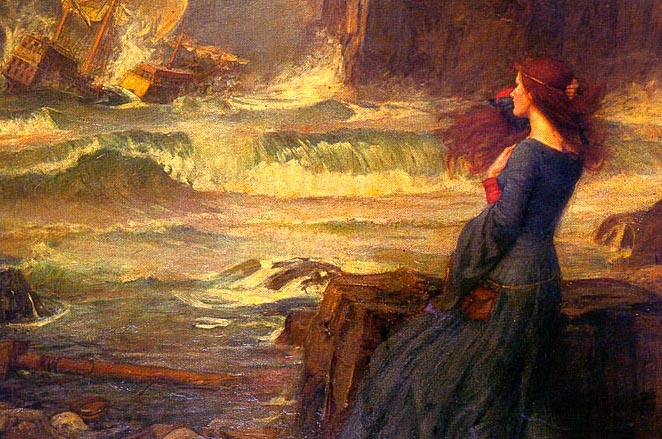
In all of the versions I have heard or found online, the chorus is always left in Gaelic.  The refrain, "Fhear a' bhàta na hóro eil'e," translates roughly as "O, my boatman, and no one else."  Here a translation of the last line of the chorus ends the song.  In fact, the verses both in Gaelic in English vary considerably.  See for, example, the lyrics on Wikipedia here, at electricscotland.com here, and at contemplator.com here.  The gist remains the same:  The boatman is gone, likely never to return, but in spite of all the hearsay against him she will keep waiting.  That hearsay paints the boatman as more than a bit of a scoundrel, off having his own fun instead of simply off at work or lost at sea.  Putting this into the context of my story, I read this as Logan's fellow boatmen not having heard anything clearly indicating his demise but perhaps rumors of his shipping across the Atlantic and even turning pirate.  The mood of the forlorn lady watching the main is, in my imagination, close to that of the famous "Miranda - The Tempest," inspired by the character in Shakespeare's play, painted by John William Waterhouse c. 1916 (just maybe ignore the shipwreck):

For once with a song of this kind, there seems to be general agreement on its attribution.  Credit goes to Sine NicFhionnlaigh--Jean Finlayson--of Tong, a small village on the Isle of Lewis.  The song was written by her in the late 18th century during what was apparently an emotionally difficult courtship with a young fisherman from Uig on the Isle of Skye, Dòmhnall MacRath, aka Donald MacRae.  The good news is that Jean and Donald were married some time after she wrote the song.  Who says Scottish airs can't have happy endings?
Black House Village, Garenin, Isle of Lewis, Scotland

  • Niamh Parsons, from Blackbirds and Thrushes.  Niamh Parsons is from Dublin and has in the last twenty years become one of the premier songstresses of traditional Celtic music.  In 1999, she recorded "Fear a' Bháta" in Gaelic.  The lyrics of her version and a translation can be found here at Celtic Lyrics Corner.  It is a sparse arrangement for her and guitar, with piano on choruses.  Parsons' voice is particularly well-suited to the heartbreak of the song.  It is available on iTunes.  A live rendition from 2011, recorded at Liverpool Philharmonic Hall as part of their "Sea Sessions" series, can be found here at YouTube.
  • Talitha MacKenzie, from Spiroad.  Back in yon Berkeley days, my best friend Harvey and I listened religiously to the late-night radio show "Tangents," hosted by the awesome Dore Stein then on KCSM, San Mateo.  "World music," whether you call it a genre, a marketing term, or a travesty, was still new.  In 1990, the album Mouth Music came out, a collaboration between Edinburgh-based composer and instrumentalist Martin Swan and Talitha MacKenzie, a Scottish-American ethnomusicologist and performer who had taught herself Scots Gaelic and done field work in Scotland.  Martin brought the synthesizers and the beats, while MacKenzie brought her knowledge of puirt à beul, a Celtic tradition of essentially using the human voice as a rhythmic and melodic instrument to accompany dancing, comparable perhaps to scat singing in jazz.  Swan and MacKenzie stopped work together after only a few years, but MacKenzie as a solo artist has continued with what she referred to as "the mouth music project," maintaining her Celtic roots but finding mouth music from many other traditions around the world.  For her 1996 album Spiorad, she recorded a very distinctive take on "Fear a' Bháta."  The percussive nature of puirt à beul, with almost a yodeling quality, makes the Gaelic itself more intense, while MacKenzie's interpretation rises and falls with the emotions of the words.  In the background are some ocean atmospherics.  A very cool track.  Words and translation can be found here, again from Celtic Lyrics Corner.  Spiorad is not available on iTunes, but "Fear a' Bháta" is, as part of the compilation A Celtic Tapestry, Vol. 2.  This is in turn is also on YouTube here.
  • Gordon Bok, Ann Mayo Muir, and Ed Trickett, originally from All Shall Be Well Again, also on The First Fifteen Years, Vol. 2.  This is the song that launched this whole blog thread.  Gordon Bok I have already praised.  Ann Mayo Muir has been a New England singer-songwriter since the '60's.  Ed (Edison) Trickett, when he is not a Professor of Psychology at the University of Illinois, is a folk musician.  From 1969 to 2000, Bok, Muir, and Trickett (or, simply, BMT) were something between a trio and collective, singing gorgeous harmonies together but maintaining their own styles, inspirations, and repertoires.  They recorded a long series of albums for the revered Folk Legacy label.  I was introduced to them as a teenager on the now-gone weekly folk programs on KPBS San Diego, and I saw them live at the University of Washington.  I was more than a little surprised, given my years-old familiarity with their works, to (re-)find "Fear a' Bháta."  Theirs are the lyrics I transcribed above, closely resembling those Silly Wizard used on Caledonia's Hardy Sons (which almost made the list and can be found here on YouTube).  BMT's "Fear a' Bháta," however stands alone and above.  Ann sings the lead on this one, Bok and Trickett singing harmony on the choruses, while Bok's 12-string holds an insistent 6/8 rhythm.  BMT's back catalog has not yet reached iTunes, and it is not on YouTube.  Maybe, if I'm nice, I'll figure out how to upload it, but in the mean time you'll have to dig yer own gold.

And so we reach the end of the Songs of Logan:  songs of Scotland, shanties both of the leaving and the getting home, and something in between.  This has been some hardcore blogging, facilitated in part (talk about mixed blessings) by round three of diverticulitis and thus some time stuck (again) on the sofa.  I'm gonna take a break now.  BUT I have two books nearby--another Aubrey-Maturin and my well-annotated copy of Rediker's Between the Devil and the Deep Blue Sea.  I also have received another commission from the CWB to perform for the holidays!  Don't touch that dial...

Tuesday, October 9, 2012

Songs of Logan #2: Tibbie Fowler o' the Glen

Here is a song that, at least by some accounts, was inspired by my Logan ancestors themselves.  It is still about a woman but not about a woman pining.  Tibbie, rather, is a woman beset by suitors, but they--and by extension all the Scottish men of the time--are more interested in her dowry than her.  Here's the full text, courtesy of the BBC; I have again given translations of a few Scots terms with guidance from www.scots-online.org and recmusic.org.
Tibbie Fowler o' the glen,
There's o'er mony [many] wooin' at her,
Tibbie Fowler o' the glen,
There's o'er mony wooin' at her.

(Chorus) Wooin' at her, pu'in [pulling] at her,
Courtin' at her, canna [cannot] get her:
Filthy elf, it's for her pelf [money],
That a' the lads are wooin' at her.

Ten cam east, and ten cam west,
Ten came rowin' o'er the water;
Twa came down the lang [long] dyke side,
There's twa and thirty [32] wooin' at her.

There's seven but, and seven ben [7 outside the house and 7 in the parlour],
Seven in the pantry wi' her;
Twenty head about the door,
There's ane and forty [41] wooin' at her.

She's got pendles in her lugs [jewels in her ears],
Cockle-shells wad set her better;
High-heel'd shoon [shoes] and siller tags [silver straps],
And a' the lads are wooin at her.

Be a lassie e'er sae black [ugly],
An she hae the name o' siller,
Set her upo' Tintock-tap,
The wind will blaw a man till her.

Be a lassie e'er sae fair,
An she want the pennie siller;
A lie may fell her in the air,
Before a man be even till her.

Dimpleknowe Cottage, Scottish Borders

It is very possible that Tibbie was real, but there is more folklore than fact.  An introduction to the story behind the song can be found at mysongbook.de.  There is no agreement on the "glen" and a good deal of question on who finally wooed her.  In Book of Scottish Story, cited at electricscotland.com, John Mackay Wilson spins the most romantic tale, placing the glen near Berwick-upon-Tweed and below Edrington Castle.  Tibby, daughter of old Ned Fowler, was left at the death of her parents with five hundred pounds and thus surrounded by a pack of desperate gold diggers.  Her chosen was none of the formal suitors but one William Gordon, a young seamen she encountered on Leith Links.  When he says he must sail on a year-long voyage, Tibbie revealed her inheritance to keep him home.  So Willie went into the coasting trade and obtained a beautiful brig he named after his beloved.  However, the ship went missing, driving Tibbie and her children into poverty.  They returned eventually to the old family cottage only to find Willie, who had escaped from the enemy after eighteen months and gained riches and honours.  They took up the cottage, and everyone lived happily ever after.


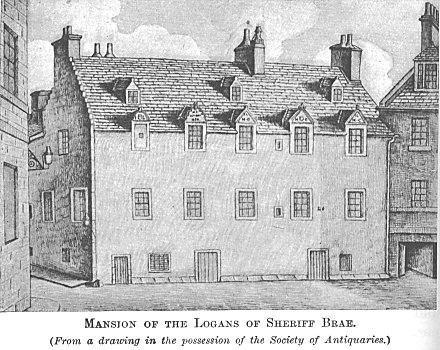
The more common story places Tibbie's story into the long, complex relationship between the Logans and Leith, Scotland.  This is written about at length in History of Leith, online at electricscotland.com.  As I have discussed before, in 1606, the "godless, drunkin, and deboshit" Sir Robert Logan of Restalrig died, but two years later his body was exhumed, put on trial, and convicted for participation in the Gowrie Conspiracy against King James VI and I.  His properties were confiscated, and the Logan name was forever besmirched, even after the sentence against his family was reversed in 1616.  Among those those to suffer was one of Sir Robert's sons, George.  Enter the heiress Isobel Fowler, said to be the inspiration for the fictional Tibbie.  It is established fact that George married Isobel, but the details are left to the interpretation of local legend.  The father from whom Isobel gained her inheritance appears to be Ludovic Fowler, but some say the "glen" where Tibbie was raised was Burncastle, while others point to an old thatched house at Lochend near Restalrig.  In the 1891 Scottish Notes and Queries, George--here a grandson not a son of Sir Robert--sought his fortune in the wars of Europe but was still shamed at home.  He was, in spite of the objections of her father, the successful wooer of the "well tochered" Isobel...or, here, "Isabella."  It is Leith tradition that Isobel's riches allowed the couple to live comfortably in a well-known mansion.  The house in question (pictured above), however, was in another area of Leith, Sheriff Brae, which had long belonged to another line of Logans.  Storytellers even point to initials carved into the building's stones, left even when most of the building was torn down and replaced by St. Thomas' Church and Manse in 1840 (now 9 Mill Lane).  Yet these initials are more likely those of John Logan and Mary Caire, who had rebuilt the mansion back in 1636.

There is even less agreement on who originally wrote the song, tho' today's version is credited to--or was at least collected by--the inevitable Burns.  I, for one, love a song with a deep back story, and this one is positively convoluted, Logan connection or not.  It is also a very, very catchy song.

  • Andy M. Stewart, from Donegal RainAndy M. Stewart was the frontman of Silly Wizard until 1988, after which he has had a successful solo career and penned such classics as "The Queen of Argyl" and "Valley of Srathmore."  Stewart recorded this version of "Tibbie" for his first solo album.  He is playful, almost sly with the lyrics.  Backed by a full band with bass and drums, this is what I like to call concert Celtic, as opposed to pub Celtic.  It is available from  iTunes.
  • Jock Tamson's Bairns, from A' Jock Tamson's Bairns.  "Jock Tamson's Bairns" is a Scottish saying that means, basically, "we are all, deep down, the same."  It is also the name of a Scottish band.  Their "Tibbie" was originally on a 1978 album but can now be found on a band compilation, an import by CD but available on iTunes.  I first found it on YouTube here.  This is pub Celtic--upbeat, strictly acoustic--and their take on the song is positively bouncing and joyful.
  • Old Blind Dogs, from LegacyOld Blind Dogs has been around for over twenty years.  Jim Malcolm was with them for quite some time, but their recording of "Tibbie" was from before Jim, in 1995.  Typical of the Dogs, the arrangement is artful, "Tibbie" being interwoven with a dance tune from Breton.  It is available on iTunes.

Coming up next:  Logan's second favorite shanty!

Sunday, October 7, 2012

Songs of Logan #1: Logan Braes

There is a playlist on my iPod called "Imaginary Logan."  It is the soundtrack to the unwritten Logan novel/movie, following him from Leith, Scotland (see old post "Logan, an introduction") and the Jacobite march to Preston (see "Logan, Pt. 2:  The Jacobite Rising of 1715") to his sailing to the Caribbean and pirate adventures.  Over half of the tracks are original compositions; a couple years back I had a flurry of inspiration and wrote half an hour of imaginary score in a few days using GarageBand.  I will likely come back to this in another post if I can figure out how to upload MP3's.  For now I want to focus on the other part of the playlist:  'traditional' Celtic tunes and shanties.  What follows is Logan's Top 5+1, the songs that he would have known, or at least the songs I love that inspire me and my character.  I'm including links to my favorite versions, either for purchase or, when possible, for listening online.  I was going to post all the songs in a single post, but that was turning into a massive blog and was thus taking too long.  So, we'll start with just one.

Logan Water

The first song is about a place called Logan.  Logan Water is a river in southwest Scotland that flows into the Nethan and thence into the Clyde.  The tune is an 'air,' a slow, melodic kind of music that is a common type in the Celtic repertoire but hardly exclusive to it.  According to contemplator.com, a very extensive site that compiles traditional songs from the British Isles and America (and some shanties), the tune "Logan Water" first appeared in print in 1709 but is quite probably much older than that.  Typical of most old tunes, it has been set to different lyrics over time, including, like pretty much every tune in Scotland, by Robert Burns, who, typically, added a political slant to the tale of woe.  His 1793 version has become known as "Logan Braes" ('brae' means hill or hillside in Scots), which is the version most people know, including myself.  Beyond simply having "Logan" in the title, it is the kind of sad, Scottish song that characterizes Logan and contains a theme central to the remainder of this list:  Man is gone--in this case to war--and woman is heartbroken.  My story is more pathos then swashbuckle.  He is "Blue" Lou, after all.  This is the poem, borrowed from Robert Burns Country (robertburns.org); I have added in brackets translations of some of the Scots language:

O Logan, sweetly didst thou glide,
That day I was my Willie's bride,
And years sin syne hae [have long since] o'er us run,
Like Logan to the simmer [summer] sun:
But now thy flowery banks appear
Like drumlie [muddy] Winter, dark and drear,
While my dear lad maun [must] face his faes [foes],
Far, far frae [from] me and Logan braes.

Again the merry month of May
Has made our hills and valleys gay;
The birds rejoice in leafy bowers,
The bees hum round the breathing flowers;
Blythe Morning lifts his rosy eye,
And Evening's tears are tears o' joy:
My soul, delightless a' [all] surveys,
While Willie's far frae Logan braes.

Within yon [yonder] milk-white hawthorn bush,
Amang [among] her nestlings sits the thrush:
Her faithfu' mate will share her toil,
Or wi' his song her cares beguile;
But I wi' my sweet nurslings here,
Nae [no] mate to help, nae mate to cheer,
Pass widow'd nights and joyless days,
While Willie's far frae Logan braes.

O wae [woe] be to you, Men o' State,
That brethren rouse to deadly hate!
As ye make mony a fond heart mourn,
Sae [So] may it on your heads return!
How can your flinty hearts enjoy
The widow's tear, the orphan's cry?
But soon may peace bring happy days,
And Willie hame [home] to Logan braes!

As a standard among Scottish songs, it has been recorded by many artists.  These are my favorites:
  • Jim Malcolm:  "Logan Braes," from Acquaintance.  Jim is a friend of mine (thanks to Zanne) and one of the best folk artists in Scotland today.  In addition to being a fabulous singer-songwriter, he is one of the foremost modern interpreters of Robert Burns.  The album Acquaintance is entirely Jim singing Burns songs and is highly recommended.  This is a gentle version of "Logan Braes" set to Jim's voice and guitar and some light instrumental backing.  I'd buy it directly from Jim, but it is also available on iTunes.
  • John Cunningham:  "Logan Water," from Fair Warning.  The late Johnny Cunningham will be familiar to any fan of Scottish music as one of the founders of Silly Wizard, not only one of the premier groups of the Scottish folk revival but one of the best band names of all time.  He was only thirteen when he joined Silly Wizard!  On one of his few solo albums, Cunningham does the old, instrumental tune, strictly overdubbing himself on fiddle.  It is the melody from this version that I learned for use in composing the Logan score.  The album and the tune are available on iTunes.
  • Jean Redpath:  "Logan Braes," from The Songs of Robert Burns, Volumes 1 & 2.  I first heard Jean Redpath as one of the regular guests on Garrison's Keillor's "A Prairie Home Companion" way back in the 80's.  She was born in Edinburgh and raised in Leven, Fife, Scotland.  Now 75, she was there with Dylan and the rest in the early 60's Greenwich Village folk scene.  In 1976, she set out to record every Robert Burns song--a projected 22 volumes--but stopped after seven albums and 323 songs when her arranger, Serge Hovey, passed away.  Their setting of "Logan Braes" is very, very dark, more classical than folk, with a low, dismal piano leading the accompaniment.  All but the seventh volume of Redpath's Burns project is available on iTunes.
Coming up next:  Logan history in song!

Monday, July 16, 2012

Kilt up! Skagit Valley Highland Games 2012


Saturday, there was a company picnic.  The organizers were excited, but not many others.  Instead, Zanne and I learned that one of her best friends of all time, the piper E.J. Jones, for whom a good deal of credit must go for my meeting Zanne at Gig Harbor Faire, was playing with the internationally known Texas Celtic band Clandestine at the Skagit Valley Highland Games.  So...coworker potluck or Scottish festival?  Duh...

Logan's beard is great and fearsome.  (Pic by Bev)

Sunday, June 19, 2011

Logan, Pt. II: The Jacobite Rising of 1715

Back towards the beginning of this blog, I gave some of the deep historical background to "Logan," my character.  I told of the ruined Highland Clan, the Lairds of Restalrig, and my own exploration of Leith.  My fictional bio reads, "Growing up in Leith, Logan learned both the ways of the sea in the Firth of Forth and the North Atlantic and the ways of the smuggler in the difficult times after the Union of the Crowns in 1707.  As a proud Scot opposed to English oppression, Logan stood with the Jacobites in the Battle of Preston."  Now I want to tell this tale, partly as an exercise in bringing various sources together, partly as a warm up for actually writing about Logan.

Warning, this is a LONG POST.

King Robert II of Scotland
Let's start with a a little royal history.  The Stuarts had been the Kings of Scotland almost as far back as the legendary Robert the Bruce, King Robert I.  His daughter married the "High Steward of Scotland," i.e. "Stewart" or "Stuart," and their son became Robert II, first of the Stuart Kings.  The Stuarts ruled Scotland through the 14th and 15th centuries.  In 1503, James IV of Scotland married King Henry VII's daughter, Margaret Tudor, and, with the birth of their son, the Stuarts now had a claim on the throne of England.  This led to the much-storied conflict between Henry Stuart, Lord Darnley; his half-cousin, Mary, Queen of Scots; and Queen Elizabeth I.  Although Mary lost her head, her cause eventually won.  When Elizabeth died without an heir, it was the son of Mary and Lord Darnley, King James VI of Scotland, who peacefully gained the throne of England, Scotland, and Ireland with the Union of the Crowns in 1603.

Wednesday, March 30, 2011

"Logan," an introduction

This is the first half of a biography of my fictional pirate I once sketched out:

"Lou Logan is a descendant of the Logans of Restalrig, Scotland, the clan famous for helping to carry the heart of Robert the Bruce to the Holy Land.  Growing up in Leith, Logan learned both the ways of the sea in the Firth of Forth and the North Atlantic and the ways of the smuggler in the difficult times after the Union of the Crowns in 1707.  As a proud Scot opposed to English oppression, Logan stood with the Jacobites in the Battle of Preston.  The uprising defeated, Logan was imprisoned in England.  On a wild chance he managed to escape.  Knowing he was an outlaw even in his homeland, Logan made his way to the busy port of Liverpool and managed to join the crew of a merchant vessel bound for America, where he hoped to start a fresh life.  The ship, however, was attacked by pirates led by Benjamin Hornigold off the Eastern Seaboard.  Knowing he had no country, and valuing above all his freedom, Logan turned pirate himself."