Showing posts with label Pirates of the Caribbean. Show all posts

Monday, October 15, 2012

When boats are movie stars

The postmodern tall ship:  The Earl of Pembroke in a poster for the upcoming Cloud Atlas

Outside of genre films, it's not very often that a boat gets to be a movie star.  The Lady Washington, thanks to her role as the Interceptor in the original Pirates of the Caribbean, is now recognizable to fans worldwide and is essentially the modern image of the pirate ship, even tho' not only as brig would she have not been common in the Golden Age Caribbean but also the ship was built as a replica of a late 18th century vessel of the U.S. Navy.  The HMS Rose, after her moment in the spotlight as Lucky Jack's dear ship in Master and Commander:  The Far Side of the World, was even renamed the Surprise and is now educating thousands at the San Diego Maritime Museum on the ways of the old Royal Navy.  Now the barque Earl of Pembroke of Bristol, already a veteran of the Hornblower series among other roles, is hitting the big screen in the new Cloud Atlas.  All of these are, at least in part, historical dramas, and readers of this blog should know these ships well.  But, the other night, the DVR captured a modern film that was all about the boats.  This is especially worth pausing for as one of the vessels is no longer with us.

At sea, no one can hear you scream

Dead Calm came out back in 1989, based on the novel from 1963 and directed by Australia's Philip Noyce.  There are only three human cast members:  the always intense Sam Neill, a young Nicole Kidman (only 22 at the time), and, the sole Yank, Billy Zane (with hair!).  Without giving too much away, as this is a film I would recommend, the premise is that Neill and Kidman are cruising the South Pacific when they are overtaken by the psychopathic Zane.  Other than some set up at the beginning, the film takes place entirely at sea.  It is a psychological thriller, but the tension would be nothing without some realistic nautical elements.  Thus one must give equal billing to the film's two boats.  The identity of these vessels are revealed in Dead Calm's production notes here.
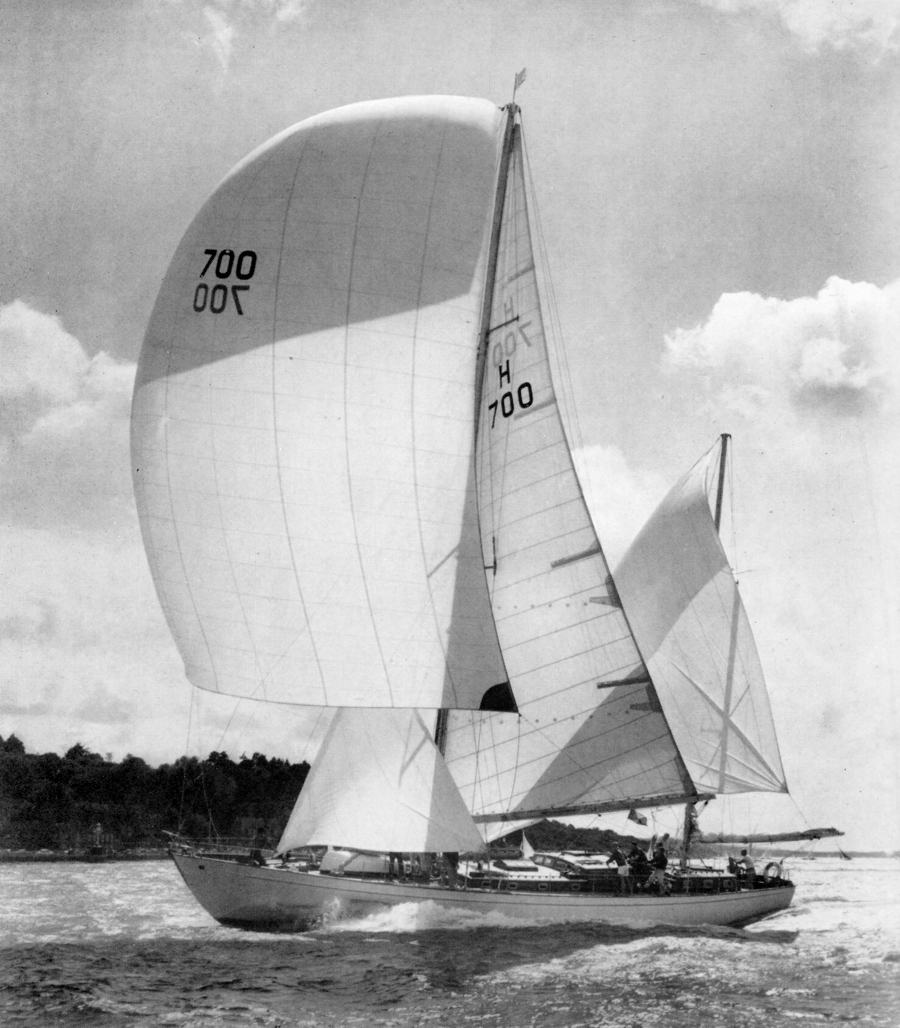
Stormvogel with sails set for running downwind, from blog.tadroberts.ca

The protagonists are sailing aboard a ketch named the Saracen.  In reality, this was a rather famous yacht named the Stormvogel.  Details of her design can be found here at boat designer Tad Roberts' blog, while a discussion of her history is here at the Wooden Boat Forum.  She was built in in 1961, commissioned by one C. Bruynzeel.  Not surprisingly, as Bruynzeel was at the time the head of a long-standing and still extant producer of plywood, he had the boat made of marine plywood.  Stormvogel was built in South Africa, purportedly the "first truly light displacement maxi ocean racer."  She has won numerous blue-water race trophies.  She is also a big boat, 74' LOA, with three double-bed cabins and a fourth twin-bed cabin.  Bruynzeel died on Stormvogel while racing her in Greece.  The producers of Dead Calm found her in Sydney, doing their filming in the Whitsunday Passage between Queensland and the Great Barrier Reef.  The latest I can find on the Stormvogel is that she is on the charter list at yachtcharter.jp.

The Golden Plover in all her finery

The Stormvogel appears to be alive and well, but her costar in Dead Calm did not fare well.  In the movie, the villainous Zane has just abandoned the "schooner" Orpheus.  The ship was in fact a 30-meter (ca. 98') brigantine, the Golden Plover, and had been around since 1910.  A well-written narrative on the ship can be found here at wordpress.com blog The Fo'c'sle.  She began life as a steam-powered tug in Melbourne and worked various jobs for decades until she caught fire.  She lay sunken in the Maribyrnong River until she was resurrected by the brothers Helmut, Gunther and Gerhardt Jacoby.  In 1974 she lived again, and by the 1980's was not only the oldest working boat in Australia but regularly used in film, including 14-year-old Brooke Shields' notorious softcore disguised as cinema, The Blue Lagoon.  In the 1990's, the Golden Plover was based in Cairns and spent time doing "Great Barrier Reef boat partying tours."  Whether as a result of this lifestyle or not, at the turn of the century she was in horrible disrepair.  In 2011, at the age of 101, she was broken up.

Golden Plover in 2009, looking weary

I don't mean to be a downer, but fame does not equal preservation when it comes to boats.  The Surprise was deemed unseaworthy by the Coast Guard for quite some time after filming Master and Commander, tho' she is now fully operational and was back in form in On Stranger TidesLady Washington underwent major hull restoration over the summer that required nearly $200,000 dollars in state and private funding.  There is even a web site, still to be seen, that tried to save the Golden Plover.  The point is simple:  If we are to continue to enjoy our tall ships, on the water or on the screen, then we must contribute how we can.  That message must and will be repeated.  You can help the San Diego Maritime Museum here, and the Historical Seaport, home of the Lady Washington and the Hawaiian Chieftain, can be supported here.  If there is a boat dear or close to you, and you can't give money, give time.  Every effort counts.

Saturday, September 29, 2012

Ethics and Morality According to Gary Gygax

Mmm, succubi
Many, many lunar cycles ago, back in the days when Cherry Coke was "new," The Police were still together, and video arcades echoed with "Elf is about to die," I was, yes, a Dungeons and Dragons geek.  I had the dice, I had the Manuals, I had the Terry Brooks novels.  It was not at all the only thing I did, nor by any means was it my only kind of geekiness, but it filled a gap.  Star Wars was over (we thought), Star Trek: The Next Generation had not yet aired, and Dr. Jones was stuck in India with the annoying Willie Scott.  OK, people, you've got the years narrowed down, right?  In that time between Wookiees and Klingons, orcs and dragons served nicely for an early teen for whom modern reality just couldn't compare to the wonders of imagined realms.  Times have changed.  I'm still a geek.  Now I carry a "real" cutlass instead of a "pretend" +3 short sword.  What I didn't know until recently is that D&D also contains a philosophical treatise that gives a very interesting map of human behavior and a sort of chart that could be applied, well, to at least fictional piracy.  A few months ago, I found this, which I urge you all to entertain--dare I say enlighten--yourselves with:

The one like Gygax
In the simplest possible terms, alignment is one of the variables in creating and using a roleplaying character.  A character may, for example, have a "race" of dwarf or human and "class" of fighter or cleric.  These variables in turn set parameters for abilities such as strength and constitution whose numeric values (this is where the famous 20-sided die comes in) are used in game play.  This is a very nutshell version of game mechanics that will be intimately familiar to anyone who has actually played.  Yet if strength, for instance, is quantified, alignment introduces something far more qualitative:  perspective and behavior.  In 1974, Gary Gygax, the inventor of D&D, gave only three possibilities: Law, Neutrality, and Chaos.  Law was essentially synonymous with good, and Chaos was the same as evil.  In fantasy, those two poles would be fairly obvious--Sauron bad, Aragorn good.  It got more interesting a few years later when Gygax developed Advanced Dungeons & Dragons (AD&D, which is what I played).  Ethics and morality were separated into two crossing axes.  Good and Evil were now the poles of morality, Law and Chaos were the poles of ethics, and true "Neutral" was where the axes crossed.  Thus, a character could of one of nine alignments (chart and links borrowed from Wikipedia):

Lawful GoodNeutral GoodChaotic Good
Lawful NeutralNeutralChaotic Neutral
Lawful EvilNeutral EvilChaotic Evil

Considering and distinguishing morals and ethics is one of the long-standing debates in philosophy.  I considered much the same in my blog "Ethics of a Sinking Lifeboat," in which I discussed the debate between "natural law," essentially the conflation of ethics and morality by thinkers like Aristotle and Socrates, and "positive law," the laws of man as defined by Thomas Hobbes.  From the perspective of AD&D alignment, morality could be defined as the value an individual places on his fellow beings.  A Good character strives to be constructive and helpful to others, while an Evil character would be destructive and harmful; Good is heroic, Evil is villainous.  Ethics, on the other hand, is the value an individual places on the structure/system created by his fellow beings, i.e. "law."  A Lawful character not only follows the rules but will fight to protect them.  A Chaotic character discards the rulebook and disregards the standards, acting instead on the basis of their own personal code and believing that it is the right of everyone else to do the same.  Neutrality, in the case of either ethics or morality, implies that these judgments don't come as a rule into play (literally or figuratively); he, she, or it will decide simply as specific circumstances require for survival.  Defining ethics and morality in this way is more or less in line with modern understanding.  In a succinct article at DailyWritingTips.com, Mark Nichol writes, "One lives according to one’s morals but adheres to one’s ethics while doing so.  Morals are the tools by which one lives, and ethics constitute the manual that codifies them."  Fact is, for me, the idea that ethics and morality are different, that good and lawful are not to be confused, is axiomatic.  So I was thus pleased with the results of my test.  As far as I can tell, this description comes directly from AD&D canon...
Chaotic Good A chaotic good character acts as his conscience directs him with little regard for what others expect of him. He makes his own way, but he's kind and benevolent. He believes in goodness and right but has little use for laws and regulations. He hates it when people try to intimidate others and tell them what to do. He follows his own moral compass, which, although good, may not agree with that of society. Chaotic good is the best alignment you can be because it combines a good heart with a free spirit. However, chaotic good can be a dangerous alignment when it disrupts the order of society and punishes those who do well for themselves.

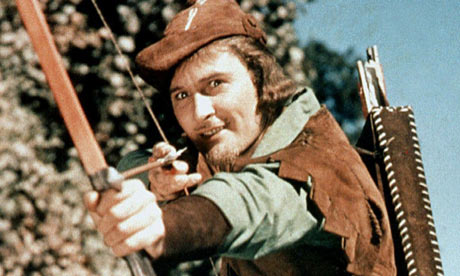
Robin Hood:  not just a hero, a philosophy

Yep, that's me, or at least I like to think so.  Easydamus.com is a thorough, well-made site on AD&D alignments that also contains a long but rewarding What D&D Character Am I? test.  The site quotes Gygax:  "To the chaotic good individual, freedom and independence are as important to life and happiness. The ethos views this freedom as the only means by which each creature can achieve true satisfaction and happiness."  This philosophy was hardly invented by Gygax.  He has credited the inspiration for the alignment system to, among others, fantasy/SF author Michael Moorcock, a self-described anarchist.  I have often said to friends that I live be one rule--Do whatever you want, as long as it doesn't prevent anyone else from doing whatever they want.  This standpoint was codified by a favorite philosopher of mine, John Stuart Mill, one of the original "liberals," or what would more likely now be called libertarianism.  In his 1859 essay "On Liberty," Mill famously wrote:
The object of this Essay is to assert one very simple principle, as entitled to govern absolutely the dealings of society with the individual in the way of compulsion and control, whether the means used be physical force in the form of legal penalties, or the moral coercion of public opinion. That principle is, that the sole end for which mankind are warranted, individually or collectively, in interfering with the liberty of action of any of their number, is self-protection. That the only purpose for which power can be rightfully exercised over any member of a civilized community, against his will, is to prevent harm to others.
The last, italicized bit has come to be known as the Harm Principle.  To those of a certain bent (myself included), it's also the Wiccan Rede:  "An it harm none, do what ye will."

I usually do.

An easy and common means to explain alignment is to exemplify the types with well-known fictional characters.  Indeed, it has become an Internet meme to create alignment charts for popular universes, from Star Wars to The Walking DeadRobin Hood, Batman, and Han Solo are often used as examples of Chaotic Good, all of which suit me just fine.  The single character, however, that hits the nail on the head for me is Captain Mal Reynolds on Firefly, truly a man with his own code, a man that fought against the "meddling" Alliance and maintains a very, very strong anti-authoritarian stance, a man that will fight for his crew and his boat, a man that may push a stranger off the Mule but will put a bullet in the man's head before he suffers at the hands of the Reavers.  This brings to mind other captains.  Captain Jack Aubrey is nothing if not Lawful Good, not only upholding Navy and country but also jumping into the sea to rescue officer and deckhand alike.  Captain Jack Sparrow would be Chaotic Neutral:  The Pirate Code itself is, with due irony, an embodiment of lawlessness as law, while wicked Jack's most singular skill is to look after (seemingly) no one but himself.  Captain Barbossa, however, points out the subjective nature of the alignment system and, indeed, of morality and ethics themselves.  As a pirate, Barbossa would be against law or at least a criminal, and thus Chaotic, yet within the pirate community he often cites the Code, which could make him Lawful.  Whether he is Good or Evil is even more vague; he is certainly the destructive villain in Curse of the Black Pearl, but is he a good guy or a bad guy after his resurrection?  Perhaps Barbossa put the whole topic of alignment best:  "The Code is more what you'd call 'guidelines' than actual rules."

All of this is, of course, an exercise in geekiness.  But isn't that the point?  Can't geekiness be not only an identity but also a means to exploring identity and big questions?  Suit yourself, go, be free, it's the Chaotic Good way.  But, in true geeky fashion, do post a comment if you take the test!

click for larger picture, and go visit mohagencomic.com

Monday, June 27, 2011

Pirates of the Caribbean 4: On Stranger Tides: Cap'n Jack vs. Dr. Jones! (a fanboy's review)

I have the most impressive sword of the whole franchise!

Yes, I finally went and saw Pirates 4.  I held off, because unless I'm in a big group and/or in costume, waiting in line to see a movie isn't much fun, in spite of anticipation.  I wore my Rogue Blackbeard Dark Rum tee shirt, which I actually had on before I knew it was movie day.  I had a wee dram of Cruzan on ice beforehand.  I went with my daughter, who was also in the mood.  We did NOT see it in 3D.  And it was a blast.  This is a movie that has taken in nearly a billion dollars worldwide already and has been critiqued up, down, and sideways.  I haven't read any of the reviews, and I won't.  But I do have a few words to say about Pirates 4, using a language I hope you all will understand:  geekspeak.

And I am going to compare it to Indiana Jones.