Monday, October 15, 2012

When boats are movie stars

The postmodern tall ship:  The Earl of Pembroke in a poster for the upcoming Cloud Atlas

Outside of genre films, it's not very often that a boat gets to be a movie star.  The Lady Washington, thanks to her role as the Interceptor in the original Pirates of the Caribbean, is now recognizable to fans worldwide and is essentially the modern image of the pirate ship, even tho' not only as brig would she have not been common in the Golden Age Caribbean but also the ship was built as a replica of a late 18th century vessel of the U.S. Navy.  The HMS Rose, after her moment in the spotlight as Lucky Jack's dear ship in Master and Commander:  The Far Side of the World, was even renamed the Surprise and is now educating thousands at the San Diego Maritime Museum on the ways of the old Royal Navy.  Now the barque Earl of Pembroke of Bristol, already a veteran of the Hornblower series among other roles, is hitting the big screen in the new Cloud Atlas.  All of these are, at least in part, historical dramas, and readers of this blog should know these ships well.  But, the other night, the DVR captured a modern film that was all about the boats.  This is especially worth pausing for as one of the vessels is no longer with us.

At sea, no one can hear you scream

Dead Calm came out back in 1989, based on the novel from 1963 and directed by Australia's Philip Noyce.  There are only three human cast members:  the always intense Sam Neill, a young Nicole Kidman (only 22 at the time), and, the sole Yank, Billy Zane (with hair!).  Without giving too much away, as this is a film I would recommend, the premise is that Neill and Kidman are cruising the South Pacific when they are overtaken by the psychopathic Zane.  Other than some set up at the beginning, the film takes place entirely at sea.  It is a psychological thriller, but the tension would be nothing without some realistic nautical elements.  Thus one must give equal billing to the film's two boats.  The identity of these vessels are revealed in Dead Calm's production notes here.
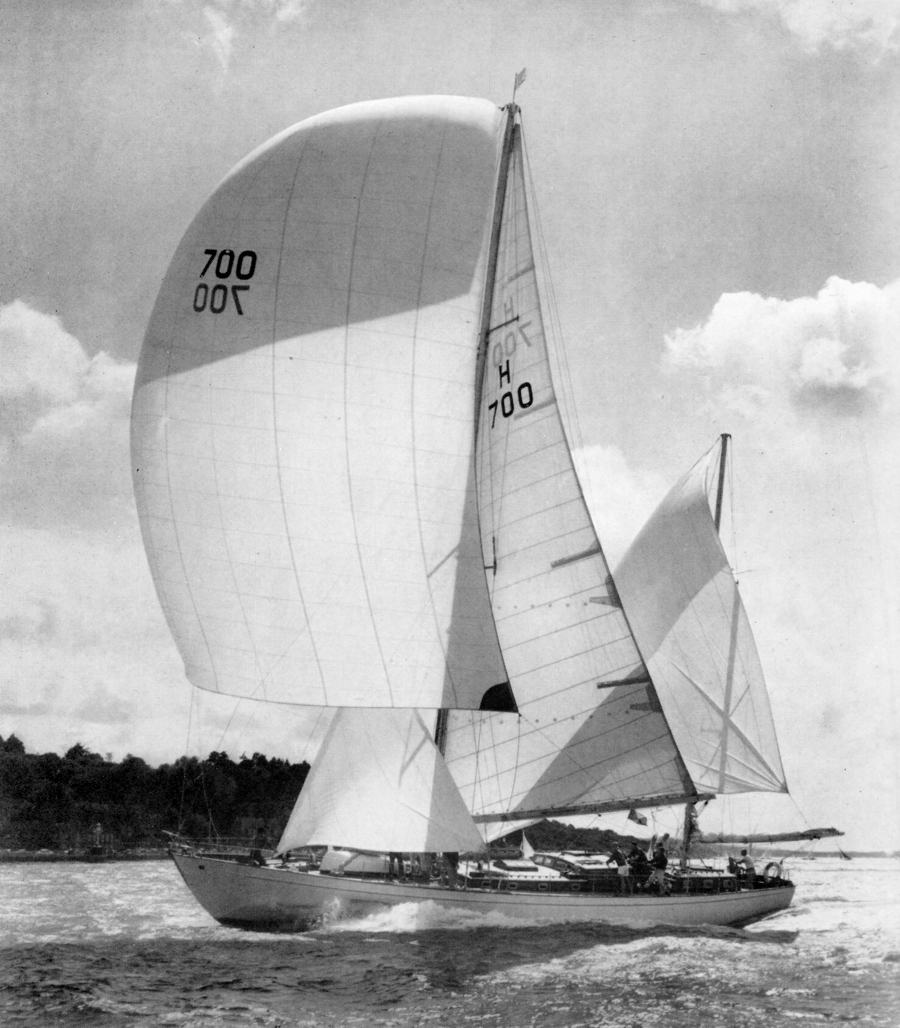
Stormvogel with sails set for running downwind, from blog.tadroberts.ca

The protagonists are sailing aboard a ketch named the Saracen.  In reality, this was a rather famous yacht named the Stormvogel.  Details of her design can be found here at boat designer Tad Roberts' blog, while a discussion of her history is here at the Wooden Boat Forum.  She was built in in 1961, commissioned by one C. Bruynzeel.  Not surprisingly, as Bruynzeel was at the time the head of a long-standing and still extant producer of plywood, he had the boat made of marine plywood.  Stormvogel was built in South Africa, purportedly the "first truly light displacement maxi ocean racer."  She has won numerous blue-water race trophies.  She is also a big boat, 74' LOA, with three double-bed cabins and a fourth twin-bed cabin.  Bruynzeel died on Stormvogel while racing her in Greece.  The producers of Dead Calm found her in Sydney, doing their filming in the Whitsunday Passage between Queensland and the Great Barrier Reef.  The latest I can find on the Stormvogel is that she is on the charter list at yachtcharter.jp.

The Golden Plover in all her finery

The Stormvogel appears to be alive and well, but her costar in Dead Calm did not fare well.  In the movie, the villainous Zane has just abandoned the "schooner" Orpheus.  The ship was in fact a 30-meter (ca. 98') brigantine, the Golden Plover, and had been around since 1910.  A well-written narrative on the ship can be found here at wordpress.com blog The Fo'c'sle.  She began life as a steam-powered tug in Melbourne and worked various jobs for decades until she caught fire.  She lay sunken in the Maribyrnong River until she was resurrected by the brothers Helmut, Gunther and Gerhardt Jacoby.  In 1974 she lived again, and by the 1980's was not only the oldest working boat in Australia but regularly used in film, including 14-year-old Brooke Shields' notorious softcore disguised as cinema, The Blue Lagoon.  In the 1990's, the Golden Plover was based in Cairns and spent time doing "Great Barrier Reef boat partying tours."  Whether as a result of this lifestyle or not, at the turn of the century she was in horrible disrepair.  In 2011, at the age of 101, she was broken up.

Golden Plover in 2009, looking weary

I don't mean to be a downer, but fame does not equal preservation when it comes to boats.  The Surprise was deemed unseaworthy by the Coast Guard for quite some time after filming Master and Commander, tho' she is now fully operational and was back in form in On Stranger TidesLady Washington underwent major hull restoration over the summer that required nearly $200,000 dollars in state and private funding.  There is even a web site, still to be seen, that tried to save the Golden Plover.  The point is simple:  If we are to continue to enjoy our tall ships, on the water or on the screen, then we must contribute how we can.  That message must and will be repeated.  You can help the San Diego Maritime Museum here, and the Historical Seaport, home of the Lady Washington and the Hawaiian Chieftain, can be supported here.  If there is a boat dear or close to you, and you can't give money, give time.  Every effort counts.

Sunday, October 14, 2012

Songs of Logan #6: Fear a' Bhàta (The Boatman)

Achiltibuie Boatman's Bothy

Last, but not least...

The essence of the fictitious Logan is that, had not so many events transpired that made his dream impossible, he'd still just be a fisherman back on the Firth of Forth, living simply, settled down with his sweetheart.  Perhaps it started with the conviction of the Logan name.  Perhaps it was Mar's calling Scotland to rise up in '15, but then maybe it was that beautiful, untouchable woman I danced with and that made me itch to prove myself.  How did I expect to woo her, anyways?  Perhaps it was Borlum and his damned fool march into England, or that coward Forster who doomed us all at Preston.  After that it was all luck, good and bad--getting to Liverpool, managing to get on a ship bound for America, tho' a hungry bitch of a freighter with an afterdeck working her crew 'til the sheets were smeared with blood.  And then it was that fateful day when Hornigold and his brigands fell on us just as we were almost to the Colonies, and we, doomed anywhere but at sea, fought with the pirate and signed his articles...

That's pretty much the first half of the unwritten Blue Lou Logan, The Pirate Far From Home.  All of this was in my head in some form when, a few years back, I was listening to my iPod and rediscovered the song "Fear a' Bháta."  It was an AHA! experience, and from it tumbled the "Imaginary Logan" score and, eventually, this blog thread.  The perspective, like "Logan Braes," is that of the woman left behind.  The song was originally written in Scots Gaelic and has gone through several variations and translations.  Here are the lyrics as I first heard them in, in English, transcribed directly by me from the recording...

Fhear a' bhàta na hóro eil'e
Mo shoraidh slàn leat's gach àit' an déd thu
Forever haunting the highest hilltops
I scan the ocean thy sails to see
Wilt come tonight love wilt come tomorrow
Wilt ever come love to comfort me?
Fhear a' bhàta na hóro eil'e...
They call thee fickle they call thee false one
And seek to change me but all in vain
For thou art with me a throughout the dark night
And every morning I watch the main
Fhear a' bhàta na hóro eil'e..
There's not a hamlet but well I know it
Where you go walking or stay a while
And all the old folks you win with talking
And charm its maidens with song and smile
Fhear a' bhàta na hóro eil'e...
From passing boatmen I would discover
If they had heard of or seen my lover
I'm never answered I'm only chided
And told my heart has been sore misguided
Fhear a' bhàta na hóro eil'e...

Fhear a' bhàta na hóro eil'e
Oh fare thee well love, where e'er you be

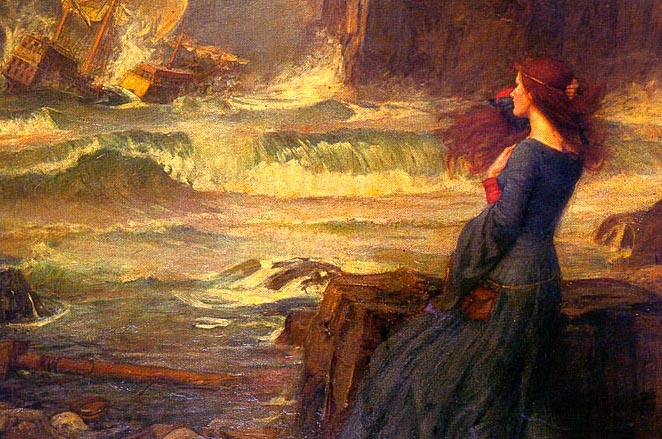
In all of the versions I have heard or found online, the chorus is always left in Gaelic.  The refrain, "Fhear a' bhàta na hóro eil'e," translates roughly as "O, my boatman, and no one else."  Here a translation of the last line of the chorus ends the song.  In fact, the verses both in Gaelic in English vary considerably.  See for, example, the lyrics on Wikipedia here, at electricscotland.com here, and at contemplator.com here.  The gist remains the same:  The boatman is gone, likely never to return, but in spite of all the hearsay against him she will keep waiting.  That hearsay paints the boatman as more than a bit of a scoundrel, off having his own fun instead of simply off at work or lost at sea.  Putting this into the context of my story, I read this as Logan's fellow boatmen not having heard anything clearly indicating his demise but perhaps rumors of his shipping across the Atlantic and even turning pirate.  The mood of the forlorn lady watching the main is, in my imagination, close to that of the famous "Miranda - The Tempest," inspired by the character in Shakespeare's play, painted by John William Waterhouse c. 1916 (just maybe ignore the shipwreck):


For once with a song of this kind, there seems to be general agreement on its attribution.  Credit goes to Sine NicFhionnlaigh--Jean Finlayson--of Tong, a small village on the Isle of Lewis.  The song was written by her in the late 18th century during what was apparently an emotionally difficult courtship with a young fisherman from Uig on the Isle of Skye, Dòmhnall MacRath, aka Donald MacRae.  The good news is that Jean and Donald were married some time after she wrote the song.  Who says Scottish airs can't have happy endings?

Black House Village, Garenin, Isle of Lewis, Scotland

  • Niamh Parsons, from Blackbirds and Thrushes.  Niamh Parsons is from Dublin and has in the last twenty years become one of the premier songstresses of traditional Celtic music.  In 1999, she recorded "Fear a' Bháta" in Gaelic.  The lyrics of her version and a translation can be found here at Celtic Lyrics Corner.  It is a sparse arrangement for her and guitar, with piano on choruses.  Parsons' voice is particularly well-suited to the heartbreak of the song.  It is available on iTunes.  A live rendition from 2011, recorded at Liverpool Philharmonic Hall as part of their "Sea Sessions" series, can be found here at YouTube.
  • Talitha MacKenzie, from Spiroad.  Back in yon Berkeley days, my best friend Harvey and I listened religiously to the late-night radio show "Tangents," hosted by the awesome Dore Stein then on KCSM, San Mateo.  "World music," whether you call it a genre, a marketing term, or a travesty, was still new.  In 1990, the album Mouth Music came out, a collaboration between Edinburgh-based composer and instrumentalist Martin Swan and Talitha MacKenzie, a Scottish-American ethnomusicologist and performer who had taught herself Scots Gaelic and done field work in Scotland.  Martin brought the synthesizers and the beats, while MacKenzie brought her knowledge of puirt à beul, a Celtic tradition of essentially using the human voice as a rhythmic and melodic instrument to accompany dancing, comparable perhaps to scat singing in jazz.  Swan and MacKenzie stopped work together after only a few years, but MacKenzie as a solo artist has continued with what she referred to as "the mouth music project," maintaining her Celtic roots but finding mouth music from many other traditions around the world.  For her 1996 album Spiorad, she recorded a very distinctive take on "Fear a' Bháta."  The percussive nature of puirt à beul, with almost a yodeling quality, makes the Gaelic itself more intense, while MacKenzie's interpretation rises and falls with the emotions of the words.  In the background are some ocean atmospherics.  A very cool track.  Words and translation can be found here, again from Celtic Lyrics Corner.  Spiorad is not available on iTunes, but "Fear a' Bháta" is, as part of the compilation A Celtic Tapestry, Vol. 2.  This is in turn is also on YouTube here.
  • Gordon Bok, Ann Mayo Muir, and Ed Trickett, originally from All Shall Be Well Again, also on The First Fifteen Years, Vol. 2.  This is the song that launched this whole blog thread.  Gordon Bok I have already praised.  Ann Mayo Muir has been a New England singer-songwriter since the '60's.  Ed (Edison) Trickett, when he is not a Professor of Psychology at the University of Illinois, is a folk musician.  From 1969 to 2000, Bok, Muir, and Trickett (or, simply, BMT) were something between a trio and collective, singing gorgeous harmonies together but maintaining their own styles, inspirations, and repertoires.  They recorded a long series of albums for the revered Folk Legacy label.  I was introduced to them as a teenager on the now-gone weekly folk programs on KPBS San Diego, and I saw them live at the University of Washington.  I was more than a little surprised, given my years-old familiarity with their works, to (re-)find "Fear a' Bháta."  Theirs are the lyrics I transcribed above, closely resembling those Silly Wizard used on Caledonia's Hardy Sons (which almost made the list and can be found here on YouTube).  BMT's "Fear a' Bháta," however stands alone and above.  Ann sings the lead on this one, Bok and Trickett singing harmony on the choruses, while Bok's 12-string holds an insistent 6/8 rhythm.  BMT's back catalog has not yet reached iTunes, and it is not on YouTube.  Maybe, if I'm nice, I'll figure out how to upload it, but in the mean time you'll have to dig yer own gold.

And so we reach the end of the Songs of Logan:  songs of Scotland, shanties both of the leaving and the getting home, and something in between.  This has been some hardcore blogging, facilitated in part (talk about mixed blessings) by round three of diverticulitis and thus some time stuck (again) on the sofa.  I'm gonna take a break now.  BUT I have two books nearby--another Aubrey-Maturin and my well-annotated copy of Rediker's Between the Devil and the Deep Blue Sea.  I also have received another commission from the CWB to perform for the holidays!  Don't touch that dial...

Saturday, October 13, 2012

Songs of Logan #5: Farewell Shanty (Padstowe Shanty)

"Moonlight Sailing" by David Van Hulst

So many sea shanties are about getting back to port and the pleasures there.  Whalers sang "Rolling Down to Old Maui" as they looked forward to leaving icy waters for the "native maids" and "tropical glades" of Hawaii.  "Rolling Home" tells of leaving Australia behind and heading eastwards to "dear ol' England."  Setting out on the voyage was, for the real working sailor, at the very least bittersweet, as loved ones (or at least the girls) were left behind, and all there was to look forward to was months of hard labor, hard weather, and hard biscuits.  But ye can call me romantic:  I feel more for the songs about the leaving.  In the words of the fictional prospector-cum-philosopher, Ben Rumson of Paint Your Wagon, "Home is made for coming from, for dreams of going to, which with any luck will never come true."  And so my favorite shanty, simply known as "The Farewell Shanty," is poetically succinct...

It's time to go now
Haul away your anchor
'Tis our sailing time

Get some sail upon her
Haul away your halyards
'Tis our sailing time

Get her on her course now
Haul away your foresheets
'Tis our sailing time

Waves are breaking under
Haul away down-channel
On the evening tide

When my time is over
Haul away for Heaven
God be at my side

It's time to go now
Haul away your anchor
'Tis our sailing time

I have repeated the first verse at the end, which is common in performance, although some insist that it shouldn't be done.  Personally, I like the roundness of the repetition as well as how "'Tis our sailing time" trails out as you slow the tempo on the last line.  Not being a churchgoing sort, I replace "Haul away for Heaven" with "Haul away forever," tho' I leave "God" where he is having not found a suitable lyrical replacement.   Among other venues, I performed this a capella at the "Customer Service Week" talent show at work, which--like the Lakota flute and Tuvan throat singing I did in prior years--very, very few understood.

Padstow Quay, Cornwall

According to a discussion thread at the huge folksong site The Mudcat Café, "The Farewell Shanty" is a relatively recent addition to the shanty canon.  It does not appear in Hugill.  It is typically credited to Mervyn Vincent, who lived, sang, and taught near Padstow, Cornwall, England.  For this reason it is also sometimes called "The Padstow Shanty."  One version of the story states that Vincent discovered the words in an old chap book and set music to it.  After he introduced it to the Stable Loft Folk Club he led, it spread throughout the maritime song community.  Others say that its discoverer was Alan Molyneaux, who found it tucked away in a book as he was doing research at Plymouth Library.  Molyneaux in turn passed it on to, among others, Vincent and the great Johnny Collins I mentioned a couple posts ago.

I don't get tired of hearing it, and I don't get tired of singing it.  Depending on how you interpret it--and by this I mean either reading the text or performing it--it can be either melancholy or hopeful, or perhaps both.  I, for one, was born under a wand'rin' star and would rather weigh anchor than drop it.  Of course, I might change my mind after a few, uninterrupted weeks on blue water, when my socks are all molded, my hands are blistered, and the rum is gone.  Yet there is nothing--EVER--to compare to starting a new adventure.  Here are my two favorite versions of my favorite shanty...

  • Johnny Collins:  "Farewell Shanty," from Shanties and Songs of the Sea.  Enough has already been said about Mr. Collins back with "Leave Her, Johnny."  Bad news is that this one is not on YouTube.  Am I supposed to do all the work?
  • Gordon Bok and Cindy Kallett:  "Padstowe Shanty," from NeighborsGordon Bok is more than one of my top musicians.  He's the kind of musician I want to be.  I have been lucky enough to see Bok perform twice here in Seattle.  Bok grew up surrounded by music in coastal Maine.  Working on boats of all kinds, including Maine's famous schooners, he learned and gathered shanties, tales, and myths from Maine, the Maritimes, and beyond.  Then he began to write his own songs and stories about the vessels and their people.  Bok describes himself as a "rememberer," an idea I respect and love:  He is a creator and a chronicler, tasked happily with keeping alive both music and lifeway.  This often lends a sort of pathos to his work, as the way of the wooden boat and the traditional fisherman often wages a losing battle with time.  Bok sings in a deep, deep baritone and like me is more than a little fond of the 12-string guitar.  For his "Padstowe Shanty," he accompanies himself on an instrument of his own creation, the cellamba, and is joined by fellow Maine artist Cindy Kallett.  I cannot emphasize enough how much you, if you are in love with the sea and its culture, need to get to know Gordon Bok if you haven't already.  The album Neighbors and his back catalog are available from the small, independent label Timberhead Music.  Although it is on iTunes, I urge you to support Bok directly.

This would be a great place poetically to stop, but coming up in the next and last installment:  The ultimate song of Logan.

Friday, October 12, 2012

Songs of Logan #4: Women of Ireland (Mná na H-Eireann)

"The Beautiful Irish Woman" by Gustave Courbet

Logan's #4 is neither a Scottish tune nor a sea shanty.  Hell, it isn't even "traditional."  It has to be included, however, as it is one of the most haunting songs I know and as a piece of music suits the fictional mood of Logan to a tee.  "Mná na H-Eireann," translated from Gaelic as "Women of Ireland," started life as a poem by Peadar Ó Doirnín, one of a group of eighteenth century poets from Ulster in what would now be Northern Ireland.  The song is a paean to the titular women but, according to Wikipedia (although with uncited sources), took on a "rebel" context in the early years of Irish nationalism.  This would have included the United Irishmen of which one fictional member was O'Brian's Dr. Stephen Maturin.  Someone at the lyrics site lyricsg.com has posted both the original Gaelic and an English translation here; as I will guess you can't read Gaelic, here is only the latter:

There's a woman in Ireland who'd give me a gem and my fill to drink
There's a woman in Ireland to whom my singing is sweeter than the music of strings
There's a woman in Ireland who would much prefer me leaping
Than laid in the clay and my belly under the sod

There's a woman in Ireland who'd envy me if I got naught but a kiss
From a woman at a fair, isn't it strange, and the love I have for them
There's a woman I'd prefer to a battalion, and a hundred of them whom I will never get
And an ugly, swarthy man with no English has a beautiful girl

There's a woman who would say that if I walked with her I'd get the gold
And there's the woman of the shirt whose mien is better than herds of cows
With a woman who would deafen Baile an Mhaoir and the plain of Tyrone
And I see no cure for my disease but to give up the drink

Séan Ó Riada
The poem would have been lost to obscurity had it not been set to music as a slow air by the legendary Séan Ó Riada and then recorded in 1969.  That recording was by the group Ceoltóirí Chualann, a key group in the revival and popularization of Irish traditional music.  One of the members of Ceoltóirí Chualann, Paddy Moloney, went on to gather his own band, which (ahem) you might have heard of--The Chieftains.  As an instrumental, "Women of Ireland" has been recorded by everyone from Mike "Tubular Bells" Oldfield to hard rock guitarist Ronnie Montrose.  The instrumental form is the one I adore, but luckily in recent years singers in both the traditional and popular realms have revived the words.  It is a song that I put on regularly just to sink into emotionally.  Music makes make me weepy like that; gimme a break.  Of the many recordings, here are my top three:

  • The Chieftains, from The Chieftains 4.  I have been a big fan of the Chieftains since I was in college.  I have seen them a number of times--even in Fairbanks, Alaska--and have, at least electronically, their complete, 50-year discography.  Their arrangement of "Women of Ireland" is the standard and still the best.  It was originally included on their 1973 'fourth' album.  Two years later, director Stanley Kubrick placed it prominently in the gorgeous film Barry Lyndon, which starts in rural Ireland in the 1750's.  The soundtrack to Barry Lyndon can be recommended not only because it also includes a solo harp version of "Women of Ireland" by the late, great Derek Bell but also for its fabulous selection of period orchestral music.  Chieftains 4 is available on iTunes, and "Women of Ireland" can be found here on YouTube.  The film Barry Lyndon is also available from iTunes but not its music, while the soundtrack CD has, unfortunately, become a collector's item; keep your eyes (real or virtual) open, it's worth it.
  • Kate Bush from Common Ground:  The Voices of Modern Irish Music.  Anyone with any taste in the 1980's will remember The Dreaming ("Sat In Your Lap") and Hounds of Love ("Running Up That Hill").  Anyone who was paying attention will recall the Irish touches to Kate Bush's music.  This was partly the result of Bush's friendship with Bill Whelan, later of Riverdance fame, who brought men like Irish bouzouki player Dónal Lunny and Uillean pipes player Liam O'Flynn, veterans of such critical Irish traditional bands as Planxty and The Bothy Band, to record on Bush's albums.  More importantly, it's in Bush's blood.  Although Bush herself was raised in South East London, her mother was Irish, while her dad's mom was a former Irish folk dancer.  In 1996, Bush contributed to the compilation Common Ground:  The Voices of Modern Irish Music a version of "Women of Ireland" sung in the original Gaelic, which she had to learn phonetically.  Authenticity aside, Kate's version carries her usual emotional weight over a sweeping orchestral backing, a cinematic piece in under three minutes.  It is available on iTunes as part of a different compilation, Éist, on which well-known Irish artists sing in Gaelic.  It can be found on YouTube here.
  • Sinéad O'Connor, from Ain't Nuthin' But A She Thing.  My introduction to Sinéad O'Connor is a unique memory.  In 1991, I was part of the second, smaller field crew excavating at the Three Saints Bay site on Kodiak Island, Alaska.  Phil McCormick--Kodiak Native from Karluk, trained chef, and archaeologist--had brought ONE cassette tape, I Do Not Want What I Haven't Got.  Picture it:  a half a dozen men wearing Helly Hansen overalls, digging in the wet dirt for Russian artifacts, the ocean behind us and towering mountains before, 10 miles from the nearest village of Old Harbor, listening to Sinéad O'Connor over and over and over.  Perhaps surprisingly, Sinéad's remains one of my favorite voices, able to glide along at a whisper and then explode into a rant.  Her Irish rebel identity is certainly no secret, and she made her love of traditional Irish music known on her 2002 album Sean-Nós Nua.  A hidden gem is her recording in Gaelic of "Mná na H-Eireann," contributed to the 1995 MTV project Ain't Nuthin' But A She Thing.  This is a spacious arrangement that begins with little more than a drone and slowly introduces fiddle, harp, and whistle, with plenty of room for Sinéad's subtle, emotive singing.  The CD is long out of print, but used copies are common and cheap.  It is not available on iTunes but can be found here on YouTube.

Coming up next:  Hands down, my favorite shanty.

Thursday, October 11, 2012

Songs of Logan #3: Leave Her, Johnny

illustration by Stan Hugill

The sea shanty, lest we forget and think of it simply as a song about life on the sea, is functional music.  Its structure and its rhythm are meant to not just accompany work but coordinate it and to make it tolerable.  Picture a dozen and more men pulling lines together on the beat of well-known choruses like "Way-hey, blow the man down," or, simply, "Haul on th' bowline, th' bowline haul."  Shanties are often categorized by how form meets function.  If there is a 'bible' in my life, it is Stan Hugill's Shanties from the Seven Seas.  Hugill sorts shanties broadly into two types.  The first is "hauling songs," made for intermittent operations like pulling sheets or halyards, typically in a "salty" 6/8 meter and usually hard to trace to their exact origin.  The second is "heaving songs" for jobs that require more continuous work like turning the capstan to weigh anchor or warp the ship, or for pumping.  Heaving songs are usually in 4/4 time and descended from songs--often still labor songs--from land.

"Leave Her, Johnny" is unique in its maritime function.  As a heaving song, it might have been sung either at the pumps or at the capstan.  Yet it was only sung in one context:  the very end of the voyage.  "Leaving her" meant leaving the ship.  This shanty was sung as the bilge was pumped out before coming into port or as they were warping to the dock.  What makes "Leave Her, Johnny" even more unique was its lyrical function of airing grievances--the only time that this could be done out on the open deck.  As a result, the only real constant in each rendition of the song was the melody and the chorus; the verses would have varied according to what there was to complain about.  Hugill gives twenty-three common verses and another eleven possibilities.  This was ultimately up to the improvisation of the shantyman.  Here are the chorus and some representative verses, drawn from Hugill via the song's page on contemplator.com.  The verses would have been sung by the shantyman, while the italicized refrains and the choruses would have been sung by all the men.  The last verse is my favorite.

(chorus)
Leave her, Johnny, leave her.
Ooooh!  Leave her Johnny, leave her.
For the voyage is done and the winds don't blow,
An' it's time for us to leave her.

Oh, I thought I heard the Ol' Man say,
Leave her, Johnny, Leave her!
Tomorrow ye will get your pay,
An' it's time for us to leave her!

The work wuz hard an' the voyage wuz long,
Leave her, Johnny, Leave her!
The sea was high an' the gales wuz strong.
An' it's time for us to leave her!

The grub was bad an' the wages low,
Leave her, Johnny, Leave her!
But now once more ashore we'll go.
An' it's time for us to leave her!

She will not wear, nor steer, nor stay,
Leave her, Johnny, Leave her!
Her sails an' gear all carried away.
An' it's time for us to leave her!

Oh, sing that we boys will never be
Leave her, Johnny, Leave her!
In a hungry bitch the likes o' she.
An' it's time for us to leave her!
The mate was a bucko an' the Old Man a Turk,
Leave her, Johnny, Leave her!
The bosun wuz a beggar with the middle name o' Work.
An' it's time for us to leave her!

turning the capstan

The problem with tracing the history of folk songs is that, essentially by definition, they originate in oral tradition.  If the main difficulty with finding the origins of Scottish folk songs is that they will very likely disappear into ancient time, then the main challenge with shanties is the closed culture from which they came.  In either case, a common folkloric approach is to find--or at least posit--connections with similar songs.  Hugill was one of that rare breed that was raised in the tradition, practiced it in its original context, and studied it academically.  In the case of "Leave Her, Johnny," Hugill's own work and that of scholars before him point to an older shanty, "Across the Rockies," dating from perhaps the time of the Irish Potato Famine, i.e. the 1840's.  If the title seems oddly un-maritime, keep in mind that this could be a song borrowed from land; Hugill specifically hypothesizes that it is "probably a Irish-Negro mixture" (pardon the old language).  This song evolved into "Across the Western Ocean," sung aboard the Western Ocean Packets, which led in turn to "Leave Her, Johnny."  There are other possible connections:  a "resemblance," according to the well-known Cecil Sharp, to the song "Seventeen Come Sunday," and more remotely to "The Twa Sisters," dating back as far as seventeenth century and one of the famous "Child Ballad" types ("Child 10").  While I naturally respect scholars such as Child and Sharp as preservationists, folklore studies has come a along way from their old taxonomic approach, and I am naturally suspicious of equating similarity with historical connection.  It means more to me when Hugill writes, "I learnt [sic] it partly from my mother's father...and partly from an old Irish sailor."

There are many shanties and many shanties that I love.  "Leave Her, Johnny" has a melody that sticks in my head, a great context, and lyrics snarky enough to make me grin.  Of the recordings out there, I pick only two...

  • Johnny Collins, from Shanties & Songs of the Sea.  This was the first CD dedicated solely to sea shanties that I ever bought, and it is still my benchmark.  Johnny Collins did not learn the art of the shantyman at sea, but during the 1960's he came to the forefront of the British folk revival and especially the performance of sea songs in an authentic manner.  His voice, which apparently has an "East Anglian brogue," is a pleasure to hear.  Amazon.com lists this solely as an import, which means you're better off trying to track down a used copy (Amazon marketplace and gemm.com are good starting points).  It is not on iTunes, but, luckily, you can find Collins' rendition of "Leave Her, Johnny" on YouTube here.
  • Stan Rogers, from From Coffee House to Concert Hall.  The importance of Stan Rogers cannot be overestimated--to the music of the sea, to the culture of the Maritime Provinces, and to Canada itself.  He also had one of the best baritone voices in folk music, along with Gordon Lightfoot and Gordon Bok...more on that later.  Although raised in Ontario, he was of Maritime stock on both sides of of the family and spent summers with them in Nova Scotia.  As the story goes, Stan's Aunt June from Canso got his career out of a rut when she suggested singing about his own background.  He made a name both writing his own songs--eg, the perennial faux-shanty "Barrett's Privateers"--and performing traditional repertoire.  He died tragically in a plane fire in 1983.  His booming version of "Leave Her, Johnny" is, poetically, the last track of his very last, posthumous live album.  It is available from iTunes and here on YouTube.

Coming up next:  A short trip to Ireland.